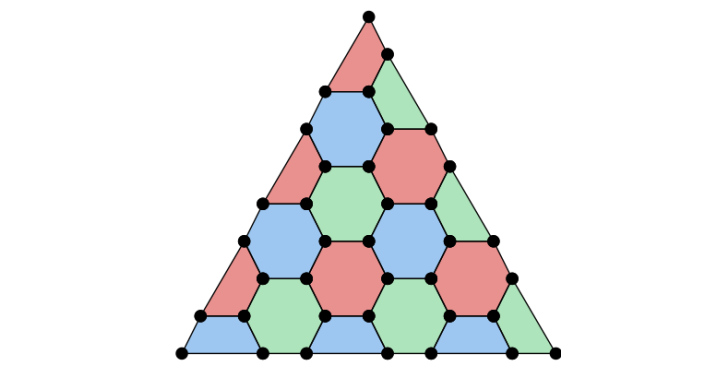
Two-dimensional colour codes represent a promising avenue for building robust quantum computers, yet realising their potential has been hampered by the complexity of interpreting the information they encode. Stergios Koutsioumpas, Tamas Noszko, and colleagues from the University of Edinburgh and University College London now demonstrate a decoding method that brings colour code performance on par with the more established surface code, a significant step towards practical quantum error correction. The team’s approach, termed Vibe decoding, employs a combination of parallel decoding strategies and statistical analysis to efficiently extract information from the code, outperforming all existing colour code decoders across a range of challenging conditions. This breakthrough establishes colour codes as a viable architecture for near-term quantum hardware, offering comparable or even improved performance to surface codes without increasing the number of qubits required, and paving the way for more efficient quantum computations.
Researchers have now introduced Vibe decoding, a new method that, for the first time, achieves colour code performance comparable to the surface code under realistic conditions. This approach leverages an ensemble of belief propagation decoders, each executing a distinct message-passing schedule, combined with localised statistics post-processing. This combined protocol, termed VibeLSD, demonstrates high versatility and outperforms all existing colour code decoders across various syndrome extraction schemes, noise models, and error rates.
VibeLSD Decoder Performance for Color Codes
This document details a new quantum error correction (QEC) decoder, VibeLSD, and its performance with colour codes. The research aims to demonstrate that VibeLSD achieves competitive or superior logical error rates compared to existing decoders, and to provide a comprehensive analysis of its capabilities. Key findings reveal that VibeLSD achieves comparable performance with fewer qubits in certain scenarios, and the research presents detailed data to support these claims. The decoder’s performance is evaluated across several colour code circuits and under both uniform and Si1000 noise models.
Vibe Decoding Rivals Surface Code Performance
The colour code presents a promising alternative to the surface code for quantum error correction, offering potential advantages for efficient quantum computations. However, a significant obstacle has been the lack of a practical decoder capable of effectively correcting errors within colour codes. Researchers have now developed Vibe decoding, a new method that achieves performance on par with the surface code under realistic conditions. This breakthrough centres on a novel approach utilising an ensemble of belief propagation decoders, algorithms commonly used in modern communication technologies.
Each decoder explores different solution pathways, increasing the probability of finding a correct error correction. When the ensemble encounters difficulties, a localised statistics decoder resolves ambiguities and guarantees a valid solution consistent with the measured errors. The results demonstrate that colour codes, when paired with this new decoding method, require comparable overhead to the surface code, and in some instances, even exhibit lower overhead. This improvement, combined with the suitability of the localised statistics component for specialised hardware, positions the colour code as a viable architecture for near-term quantum hardware, offering improved compilation efficiency without increasing qubit requirements.
VibeLSD Surpasses Surface Codes in Decoding Performance
This research presents VibeLSD, a new decoding algorithm that enables colour codes to achieve error correction performance comparable to that of surface codes, a significant step towards practical quantum computing. Previous colour code decoders struggled to match surface code performance under realistic conditions, but VibeLSD overcomes this challenge by combining multiple belief propagation decoders with localised statistics post-processing. Simulations demonstrate that VibeLSD outperforms existing colour code decoders across various noise models and error rates, and even surpasses the surface code in logical error rate when using a specific colour code variant. This advancement is particularly important because VibeLSD’s versatility allows it to perform well with different colour code circuits and error rates without requiring individual adjustments, making it suitable for complex logical gate circuits. Furthermore, the algorithm’s parallel structure lends itself to implementation on specialised hardware, potentially enabling real-time decoding for near-term quantum devices.
🗞 Colour Codes Reach Surface Code Performance using Vibe Decoding
🧠 ArXiv: https://arxiv.org/abs/2508.15743