The quest to reconcile quantum mechanics and general relativity drives physicists to explore the boundaries of what’s possible, and a key challenge lies in testing quantum principles with increasingly massive objects. Now, N. Levi, O. Feldman, Y. Rosenzweig, and colleagues at Ben-Gurion University of the Negev are demonstrating a crucial step towards building a matter-wave interferometer capable of doing just that. Their research focuses on controlling the spin of nitrogen-vacancy centres within diamond crystals, effectively using these tiny defects as sensitive probes of quantum behaviour. By achieving precise control over these spins, the team shows that nanodiamonds containing millions of atoms could be split apart by just a few nanometres, paving the way for experiments that probe the interplay between quantum mechanics and gravity in previously inaccessible regimes. This advance represents a significant contribution to the growing field of macroscopic quantum mechanics and offers a promising pathway towards testing fundamental laws of physics.
Nanodiamond Interferometry Tests Quantum Limits
Researchers are pioneering a new approach to matter-wave interferometry, employing nanodiamonds containing nitrogen-vacancy (NV) centers as test masses to explore fundamental physics. This innovative technique aims to push the boundaries of quantum mechanics by investigating the limits of quantum behavior in increasingly massive objects and searching for new physics beyond our current understanding. The team hopes to test the Equivalence Principle and potentially detect interactions with dark matter through highly precise measurements. This research program relies on a combination of cutting-edge technologies, starting with nanodiamonds containing NV centers, which act as robust, optically addressable quantum systems.
NV centers allow for precise control and measurement of the nanodiamond’s internal state, enabling both state preparation and readout. Researchers utilize optical and potentially parametric feedback cooling techniques to reduce the nanodiamond’s motion, and the sensitivity of NV centers to external fields allows for feedback control and sensing. Paul traps and, notably, needle traps are employed to levitate and confine the nanodiamonds within an ultra-high vacuum environment, minimizing disturbances. Specific research areas focus on improving coherence times, a major challenge in maintaining quantum behavior long enough for meaningful interferometry.
Researchers are working to purify the diamond material using carbon-12 to reduce noise, minimize surface defects that cause decoherence, and apply pulse sequences to suppress environmental disturbances. Cooling the nanodiamond is also crucial, with researchers exploring both laser cooling and parametric feedback cooling to reduce kinetic energy and maximize interference contrast. Developing traps that provide strong confinement while minimizing noise and improving state preparation and readout fidelity are also key areas of focus. Recent advancements include improved methods for loading nanodiamonds into traps, a new trap design for stronger confinement, and demonstrated cooling of the nanodiamond’s rotational motion. Progress in developing integrated circuits for control and readout, alongside techniques for stabilizing the nanodiamond’s rotation, suggests the team is making significant strides towards realizing their ambitious goals. This research promises to push the boundaries of quantum technology and explore the quantum realm at unprecedented scales.
Nanodiamond Levitated Interferometry for Quantum Tests
Researchers are developing a novel matter-wave interferometer that utilizes nanodiamonds containing nitrogen-vacancy (NV) centers as test particles, aiming to explore the intersection of quantum mechanics and general relativity. This approach seeks to observe spatial superposition in massive objects, extending the scale at which such quantum phenomena are observed. The team chose nanodiamonds because the NV centers within them offer a stable and controllable quantum system suitable for precise measurements. A key innovation lies in the method of levitating and manipulating these nanodiamonds, achieved through electrostatic charging and Paul traps.
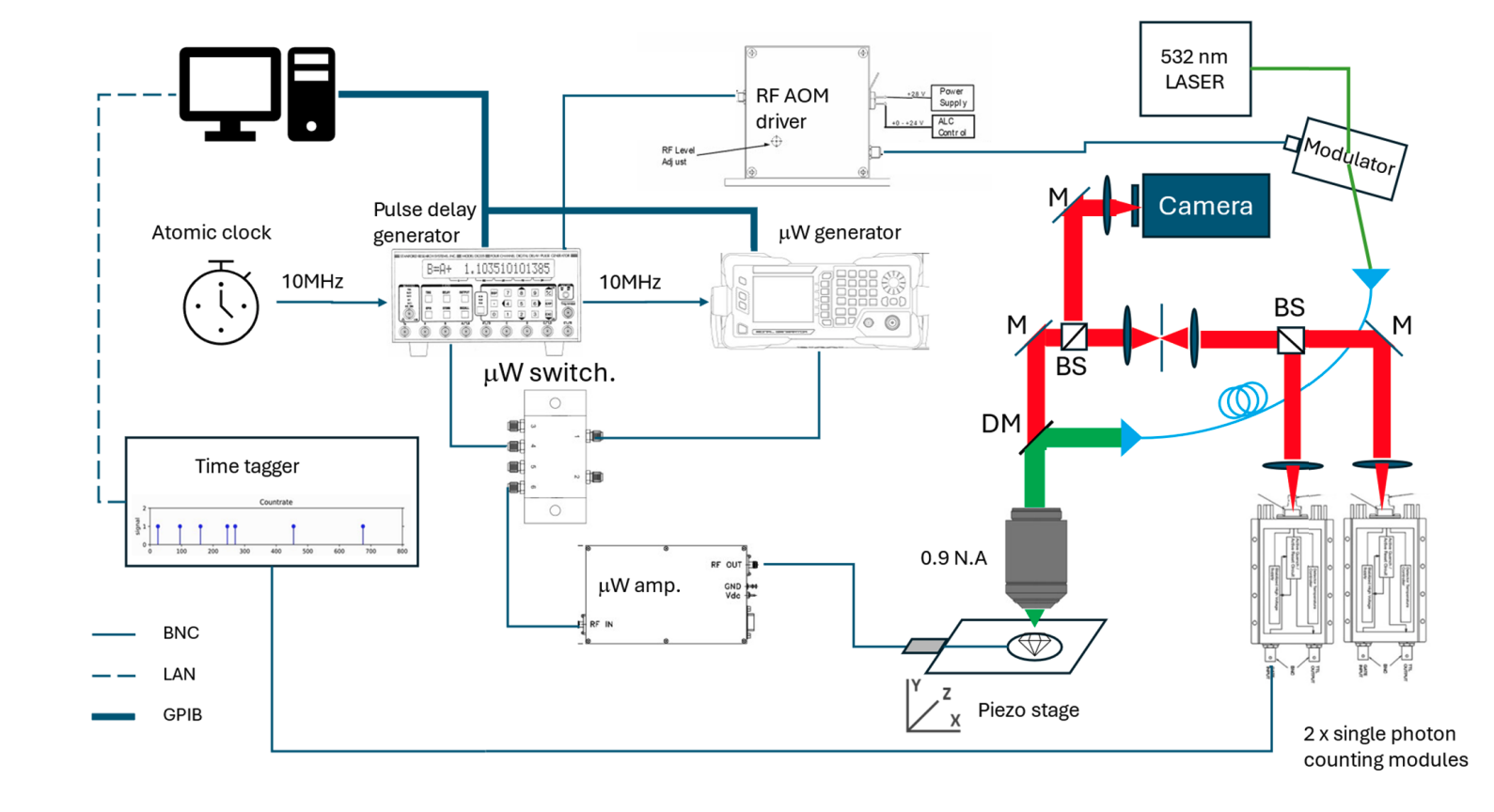
Particles are collected as a powder and charged, then introduced into the trap using a carefully controlled process, allowing researchers to isolate individual nanodiamonds and maintain them in a stable position. The optical setup focuses a green laser onto the diamond, enabling observation of red fluorescence emitted from the NV center, which serves as the quantum probe. To facilitate the interferometer, researchers are employing a technique inspired by the Stern-Gerlach experiment, using magnetic gradients to spatially separate the spin states of the NV center. This separation allows for the observation of quantum interference effects.
The team has demonstrated the ability to control and read out the spin state of the NV center in both stationary and levitated diamonds, a crucial step towards realizing the full interferometer. Currently, the team is focused on extending the coherence time of the NV center’s spin state, aiming for tens of microseconds without complex techniques. This improved coherence is essential for achieving the necessary spatial separation within the interferometer and obtaining meaningful results. Furthermore, they are developing advanced antenna designs and exploring dry particle loading methods to enhance the stability and efficiency of the experiment, paving the way for probing fundamental questions at the boundary between the quantum and classical realms.
Levitated Nanodiamonds Demonstrate Quantum Control
Researchers are actively pursuing the creation of a matter-wave interferometer using nanodiamonds, aiming to test fundamental principles of quantum mechanics and gravity in previously unexplored territory. This ambitious project seeks to combine the realms of quantum mechanics and general relativity, potentially offering insights into the quantization of gravity itself. The core of this approach involves utilizing nanodiamonds containing nitrogen-vacancy (NV) centers as test particles, leveraging the sensitivity of these defects to external forces. The team has demonstrated precise control over the spin state of NV centers both within bulk diamonds and, crucially, within levitated nanodiamonds.
Simulations indicate that with current coherence times, a nanodiamond composed of approximately ten million atoms could experience spatial separation on the nanometer scale within the interferometer. This level of control is essential for achieving the necessary precision to observe subtle effects predicted by theoretical models. The researchers have successfully implemented optical detection methods to read out the spin state of the nanodiamonds, and are refining techniques to spatially separate the spin states using magnetic gradients. A key innovation involves levitating the nanodiamonds within a Paul trap, a device that uses electric fields to suspend particles in mid-air, allowing for free movement and minimizing external disturbances.
The team has developed methods for loading nanodiamonds into these traps, including techniques using static electricity, electro-spray, and dry loading systems. Initial tests demonstrate successful optical detection of NV centers within these levitated diamonds, paving the way for more complex experiments. The researchers are also developing a chip-based system integrating current-carrying wires for generating the necessary magnetic gradients and an antenna layer for controlling the nanodiamonds. This integrated approach promises to enhance the stability and precision of the interferometer, bringing the realization of a quantum gravity experiment closer to reality. The team’s progress represents a significant step towards probing the fundamental laws of physics at the intersection of quantum mechanics and gravity, potentially unlocking new insights into the nature of spacetime itself.
Nanodiamond Interferometry Probes Quantum Gravity Limits
This research demonstrates progress towards realising a matter-wave interferometer using nanodiamonds with embedded nitrogen-vacancy (NV) centers, a promising approach for testing fundamental physics. The team successfully designed and built a compact microwave resonator capable of generating the precise and uniform magnetic fields required to control the spin states of NV centers within both bulk diamonds and levitated nanodiamonds. Simulations indicate that current coherence times within these nanodiamonds are sufficient to achieve nanometer-scale spatial splitting in a Stern-Gerlach interferometer, a crucial step towards probing the intersection of quantum mechanics and general relativity. The work represents a significant advancement in the challenging field of macroscopic quantum superpositions. By demonstrating control over NV center spins in levitated nanodiamonds, the researchers have addressed a key obstacle in realising this ambitious goal.
🗞 Quantum control of Nitrogen-Vacancy spin in Diamonds: Towards matter-wave interferometry with massive objects
🧠 ArXiv: https://arxiv.org/abs/2508.15504