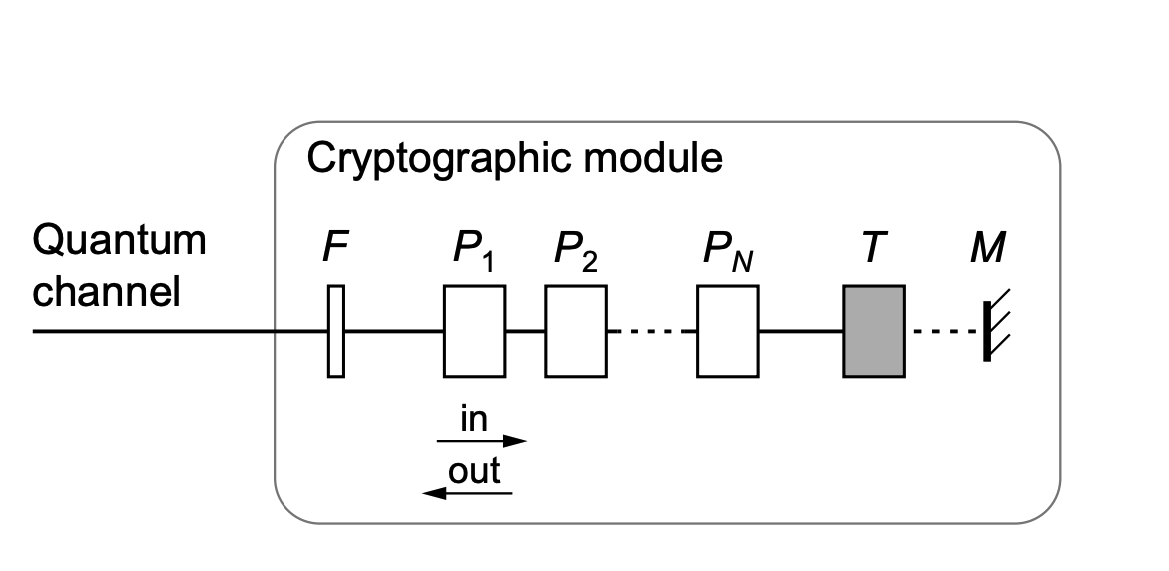
Quantum key distribution (QKD) promises unhackable communication, but the security of real-world implementations relies on identifying and closing potential loopholes. Researchers now demonstrate a comprehensive method for evaluating QKD systems against a broad range of attacks that exploit vulnerabilities across the entire optical spectrum. Hao Tan from Hefei National Research, along with colleagues, developed a testbench capable of precisely measuring light transmission through optical components from 400 to 2300 nanometres, with a sensitivity up to 70 decibels. This detailed analysis allows for a thorough assessment of potential eavesdropping strategies, such as ‘Trojan-horse’ attacks, and paves the way for robust certification of future QKD systems, ensuring truly secure communication networks.
Most attacks involve injecting or receiving unwanted light through the communication channel. An eavesdropper can select the wavelength of attack, and current detectors sometimes struggle to distinguish these wavelengths from the intended signal, creating a significant security risk. Consequently, there is a pressing need for more robust QKD systems and thorough characterisation of existing systems against extraneous light.
Physical Implementation Attacks on Quantum Key Distribution
This body of work represents a comprehensive overview of research related to QKD security, implementation, and potential attacks. The research primarily focuses on vulnerabilities in the physical implementation of QKD systems, rather than theoretical cryptographic weaknesses. A substantial portion details attacks targeting single-photon detectors, specifically avalanche photodiodes, focusing on issues like false detections caused by detector recovery time and other imperfections. Other areas of investigation include attacks exploiting imperfections in single-photon sources, the wavelength dependence of components, and nonlinear effects in optical fibres.
Researchers also explore timing attacks, Trojan-horse attacks involving bright light, and methods for improving the security analysis of the decoy state method, which estimates the quantum bit error rate. This includes developing tighter security proofs, analysing security for a limited number of exchanged keys, and using different decoy state intensities. A significant portion addresses Measurement-Device-Independent QKD, a protocol designed to eliminate detector side-channel attacks, though studies demonstrate it is not entirely immune and can be vulnerable to new types of interference. Foundational security proofs and improvements to existing protocols are also explored, alongside the technology behind core QKD components, the properties of optical fibres, free-space QKD systems, and the use of integrated photonic circuits.
Efforts to increase key generation rates and the use of supercontinuum lasers as light sources are also investigated. Specific technologies and components, such as optical spectrum analysers, fibre splitters, connectors, and silicon photonic devices, are subject to detailed analysis. Key takeaways highlight the importance of practical security, the significant threat posed by side-channel attacks, the limitations of MDI-QKD as a complete solution, the need for high-speed QKD, and the promise of integrated photonics. This represents a very active and evolving field, with ongoing efforts to develop secure, practical, and high-performance QKD systems.
Broadband Vulnerability Analysis for Quantum Key Distribution
Researchers have developed a new method for evaluating the security of QKD systems against eavesdropping attacks, extending beyond assessments focused solely on standard operating wavelengths. This methodology addresses a critical vulnerability: the potential for attackers to exploit transparency windows in system components across a broad spectrum of light wavelengths to inject signals or intercept information. The approach involves meticulously characterising the transmission properties of all optical components within a QKD system, spanning a range from 400 to 2300 nanometers, and identifying wavelengths where vulnerabilities are greatest. The team’s technique systematically assesses the potential for various attacks, including direct light injection and those relying on analysing unintended light emissions from the system.
By mapping the spectral response of each component and calculating the overall transmission spectrum of the attack pathway, researchers can pinpoint wavelengths where an eavesdropper could most effectively interfere with the QKD process. This detailed analysis allows them to quantify potential information leakage at each wavelength and determine the level of security against different attack scenarios. The methodology has been demonstrated through analysis of common QKD configurations, revealing that vulnerabilities can arise at wavelengths significantly different from the standard operating range, creating a “window of attack” for eavesdroppers. By identifying these weak points, the team can recommend countermeasures, such as incorporating band-pass filters or modifying the optical scheme, to strengthen the system’s overall security. The ability to assess security across such a wide spectral range is crucial for the upcoming certification of QKD systems, ensuring robust protection against increasingly sophisticated attacks and paving the way for more secure communication networks.
Broadband Testing Reveals QKD Vulnerabilities
This research presents a comprehensive methodology for evaluating the security of QKD systems across the full spectrum of light used for communication. The team developed a testbench capable of characterising the transmission of optical signals over a wide range of wavelengths, from 400 to 2300 nanometers, with a high degree of sensitivity. This allows for detailed analysis of potential vulnerabilities arising from extraneous light injected into the system, a common tactic for eavesdropping. The researchers applied this methodology to assess the susceptibility of QKD systems to Trojan-horse attacks and outlined its applicability to induced-photorefraction and detector-backflash attacks.
Their results demonstrate that the characteristics of optical components can vary significantly depending on the wavelength of light, potentially creating security weaknesses. Notably, they identified a specific source configuration, utilising a fibre-based filter, that effectively protects typical one-way decoy-state BB84 and Measurement-Device-Independent QKD systems. The authors acknowledge a limitation in their current setup, specifically the inability to directly measure the spectral distribution of photon emission from detectors with sufficient sensitivity, which could be addressed in future work using spectral or tunable filters combined with single-photon detectors. However, the developed testbench and characterisation methodology are presented as a valuable tool for the certification of QKD systems, promoting secure implementation and standardisation of this emerging technology.
🗞 Wide-spectrum security of quantum key distribution
🧠 ArXiv: https://arxiv.org/abs/2508.15136
See today’s quantum computing news on Quantum Zeitgeist for the latest breakthroughs in qubits, hardware, algorithms, and industry deals.