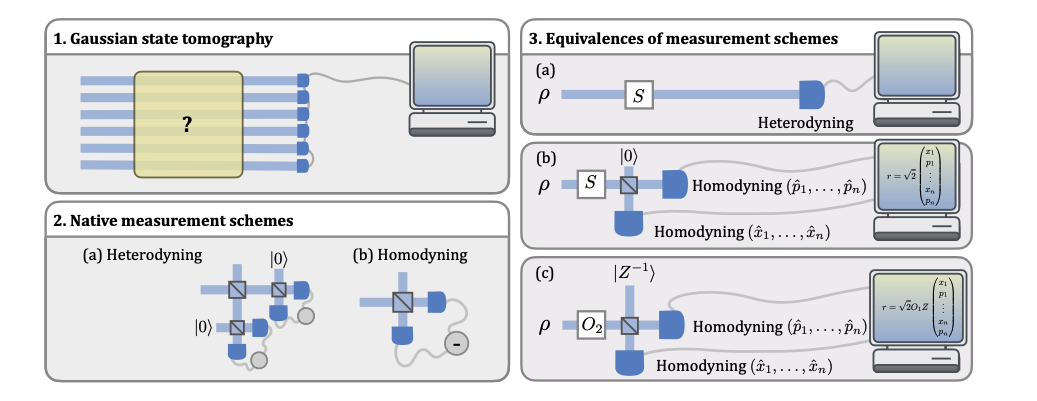
The accurate characterisation of quantum states, known as tomography, remains a central challenge in quantum physics, and is particularly complex for states exhibiting uniquely quantum properties like squeezing. Lennart Bittel, Francesco A. Mele, and Jens Eisert, alongside Antonio A. Mele, all from the Dahlem Center for Complex Quantum Systems and Scuola Normale Superiore, now present a new tomography method that overcomes a significant limitation of existing techniques. Their algorithm efficiently reconstructs Gaussian quantum states, and crucially, its accuracy does not depend on the state’s energy or the number of photons it contains, representing a substantial improvement over previous approaches. This energy-independence, coupled with the method’s reliance on readily available experimental tools, promises to accelerate progress in areas like precision measurement and quantum technologies, while also providing a more rigorous foundation for standard tomography protocols.
Investigations into the focus of attention are increasingly motivated by technological developments. This work presents efficient algorithms for characterizing Gaussian quantum states, addressing a long-standing problem in quantum optics and learning theory. The sample complexity of these algorithms depends primarily on the number of modes within the system and, remarkably, is largely independent of the state’s energy, up to doubly logarithmic factors.
Gaussian State Tomography with Continuous Variables
Quantum state tomography aims to fully characterize a quantum state by making a series of measurements. This research focuses on Gaussian states, a special class of quantum states simplified by their description using mean and covariance matrix. Researchers have developed new protocols to improve the efficiency of this process, particularly for complex states, achieving a double-exponential improvement over existing methods. The algorithms utilize a technique called generalized heterodyne measurement to estimate key parameters and build upon established techniques like heterodyne tomography, providing them with rigorous guarantees for reconstruction accuracy in trace distance.
The team presents protocols that achieve significant improvements when access to the transposed state is available. In this case, the number of measurements needed remains constant regardless of the state’s energy, representing a major breakthrough in efficiency and offering a pathway to even more efficient characterization. This energy-independent protocol is particularly important for practical applications involving high-energy states commonly used in quantum communication, computing, sensing, and fundamental physics experiments. Furthermore, the constant sample complexity makes the protocols more scalable to larger systems with more modes. This result highlights the power of utilizing additional information, like the transposed state, to simplify complex quantum problems and bridges a gap between theoretical requirements and practical implementation.
Efficient Gaussian State Tomography with Fewer Measurements
Researchers have developed a new method for precisely characterizing Gaussian quantum states, which are fundamental in many quantum technologies. This technique, known as tomography, aims to fully determine the properties of a quantum state by performing a series of measurements. The breakthrough lies in an algorithm that dramatically reduces the number of measurements needed, particularly for states with high energy. This new algorithm achieves a double-exponential improvement in efficiency through an adaptive strategy that assesses the initial squeezing of the quantum state and systematically reduces it using auxiliary inputs before performing standard measurements.
Interestingly, the team discovered that estimating the state’s properties is more efficient than directly estimating its covariance matrix, a common approach in quantum state tomography. Furthermore, the algorithm can be simplified even further if access to the transposed state is available, demonstrating a quantum advantage where utilizing a related state simplifies the measurement process. The researchers have also established new theoretical bounds on the accuracy of these measurements, advancing the fundamental understanding of how precisely quantum states can be determined.
Guaranteed Reconstruction of Gaussian Quantum States
The team demonstrates that accurate reconstruction of Gaussian quantum states is possible with a sample complexity that depends primarily on the number of modes within the system, and remarkably, is largely independent of the state’s energy. This represents a significant improvement over existing methods, which often struggle with highly squeezed, high-energy states. This work advances the field of quantum learning, drawing parallels to classical problems of learning Gaussian probability distributions. The authors acknowledge that their analysis relies on certain assumptions regarding the experimental setup and the availability of the transposed state. Future research could explore the robustness of these algorithms to experimental noise and imperfections, and investigate potential applications in more complex quantum systems.
🗞 Energy-independent tomography of Gaussian states
🧠 ArXiv: https://arxiv.org/abs/2508.14979



See today’s quantum computing news on Quantum Zeitgeist for the latest breakthroughs in qubits, hardware, algorithms, and industry deals.