The fundamental concept of the Dirac monopole, a theoretical magnetic monopole, receives a surprising twist in new research exploring the behaviour of these structures within non-Hermitian systems, which describe physics beyond traditional constraints. Haiyang Yu, Tao Jiang, and Li-Chen Zhao, all from Northwest University, demonstrate that introducing these perturbations causes point-like monopoles to spread into extended distributions with unique charge configurations. This work establishes a clear relationship between minute energy differences and measurable geometric phase shifts, a connection that is exclusive to these non-Hermitian systems, and proposes a method for direct measurement using soliton dynamics in Bose-Einstein condensates. By revealing how Dirac monopole charge distributes and geometric phases manifest in these unconventional systems, this research offers a significant step forward with implications for areas including non-Hermitian photonics and fundamental physics.
Non-Hermitian Physics and Topological Quantum Systems
This collection demonstrates the rapid growth of research in non-Hermitian physics over the last decade. Traditionally, quantum mechanics relies on Hermitian operators, which guarantee real, measurable energies. However, researchers are increasingly investigating non-Hermitian systems, where the Hamiltonian deviates from this standard, because they accurately describe many real-world scenarios and open quantum systems that interact with their environment, leading to energy loss or gain. A specific type, exhibiting PT-symmetry, can still possess real energies, leading to unique physical phenomena and novel topological phases, distinct from those found in conventional quantum materials.
The collection covers a broad range of topics, including the mathematical foundations of non-Hermitian physics, the classification of exceptional points (singularities in the energy spectrum), and the development of new topological invariants. Research also focuses on non-Hermitian topological insulators, semimetals, and superconductors, and the associated edge and surface states, exploring how Berry phases, geometric phases acquired during quantum evolution, are modified in these systems and the validity of adiabatic theorems in environments with energy loss. Researchers are also investigating the properties of exceptional points and their potential applications in sensing and lasing. The study of open quantum systems and their dynamics is becoming increasingly important, with a focus on understanding how dissipation affects quantum coherence and entanglement.
Combining non-Hermitian physics with Floquet theory, the study of periodically driven systems, is opening up new possibilities for controlling quantum states. The interplay between non-Hermitian physics and topological quantum matter is a particularly active area of research, with some recent work exploring using non-Hermitian systems for machine learning tasks. The collection offers a comprehensive overview of this rapidly evolving field and its potential for revolutionizing our understanding of quantum mechanics and driving technological innovation.
Non-Hermitian Perturbations Extend Dirac Monopole Structure
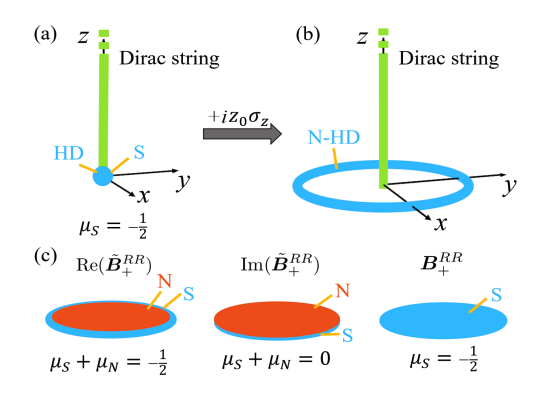
Researchers have developed a novel methodology to investigate how disturbances in physical systems alter the properties of Dirac monopoles, theoretical entities with magnetic charge. Traditionally considered point-like, the research demonstrates that introducing “non-Hermitian perturbations” transforms these monopoles into extended distributions of charge, fundamentally changing their characteristics. This approach departs from standard investigations by focusing on systems that do not adhere to the usual rules of energy conservation, allowing for the exploration of previously hidden phenomena. The core of this methodology lies in a theoretical framework combined with detailed numerical simulations, employing “piecewise adiabatic evolution,” a technique that carefully tracks changes in a system as it evolves.
This allowed them to observe how geometric phases are affected by the altered monopole distributions and identify a quantitative relationship between minute energy differences and the resulting shifts in these geometric phases, a connection previously unobserved in non-Hermitian systems. A particularly innovative aspect of this work is the proposed experimental realization using dissipative Bose-Einstein condensates. These ultra-cold gases provide a platform to directly measure the predicted signatures of the altered monopole distributions by leveraging the dynamics of “solitons” within these condensates. This combination of theoretical modelling and proposed experimental validation strengthens the findings and opens avenues for future research.
The team discovered that in these non-Hermitian systems, the traditional connection between energy levels and geometric phases breaks down. Standard calculations of geometric phase rely on instantaneous energy levels, but the researchers found this approach inaccurate for their model, demonstrating that a calculation focusing on the time-dependent energy expectation value accurately predicts the observed geometric phase shifts. This finding highlights the need for revised theoretical frameworks when studying systems that deviate from conventional energy conservation and provides a more accurate method for predicting and interpreting experimental results.
Non-Hermitian Monopoles Exhibit Extended Geometric Phases
Researchers have uncovered a surprising connection between energy and geometric phases in non-Hermitian systems, deepening our understanding of how these systems behave and offering new avenues for technological applications. Traditionally, the study of Dirac monopoles has focused on systems where energy levels are well-behaved and predictable. However, this research demonstrates that when these systems are “non-Hermitian,” the behaviour of these monopoles dramatically changes, transforming from point-like singularities into extended, distributed configurations. The team discovered three distinct forms of “Berry connections”, mathematical descriptions of how a system evolves, within these non-Hermitian systems, each leading to unique distributions of monopole charge.
While the total charge remains constant, the way it’s spread out differs significantly depending on the Berry connection used, resulting in variations in the geometric phases experienced by the system. This is particularly noteworthy because geometric phases are crucial for controlling quantum systems and could be harnessed for advanced technologies. Importantly, the researchers established a quantitative relationship demonstrating that even minute differences in energy accumulation directly translate into measurable differences in geometric phase. This connection holds true for both standard and non-Hermitian systems, but manifests much more strongly in the latter, offering a sensitive probe of their unique properties.
They validated these findings through detailed calculations and propose a method for directly measuring these signatures using solitons in specially engineered Bose-Einstein condensates. This research not only advances our theoretical understanding of Dirac monopole charge distributions but also provides a pathway for measuring complex geometric phases in non-Hermitian systems, with potential implications for fields like topological quantum computing and the development of novel photonic devices. The ability to manipulate and control these geometric phases could unlock new possibilities for creating robust and efficient quantum technologies.
This research establishes that introducing non-Hermitian perturbations transforms Dirac monopoles from point-like singularities into extended, magnet-like distributions of charge. This alters the fundamental characteristics of these theoretical entities and provides new insights into non-Hermitian systems.
🗞 Dirac monopole magnets in non-Hermitian systems
🧠 ArXiv: https://arxiv.org/abs/2508.15186
See today’s quantum computing news on Quantum Zeitgeist for the latest breakthroughs in qubits, hardware, algorithms, and industry deals.