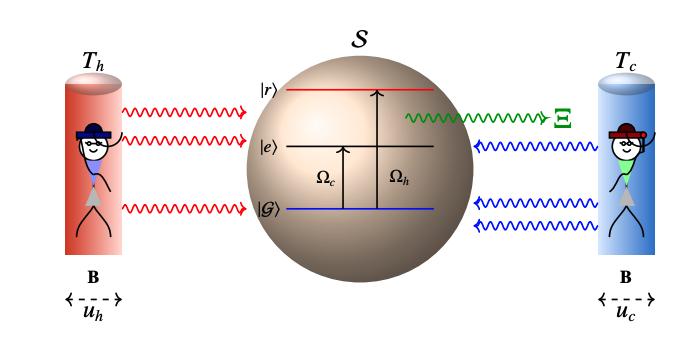
The pursuit of more efficient engines continually pushes the boundaries of thermodynamics, and recent work demonstrates that relativistic effects may offer a surprising pathway to surpass conventional limits. Tanmoy Pandit from the Leibniz Institute of Hannover, along with Tanmoy Pandit from TU Berlin and Pritam Chattopadhyay from the Weizmann Institute of Science, and colleagues, investigate a novel thermal machine that harnesses the principles of relativity to achieve efficiencies beyond those dictated by the Carnot cycle. Their research reveals that by incorporating relativistic motion into the system, specifically through the reshaping of energy spectra via the Doppler effect, it becomes possible to extract useful work even without a temperature difference, effectively establishing relativistic motion as a valuable resource for energy conversion. This discovery not only challenges established thermodynamic boundaries, but also opens exciting possibilities for designing future technologies that leverage the fundamental principles of relativity to enhance performance.
Relativistic Thermal Machine Calculations and Derivations
Theoretical Framework for Quantum Thermal Machines
Theoretical Framework and System Dynamics
This document provides a comprehensive explanation of the theoretical framework, calculations, and numerical methods used in a research paper on relativistic quantum thermal machines. It is well-structured, using appendices with clear headings to facilitate navigation and understanding, and the logical flow of explanations builds from foundational concepts to more complex derivations. Detailed mathematical derivations of key equations, such as those for the steady-state density matrix elements, power output, and efficiency, are presented, allowing independent verification of the results. The computational methodology, including the Monte Carlo method for estimating the generalized bound, is clearly described, providing sufficient information for reproduction, and effectively connects the mathematical formalism to the underlying physical concepts, including relativistic effects, thermal reservoirs, and quantum coherence.
The appendices detail the Lindblad superoperator used to describe the system’s dynamics and the transformation to a rotating frame to simplify the analysis. They show how relativistic motion affects the average number of quanta in the reservoir and the superoperators, and present the detailed derivation of the steady-state density matrix elements for the three-level heat engine, providing equations for power output and efficiency. The document describes the Monte Carlo method used to estimate the generalized Carnot-like efficiency bound in relativistic quantum thermal machines, providing pseudocode for implementation and explaining how the efficiency bound is extracted from efficiency and power pairs. Overall, this is an excellent supplementary material document that provides a comprehensive and detailed explanation of the theoretical framework, calculations, and numerical methods used in the research paper. The clear organization, detailed derivations, and well-explained physical concepts make it a valuable resource for anyone interested in relativistic quantum thermal machines.
Relativistic Motion Boosts Heat Engine Efficiency
Relativistic Motion as a Thermodynamic Resource
Demonstrating Efficiency Gains from Relativistic Motion
Researchers have demonstrated that relativistic motion can function as a genuine thermodynamic resource, enabling a heat engine to surpass the conventional limits of efficiency. The team investigated a three-level maser, where thermal reservoirs are in constant relativistic motion relative to the working medium, using a model that accurately captures the effects of relativistic motion on energy transfer. The results reveal that the engine’s performance is not solely dictated by temperature differences, but is significantly influenced by the velocity of the thermal reservoirs. Specifically, the engine can operate with greater efficiency than predicted by the Carnot limit, due to the reshaping of the energy spectrum caused by relativistic motion.
The researchers derived a generalized Carnot bound that accurately predicts this enhanced performance, recovering the standard Carnot limit when motion is absent. Notably, the engine’s ability to produce work depends in a complex way on the motion of the reservoirs, exhibiting asymmetries between configurations where the reservoirs are moving towards hotter or colder states. This behaviour fundamentally alters the boundary between operating as a heat engine and functioning as a refrigerator, and, surprisingly, allows the engine to generate work even when both reservoirs are at the same temperature. This demonstrates that relativistic motion itself can be a source of energy, opening new avenues for thermodynamic design and potentially impacting the development of nanoscale heat engines and energy harvesting technologies. The findings establish a clear link between relativistic effects and thermodynamic performance, suggesting that manipulating the motion of thermal reservoirs could provide a novel means of controlling and enhancing energy conversion processes. This research moves beyond theoretical exploration, as the model employed is compatible with existing experimental platforms, paving the way for future validation and practical applications of relativistic thermodynamics.
Relativistic Motion Enables Enhanced Thermodynamic Efficiency
Implications for Quantum Efficiency Bounds and Thermodynamics
Implications for Quantum Efficiency Bounds
This study demonstrates that relativistic motion fundamentally reshapes the thermodynamic behaviour of quantum thermal machines. Through detailed numerical analysis, researchers identified a generalized Carnot bound, which reduces to the standard Carnot limit when the system is stationary, but allows for efficiencies exceeding the conventional limit at a given power output. Importantly, the efficiency always remains constrained by this newly identified bound. The research also reveals pronounced asymmetries between configurations where the hot and cold reservoirs are in motion, demonstrating that relativistic motion can enable the extraction of positive work even when both reservoirs are at the same temperature. These findings establish relativistic motion as a genuine thermodynamic resource for quantum heat engines, suggesting potential for novel thermal technologies.
🗞 Relativistic Quantum Thermal Machine: Harnessing Relativistic Effects to Surpass Carnot Efficiency
🧠 ArXiv: https://arxiv.org/abs/2508.14183




See today’s quantum computing news on Quantum Zeitgeist for the latest breakthroughs in qubits, hardware, algorithms, and industry deals.