Controlling the movement of anyons, exotic particles with unique quantum properties, is fundamental to developing robust quantum memory and understanding complex states of matter known as symmetry-enriched topological phases. Jie-Yu Zhang, Peng Ye, and colleagues at Sun Yat-sen University have established a new framework for precisely controlling anyon mobility within these phases, regardless of the intricate patterns of their underlying symmetries. The researchers achieve this control by applying the principles of higher-order cellular automata, a powerful computational tool, to the realm of topological physics. This innovative approach allows for the design of exactly solvable models and demonstrates a direct link between the rules governing the cellular automata and the resulting movement of anyons, offering a pathway to programmable quantum codes and a deeper understanding of these fascinating materials.
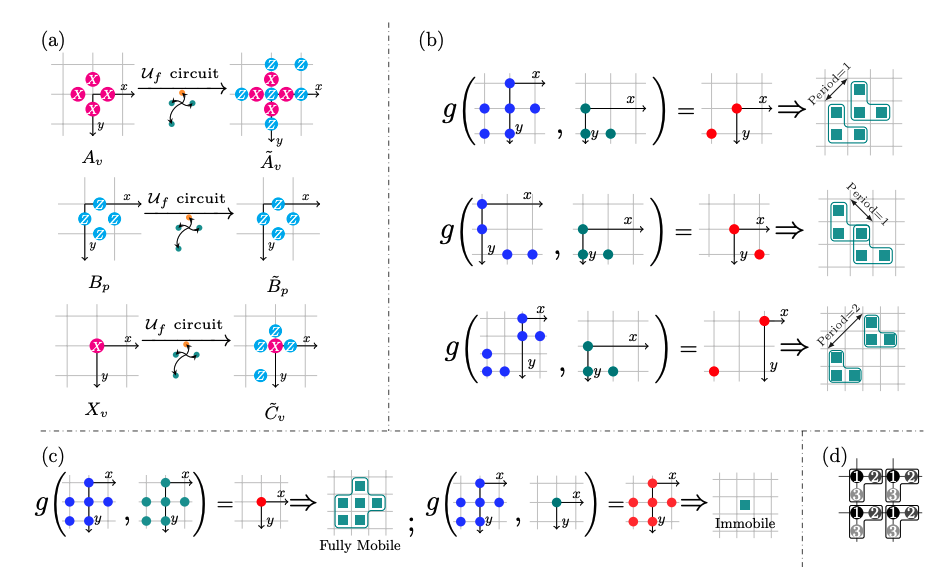
Existing theoretical descriptions of anyon mobility in symmetry-enriched topological phases often rely on specific support structures. However, a unified framework capable of addressing anyon mobility across diverse geometric patterns of subsystem symmetry has remained a significant challenge. This work introduces higher-order cellular automata, a powerful tool from computer science, to the study of these quantum systems, establishing a unified approach for completely characterizing anyon mobility induced by the complexity of subsystem symmetries. Researchers designed finite-depth cellular automata-controlled quantum circuits, yielding exactly solvable models featuring Abelian anyons and encompassing all possible locally generated subsystem symmetries, and subsequently developed a theorem that precisely programmes all relevant characteristics of these systems.
Anyon Fusion Rules and Mobility Constraints
This research presents a detailed derivation of the fusion rules for a specific anyon model, proving how these exotic particles behave within the model’s constraints. The study categorizes anyon mobility into three types: fully mobile particles, lineons constrained to move along a line, and immobile fractons. Fusion rules describe how anyons combine, crucial for understanding the system’s behaviour. The analysis demonstrates that fusing two fully mobile anyons results in another fully mobile anyon, while fusing a fully mobile anyon with a lineon or fracton results in a lineon or fracton, respectively.
Fusing two lineons can result in a fully mobile excitation, another lineon with a different direction, or a fracton. The proofs rely on techniques such as polynomial factorization, calculating the greatest common divisor of polynomials, and measuring the number of independent degrees of freedom of the excitations. The research highlights a fundamental connection between anyon movement and combination, simplifying the analysis of complex systems and providing a powerful tool for predicting and controlling anyon behaviour, contributing to topological quantum computation and condensed matter physics.
Anyon Mobility Controlled Via Cellular Automata
Researchers have developed a new framework for understanding and controlling anyons, exotic particles emerging in specific quantum systems, and their role in symmetry-enriched topological phases of matter. These phases exhibit unusual properties stemming from quantum mechanics and symmetry, and controlling anyon mobility is crucial for robust quantum memory and computation. The team’s breakthrough lies in applying higher-order cellular automata, a powerful computational tool, to the study of these quantum systems. By designing specific cellular automata rules, researchers can create exactly solvable models exhibiting a wide range of anyon behaviours and symmetries.
This allows for precise characterization of how anyons move, revealing whether they are fully mobile, restricted to lines, or completely immobile, directly from the rules governing the cellular automaton. The method establishes a direct link between a system’s symmetry and the resulting anyon mobility, offering a comprehensive way to predict and control these particles. Importantly, the research demonstrates that even in systems with complex symmetries, the fusion of anyons can exhibit non-Abelian characteristics, meaning the order of combination affects the outcome. This is significant because non-Abelian anyons are promising candidates for fault-tolerant quantum computers. The team’s approach also reveals how the fusion of anyons can be constrained by their direction of movement, with certain outcomes only possible when anyons move in the same or different directions. The results show that mathematical series describing anyon behaviour are related by a divisibility rule, indicating a fundamental connection between movement and combination, potentially leading to more robust and efficient quantum technologies.
Cellular Automata Reveal Anyon Mobility Characteristics
This research resolves a long-standing challenge in understanding and controlling anyon mobility within symmetry-enriched topological phases of matter. By introducing higher-order cellular automata, a computational tool from computer science, the team establishes a unified framework for characterizing anyon behaviour. This approach allows for the complete characterization of anyon mobility, including fractons, lineons, and fully mobile anyons, directly from the rules governing the cellular automata. Importantly, the research demonstrates that these systems can exhibit non-Abelian characteristics even with Abelian anyons, revealed through multiple fusion channels during particle interactions. This framework not only advances the fundamental understanding of these complex phases but also provides an algorithmic toolkit for designing topological quantum codes and searching for novel quantum materials.
🗞 Programmable Anyon Mobility through Higher Order Cellular Automata
🧠 ArXiv: https://arxiv.org/abs/2508.13961




See today’s quantum computing news on Quantum Zeitgeist for the latest breakthroughs in qubits, hardware, algorithms, and industry deals.