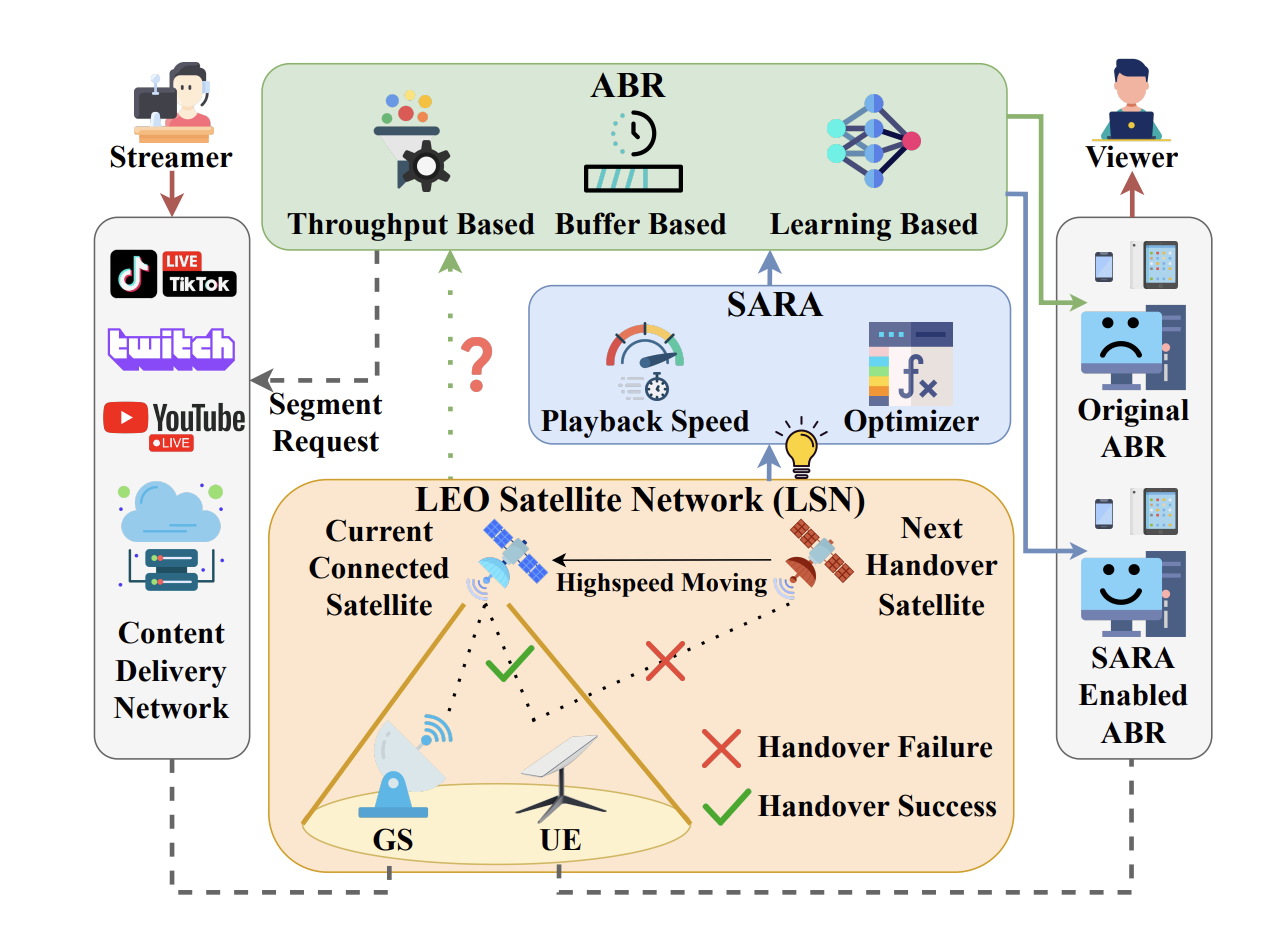
The increasing popularity of live streaming stands in contrast to the significant portion of the world’s population still lacking reliable internet access, but emerging Low Earth orbit Satellite Networks (LSNs) offer a potential solution. Hao Fang from [Institution Name] and colleagues demonstrate that current live streaming platforms struggle to deliver smooth experiences over these networks, due to frequent interruptions as connections switch between satellites. The team’s research reveals that even advanced algorithms, designed to adjust video quality based on network conditions, fail to cope with the rapid changes inherent in LSNs, leading to frustrating buffering delays. To address this, they introduce Satellite-Aware Rate Adaptation (SARA), a new system that works alongside existing algorithms, intelligently managing playback speed and providing crucial information about the unique characteristics of satellite networks, ultimately reducing buffering and improving the viewing experience.
Starlink Challenges for Realtime Multimedia Streaming
This research investigates the performance of Low Earth Orbit (LEO) satellite networks, specifically Starlink, for real-time multimedia services like live streaming. LEO satellite networks, while promising global coverage, introduce unique challenges due to high latency, variable bandwidth, and frequent handovers, impacting the quality of experience (QoE) for users. The study presents a comprehensive measurement of Starlink performance from the perspective of end-users, collecting data on network characteristics and QoE metrics under real-world conditions, identifying key challenges including high and variable latency, fluctuating bandwidth, and frequent handovers. The research evaluates several popular adaptive bitrate (ABR) algorithms and finds they often struggle to adapt quickly enough to bandwidth fluctuations and handovers, leading to frequent buffering and reduced video quality.
To address this, the authors introduce an Informer-based prediction model to forecast future bandwidth availability, allowing the ABR algorithm to proactively adjust the bitrate and minimize buffering. The Informer model, a type of transformer architecture, is specifically designed for long sequence time-series forecasting and utilizes ProbSparse attention to reduce computational complexity. The Informer model is developed and trained using historical bandwidth data, and simulations and experiments demonstrate significant performance improvements in buffering frequency, video quality, and overall QoE, with reported reductions in buffering events and improvements in video quality metrics. The research employs a mixed-methods approach, combining real-world measurements, simulations, and algorithm development, and confirms that LEO satellite networks exhibit high and variable latency, fluctuating bandwidth, and frequent handovers.
This research has the potential to significantly improve the QoE for live streaming over LEO satellite networks and enhance network efficiency by proactively adjusting the bitrate. Future research directions include integrating the prediction model with network control mechanisms, developing adaptive learning algorithms, exploring multi-satellite coordination, and deploying the solution in a real-world setting. Recognizing that frequent satellite handovers disrupt network connectivity and cause buffering, the team created a middleware solution that enhances the performance of existing adaptive bitrate (ABR) algorithms, offering broad compatibility and adaptability. SARA’s core innovation lies in its proactive prediction of network outages, anticipating disruptions caused by satellite transitions and preemptively mitigating their impact. This is achieved through a sophisticated optimization process employing Particle Swarm Optimization (PSO), a technique borrowed from complex systems research.
PSO allows SARA to explore a range of potential parameter settings, identifying configurations that minimize buffering and maintain a smooth viewing experience. The PSO algorithm functions by creating a ‘swarm’ of potential solutions, iteratively refined by both individual performance and collective knowledge, prioritizing solutions that offer a robust buffer against upcoming disruptions. To rigorously test SARA’s effectiveness, the researchers created a detailed simulation environment mirroring the dynamics of LSNs, using real-world data gathered from Starlink networks, and demonstrated its versatility and ability to consistently reduce buffering times and improve the overall streaming experience.
SARA Improves Live Streaming Over Satellite Networks
Recent growth in live streaming services contrasts with limited internet access for a significant portion of the global population. Low Earth orbit satellite networks (LEO constellations) offer a potential solution, but current live streaming platforms struggle to deliver smooth viewing experiences due to frequent disruptions caused by satellite handovers. These handovers lead to noticeable pauses in video playback, as existing adaptive bitrate (ABR) algorithms cannot effectively manage the rapidly changing network conditions. Extensive testing demonstrates that SARA reduces average rebuffering time by 39. 41%, a substantial improvement for viewers experiencing these connections.
🗞 Robust Live Streaming over LEO Satellite Constellations: Measurement, Analysis, and Handover-Aware Adaptation
🧠 ArXiv: https://arxiv.org/abs/2508.13402




See today’s quantum computing news on Quantum Zeitgeist for the latest breakthroughs in qubits, hardware, algorithms, and industry deals.