Quantum sensing increasingly demands the ability to measure rapidly changing external fields, and researchers are now pushing the boundaries of how quickly and accurately these measurements can be made. Chungwei Lin from Mitsubishi Electric Research Laboratories, Qi Ding from the Massachusetts Institute of Technology, and Yanting Ma, also of Mitsubishi Electric Research Laboratories, have investigated how to optimise the process of time-resolved sensing using advanced control techniques. Their work demonstrates that there is a fundamental limit to interrogation time, beyond which the most effective sensing protocols change dramatically, shifting from abrupt control signals to smoother, more experimentally feasible approaches. This analysis reveals a critical point where a specifically designed “detune protocol” becomes optimal for high time resolution, offering a pathway to overcome practical challenges in building and deploying these sensitive quantum sensors, and potentially improving the calibration of superconducting qubits.
Optimal Control of Superconducting Qubit States
This document presents a comprehensive overview of research into controlling superconducting qubits, the building blocks of many promising quantum computers. It details methods for precisely manipulating these qubits using tailored control pulses, aiming to achieve fast, accurate, and reliable quantum operations. The work explores various techniques for designing these control pulses, including methods to optimize their shape and robustness, while addressing limitations imposed by physical constraints and noise. Accurate calibration and characterization of the qubit system are crucial, ensuring the control pulses are effective and deliver the desired results. A significant challenge in quantum computing is the presence of noise, which can disrupt delicate quantum states. This approach moves beyond standard measurement techniques by actively optimizing the entire process, allowing for the precise tailoring of the measurement process to achieve the best possible performance. The methodology centers on a mathematical framework where the quantum system’s evolution is described by its dynamic state, and the goal is to minimize a “cost function” that represents the uncertainty in the measured field. To account for this complex relationship, researchers treat the system’s initial state and its rate of change as independent variables, allowing for a more comprehensive optimization process.
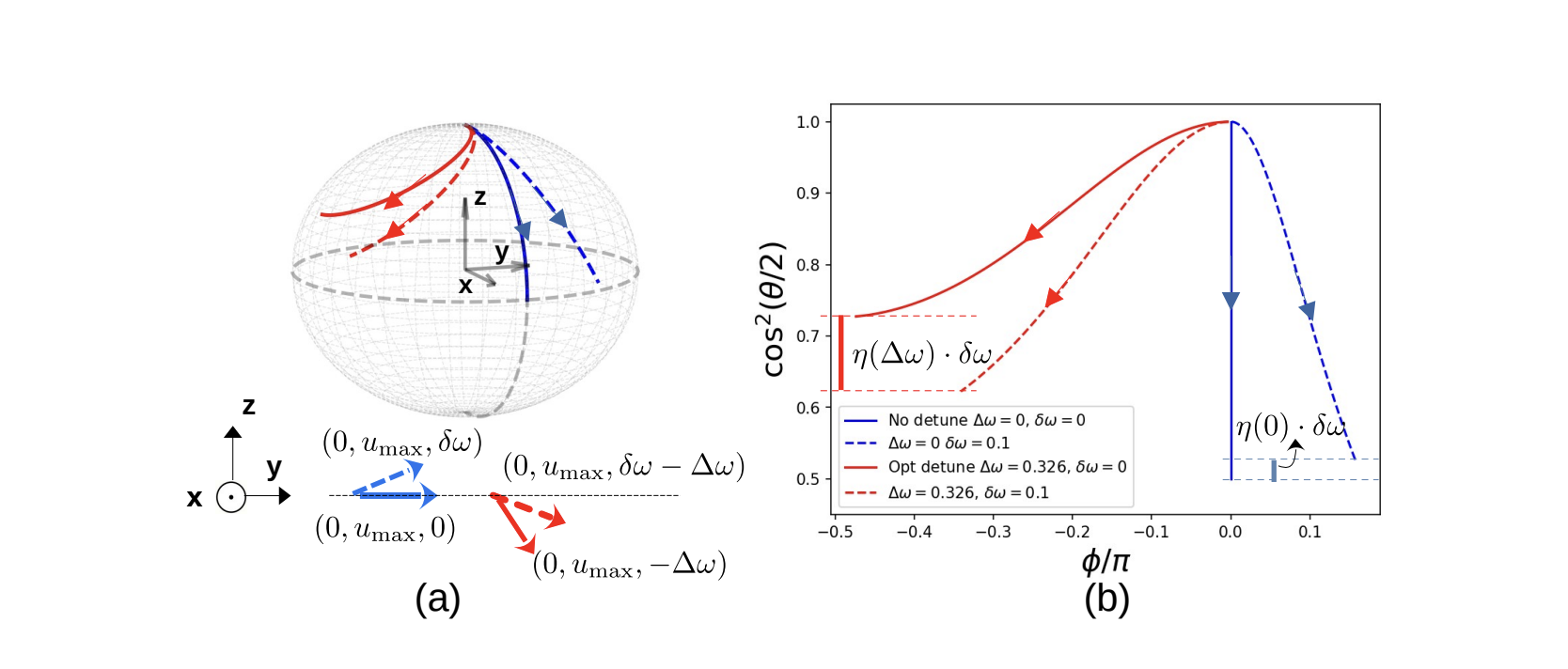
A key innovation lies in the use of “adjoint variables,” which act as a computational tool to characterize the system’s response to external influences and guide the optimization process. These variables, alongside a “control-Hamiltonian,” are calculated to determine the optimal control signals needed to minimize the cost function, revealing whether the optimal control should be applied abruptly or smoothly. Their analysis reveals a critical interrogation time, a threshold determined by the sensor’s properties, that dictates the most effective control strategy. The team employed optimal control theory to identify the best possible performance for this time-resolution protocol, discovering that the ideal control signal isn’t always smooth and can involve abrupt changes. To address this, they proposed a “detune protocol” that utilizes only smooth control signals, making it more practical for real-world applications while maintaining high sensitivity. When comparing the performance of this new detune protocol to a standard technique, researchers found that it offers a viable alternative, particularly when experimental constraints limit the ability to implement abrupt control signals. By carefully tailoring the control signal, it is possible to achieve a time resolution potentially shorter than previously thought possible, opening the door to even more precise measurements and applications like calibrating quantum devices.
Optimal Sensing Beyond Ramsey Sequences
This research investigates the fundamental limits of time-resolution protocols for quantum sensing, aiming to optimise the ability to measure rapidly changing external fields. Their analysis reveals a critical interrogation time, separating regimes where the optimal control strategy differs significantly; short times favour a simple, smooth control approach, while longer times resemble established Ramsey sequences. The key contribution is the development of a “detune protocol”, a practical measurement strategy designed for implementation in real-world experiments. This protocol avoids abrupt changes in control signals, which are difficult to achieve experimentally, while still maintaining high sensitivity. They also suggest applying this protocol to calibrate distortions in control pulses for superconducting qubits, demonstrating a potential application for this research.
🗞 Application of Optimal Control to Time-Resolution Protocol for Quantum Sensing
🧠 ArXiv: https://arxiv.org/abs/2508.13405