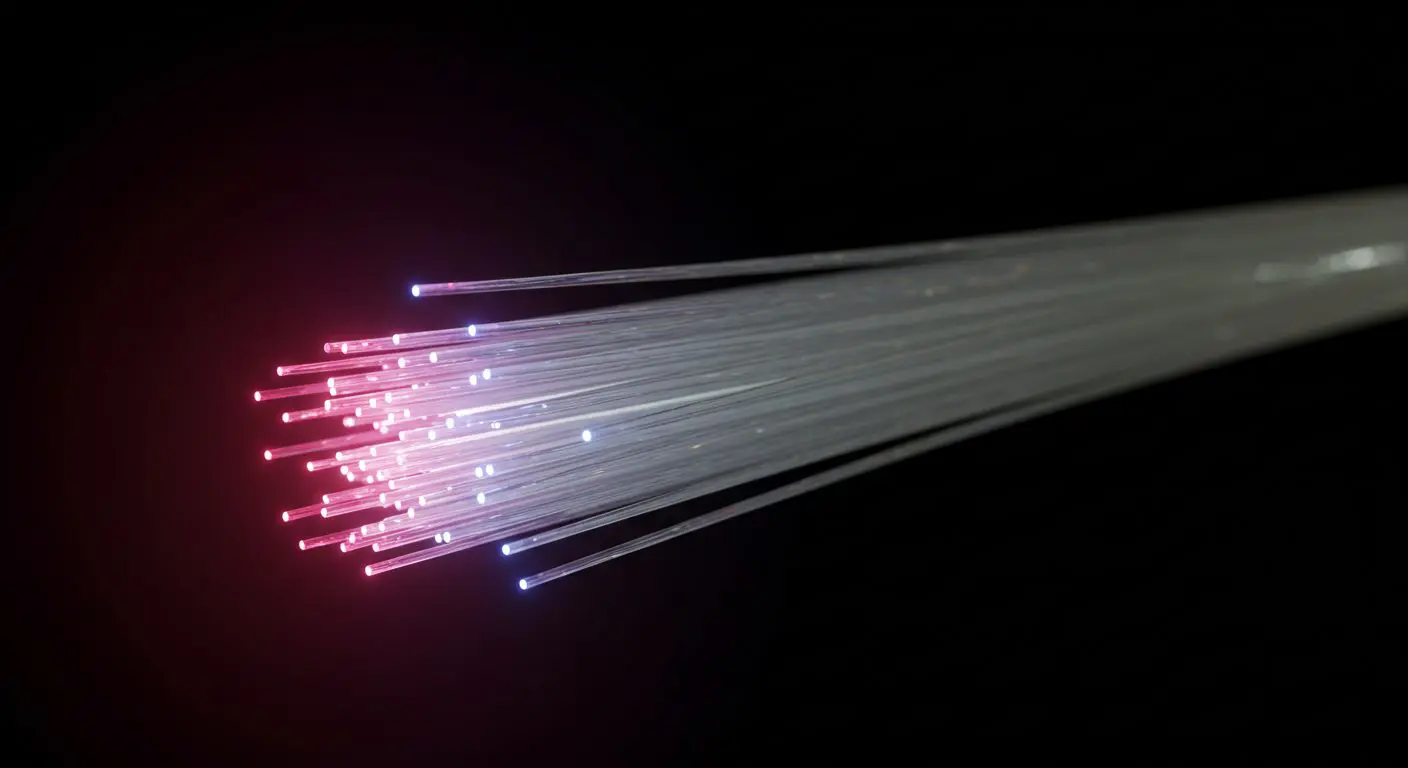
Lightmatter has demonstrated a 16-wavelength bidirectional Dense Wavelength Division Multiplexing (DWDM) optical link operating on a single strand of standard single-mode fiber. Utilizing its Passage interconnect and Guide laser technologies, the company achieved 800 Gbps bidirectional bandwidth, comprising 400 Gbps transmit and 400 Gbps receive, over distances exceeding several hundred meters. This innovation addresses limitations in data center bandwidth and radix, employing a closed-loop digital stabilization system to compensate for thermal drift and maintaining performance through polarization insensitivity, thereby enabling the use of cost-effective standard single-mode fiber.
Advancing Data Center Interconnects
Lightmatter has demonstrated a 16-wavelength bidirectional Dense Wavelength Division Multiplexing (DWDM) optical link operating on a single strand of standard single-mode (SM) fiber, representing an advancement in fiber bandwidth density and spectral utilization. This achievement utilizes Lightmatter’s Passage interconnect and Guide laser technologies to establish a new benchmark for high-performance data center interconnects, addressing limitations imposed by bandwidth and radix constraints in scaling AI workloads. Historically, bidirectional transmission on a single fiber has been limited to two wavelengths, while achieving 16 wavelengths typically required multiple or specialized fibers.
The company’s 16-lambda bidirectional link addresses technical challenges including managing wavelength-dependent propagation characteristics, power budget constraints, and optical nonlinearity within a single fiber. Mitigating crosstalk and backscattering were also key considerations in the development of this technology, which is crucial for enabling the next generation of AI model development and demanding more efficient high-bandwidth networking. Lightmatter’s breakthrough incorporates a proprietary closed-loop digital stabilization system that actively compensates for thermal drift, ensuring continuous, low-error transmission over wide temperature fluctuations.
Architectural innovations within the Passage 3D CPO platform render it inherently polarization-insensitive, maintaining robust performance even with fiber handling or mechanical stress. Standard SM fiber does not inherently maintain light polarization, unlike specialized polarization-maintaining fiber; by achieving polarization insensitivity, Lightmatter enables the use of cost-effective SM fiber for its Dense Wavelength Division Multiplexing technology. This combination of increased fiber bandwidth density, efficient spectral utilization, and robust performance positions Lightmatter’s Passage technology as foundational for the industry’s transition from electrical to optical interconnects in AI data centers.
Overcoming Technical Hurdles in DWDM Technology
Lightmatter’s 16-wavelength bidirectional link establishes a new benchmark for high-performance data center interconnects by operating on a single strand of standard single-mode (SM) fiber. This achievement delivers 800 Gbps bidirectional bandwidth, comprising 400 Gbps transmit and 400 Gbps receive, for distances exceeding several hundred meters, simultaneously increasing both radix and bandwidth per fiber compared to existing co-packaged optics (CPO) solutions.
Historically, achieving 16 wavelengths, or lambdas, typically required multiple or specialized fibers, but Lightmatter’s technology operates within a single fiber. The company’s approach is expected to significantly improve data center scalability and efficiency, solving a pressing challenge in AI development and accelerating the adoption of advanced Co-Packaged Optics, while also reducing capital and operational expenditure.
Further enabling this performance, the Passage 3D CPO platform is inherently polarization-insensitive, maintaining robust performance even when fibers are handled or subject to mechanical stress, allowing for the use of cost-effective SM fiber for its Dense Wavelength Division Multiplexing technology. This combination of increased fiber bandwidth density, efficient spectral utilization, and robust performance positions Lightmatter’s Passage technology as foundational for the industry’s transition from electrical to optical interconnects in AI data centers.
Implications for AI and Scalability
Lightmatter’s milestone addresses significant technical challenges related to managing wavelength-dependent propagation characteristics, power budget constraints, and optical nonlinearity within a single fiber. Mitigating crosstalk and backscattering also presented key hurdles overcome in the development of this 16-lambda bidirectional link.
A proprietary closed-loop digital stabilization system actively compensates for thermal drift, ensuring continuous, low-error transmission over wide temperature fluctuations. This technology is crucial for maintaining performance stability in data center environments.
Standard SM fiber does not inherently maintain light polarization, but Lightmatter’s architectural innovations enable the use of cost-effective SM fiber for its Dense Wavelength Division Multiplexing technology, despite this limitation. By achieving polarization insensitivity, the company avoids the need for specialized polarization-maintaining (PM) fiber.
More information
External Link: Click Here For More
See today’s quantum computing news on Quantum Zeitgeist for the latest breakthroughs in qubits, hardware, algorithms, and industry deals.