Quantum computing, with its promise of solving problems intractable for even the most powerful conventional computers, is rapidly moving from theoretical possibility to practical pursuit, attracting significant global investment. Gilles Johansson and colleagues from CSC, IT Center for Science, alongside researchers at the Accelerated Data Analytics and Computing Institute (ADAC), investigate the evolving relationship between quantum computing and established high-performance computing (HPC) methods. Their work demonstrates that, despite ongoing challenges in scaling quantum systems, the future of computationally intensive science likely resides in hybrid infrastructures that intelligently combine the strengths of both approaches. This perspective, synthesised from insights within ADAC’s Computing Working Group and a comprehensive member survey, offers HPC specialists a crucial overview of quantum computing’s potential and the key considerations for integrating these technologies into existing ecosystems, ultimately paving the way for accelerated scientific discovery.
NISQ Error Mitigation via Zero-Noise Extrapolation
Addressing Noise and Hardware Limitations in Quantum Computing
Mitigating Noise and Overcoming Hardware Limitations
Quantum computing is advancing rapidly, but current devices are limited by qubit count, coherence, and gate fidelity, hindering their ability to solve practical problems. This necessitates robust error mitigation techniques to extract meaningful results from noisy intermediate-scale quantum (NISQ) devices without requiring full quantum error correction. Several strategies exist, including extrapolation, probabilistic error cancellation, and symmetry verification. Extrapolation techniques, such as zero-noise extrapolation, estimate ideal results by extrapolating from results obtained with increasing levels of noise.
This work investigates a novel approach to error mitigation based on symmetry-adapted basis sets. By representing quantum states in a basis that respects the symmetries of the Hamiltonian, researchers can reduce the computational space and suppress symmetry-breaking noise. Symmetry-preserving error mitigation (SPEM) offers advantages over existing methods, reducing required measurements, simplifying calibration, and improving accuracy for problems with high symmetry. The research focuses on validating SPEM for quantum simulations of molecular energies, a crucial application in quantum chemistry and materials science, aiming to achieve higher accuracy and efficiency compared to conventional techniques.
Benchmarking Quantum Computers, Challenges and Metrics
Standardizing Metrics for Quantum Platform Benchmarking and Validation
Establishing Metrics for Quantum Platform Validation
The field of quantum computing requires robust metrics to track advancements in hardware and software. Benchmarks are crucial for comparing different quantum computing platforms and pinpointing limitations in hardware, control systems, and algorithms. Validating quantum advantage, demonstrating that quantum computers can outperform classical computers, remains a key goal, requiring full-stack evaluation of the entire system. Random Circuit Sampling (RCS) is a widely used benchmark, though its value is debated. Hybrid quantum-classical algorithms, such as the Variational Quantum Eigensolver (VQE) and the Quantum Approximate Optimization Algorithm (QAOA), are also used for benchmarking.
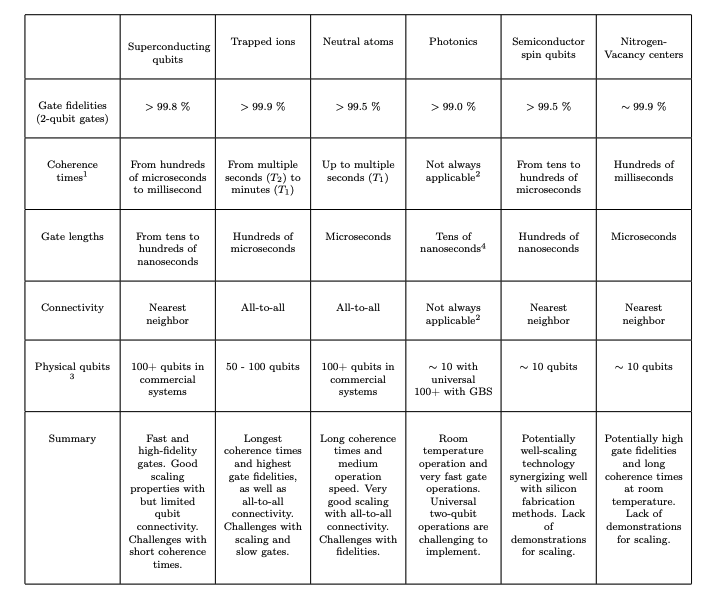
Theoretical benchmarks like Shor’s algorithm and the Quantum Fourier Transform (QFT) demonstrate potential speedups. Benchmarks include adaptations of classical tools like Linpack and the Parsec Benchmark Suite, alongside specialized tools like RevLib and MQTBENCH. Key metrics include qubit count, connectivity, gate fidelity, and coherence time. Algorithmic qubits, depth, and compilation efficiency are also important considerations. Characterizing different error types and developing logical qubits are vital for achieving fault-tolerant quantum computing.
Scalability, error correction overhead, and the design of heterogeneous architectures are significant challenges. Developing quantum memory and standardized benchmarks will facilitate comparison between platforms. The ultimate goal is to demonstrate practical quantum advantage by solving real-world problems intractable for classical computers.
Industry Momentum and Commercial Investment Trends
Industry Momentum and Surging Global Investment Trends
Quantum investment surges, confidence steadily grows
Quantum computing is gaining momentum, attracting substantial investment and transitioning from an academic field to a commercially viable technology. Experts anticipate a future where quantum computers work alongside traditional high-performance computers (HPC) to tackle complex problems. Recent analysis indicates global investment in quantum technology reached $42 billion in 2023, demonstrating growing confidence. The prevailing view is that even fully error-corrected quantum computers will be best suited for specific tasks, complementing the strengths of HPC. Current noisy intermediate-scale quantum (NISQ) devices face hurdles in achieving practical applications due to limited qubit counts, error rates, and coherence limitations.
The Core Principles and Future Scaling of Qubits
However, projections suggest a substantial increase in qubit numbers by the end of the decade, expanding the range of solvable problems. The core of quantum computing lies in the qubit, which leverages superposition and entanglement to perform calculations. Unlike classical bits, a qubit can exist in a combination of states simultaneously, allowing it to explore a larger computational space. This capability, combined with the potential for exponential speedups, is driving interest in quantum computing for applications in materials science, drug discovery, and financial modeling.
🗞 The Role of Quantum Computing in Advancing Scientific High-Performance Computing: A perspective from the ADAC Institute
🧠 ArXiv: https://arxiv.org/abs/2508.11765



See today’s quantum computing news on Quantum Zeitgeist for the latest breakthroughs in qubits, hardware, algorithms, and industry deals.