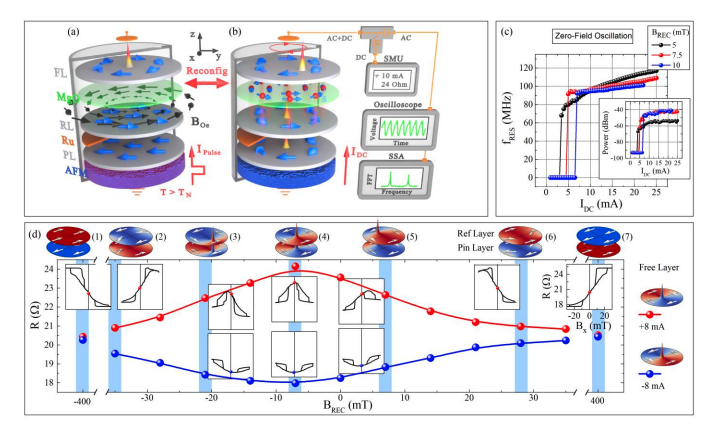
Magnetic tunnel junctions are fundamental to modern spintronics, powering data storage and processing, and increasingly enabling more efficient computing technologies. Maksim Stebliy, Alex Jenkins, and Luana Benetti, along with colleagues at the International Iberian Nanotechnology Laboratory, have discovered a way to fundamentally alter the behaviour of these junctions by reconfiguring a key magnetic layer. Their research demonstrates a method for switching a magnetic tunnel junction from a standard state to one exhibiting a vortex magnetic state, crucially without the need for an external magnetic field. This reconfiguration generates a unique spin current, allowing for stable oscillations within the junction and opening up new possibilities for non-volatile radiofrequency spintronic devices, potentially leading to more energy-efficient and adaptable technologies. The team’s findings reveal that the junction retains a ‘memory’ of previous configurations, further enhancing its potential for advanced applications.
Magnetic tunnel junctions (MTJs) represent fundamental elements, facilitating the development of efficient hardware for neuromorphic computing. The functionality of an MTJ is determined by the properties of its free layer and reference layer, separated by an insulating barrier. Researchers now present a mechanism for reconfiguring the reference layer, specifically its upper portion within a pinned magnetic structure, enabling a reversible transition from a simple magnetic state to a vortex state with different core positions. When the reference layer adopts the vortex state, it generates a spin current with a swirling polarization, enabling stable oscillations in the free layer even without an external magnetic field.
Spin Torque Oscillations and Vortex Dynamics
Spin-torque nano-oscillators (STNOs) are nanoscale devices that generate microwave signals through the interaction of spin-polarized currents and magnetic materials. These oscillators rely on the creation and manipulation of magnetic vortices, swirling magnetic patterns that generate the microwave signals, and function through spin-transfer torque, a fundamental mechanism driving the oscillations. Electrical currents are used to control and sustain these oscillations. STNOs have a wide range of potential applications, including mimicking the behaviour of biological neurons for more efficient and parallel processing, a key focus for neuromorphic computing.
They also generate precise and tunable microwave signals for communication and sensing, and could be used in wireless communication standards. Furthermore, STNOs can function as sensors, detecting magnetic fields or other physical quantities, and generate truly random numbers for cryptography and simulations. They also offer potential for analog control and reconfiguration, and can be integrated into reservoir computing systems. Ongoing research focuses on improving oscillator performance by increasing signal power, reducing noise, and enhancing frequency stability. Controlling vortex dynamics to achieve desired oscillation characteristics is also crucial. Researchers are actively optimizing materials to find those with optimal magnetic properties and spin polarization, and developing reliable fabrication techniques for nanoscale devices. Achieving precise analog control of the oscillator frequency, ensuring stable operation, synchronizing multiple oscillators, and reducing power consumption are also key challenges.
Reconfigurable Magnetism Enables Vortex Spin Currents
Researchers have demonstrated a new level of control over the behaviour of magnetic tunnel junctions (MTJs) by reconfiguring the magnetic layers within them. This reconfiguration allows a transition from a simple magnetic state to one containing swirling magnetic textures called vortices, opening possibilities for more efficient and versatile electronic devices. Importantly, this process is reversible, enabling dynamic control over the MTJ’s properties. The team discovered that carefully manipulating the magnetic configuration of a key layer within the MTJ generates a unique spin current with a swirling polarization.
This current sustains stable oscillations within another magnetic layer, even without external magnetic fields. These oscillations were observed in devices ranging from 400 to 1000 nanometers in diameter, representing a significant step towards creating self-oscillating spintronic devices. The reconfiguration process subtly alters the spin current and introduces asymmetry into the vortex oscillations, creating a “memory” of previous states. This analogue reprogrammability offers multiple pathways for creating non-volatile devices, meaning they retain information even when power is switched off. The reconfiguration is remarkably fast, achievable with pulses lasting just 20 nanoseconds.
By precisely controlling the magnetic configuration, the team tuned the conditions required to initiate these oscillations, effectively creating an adjustable “activation level” similar to that found in artificial neurons. This tuning resulted in a measurable change in oscillation frequency, increasing from 70 to 120 MHz, and a substantial increase in signal power, from -70 to -40 dBm. Further investigation revealed that the ability to excite these oscillations is strongly linked to the magnetic state of the MTJ. By mapping the relationship between external magnetic fields and oscillation power, the researchers demonstrated a clear correlation between the magnetic configuration and the onset of sustained oscillations. This control extends to the polarity of the magnetic vortex, allowing for precise manipulation of the device’s behaviour. These findings pave the way for innovative spintronic devices with enhanced functionality and energy efficiency.
Voltage Controls Magnetism and Oscillations
This research demonstrates a method for reversibly reconfiguring the magnetic structure within magnetic tunnel junctions (MTJs) using voltage pulses. This reconfiguration affects the reference layer of the MTJ, switching it between a single-domain state and a vortex state, and introduces a non-volatile change in the device’s residual resistance. Importantly, fixing the reference layer in a vortex state enables the injection of a spin current with a unique polarization distribution into the free layer, resulting in stable oscillations without the need for external magnetic fields. These oscillations were observed in MTJs ranging in diameter from 400 to 1000 nanometers.
The dynamics of these MTJs exhibit a symmetry breaking in the vortex core polarity, linked to the prior thermal history of the antiferromagnet. Micromagnetic simulations confirm that this behaviour arises from a deformation within the pinned antiferromagnet and reference layers. The ability to reconfigure both the static and dynamic properties of individual MTJs after fabrication is significant, with potential applications in radio frequency spintronic neuromorphic computing. The authors acknowledge that precise control of the antiferromagnet reannealing procedure is crucial for device performance. Future work will likely focus on optimizing this control and exploring the full potential of these reconfigurable MTJs in advanced computing architectures.
🗞 Reconfiguration of a Magnetic Tunnel Junction as a Way to Turn It into a Field-Free Vortex Oscillator
🧠 ArXiv: https://arxiv.org/abs/2508.10739
See today’s quantum computing news on Quantum Zeitgeist for the latest breakthroughs in qubits, hardware, algorithms, and industry deals.