Understanding the behaviour of electrons in complex materials requires tackling the challenge of ‘strongly correlated fermions’, and dynamical mean-field theory provides a powerful approach to this problem. Stefan Wolf, from Friedrich-Alexander Universität Erlangen-Nürnberg, Martin Eckstein from the University of Hamburg, and Michael J. Hartmann, also at Friedrich-Alexander Universität Erlangen-Nürnberg, and their colleagues have developed a new method to solve a key component of this theory, the single impurity Anderson model, using quantum computers. Their work addresses a significant hurdle in simulating these models, namely the depth of the quantum circuits required for accurate time evolution, by training a simplified representation of the time evolution process itself. This innovative approach dramatically reduces the complexity of the required quantum circuits, potentially unlocking the ability to simulate more realistic materials and gain deeper insights into their electronic properties.
Variational Quantum Green’s Function Calculation
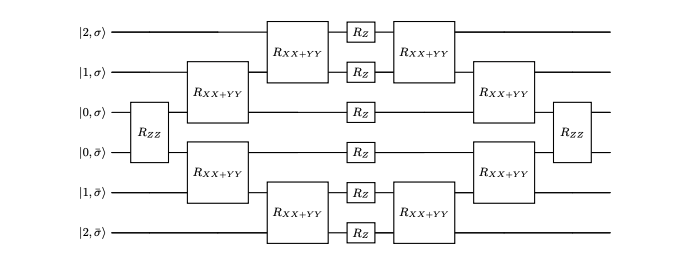
Strongly correlated fermions, found in many complex materials, present a significant challenge in condensed matter physics. Dynamical Mean-Field Theory offers a powerful approach to tackle these systems by simplifying complex interactions and focusing on a single “impurity” site within an effective environment. This transformation leads to the single impurity Anderson model, which researchers solve using a hybrid quantum-classical algorithm. This process involves preparing the ground state on a quantum computer and evolving it in time to measure the Green’s function, crucial for understanding the system’s properties. This work develops an approximation to the time evolution operator by training a flexible quantum state representation, known as a Hamiltonian variational ansatz, determined using a variational quantum algorithm that efficiently utilises a small number of time steps, employing the Suzuki-Trotter decomposition to manage complexity.
Hybrid Algorithm Simulates Correlated Fermions Efficiently
Researchers have developed a novel approach to simulating complex materials by combining the strengths of classical and quantum computing. This method addresses the challenge of understanding strongly correlated fermions, systems where electrons interact intensely, influencing material properties like superconductivity and magnetism. The core of their work lies in dynamical mean-field theory, which simplifies complex interactions by focusing on a single “impurity” site within an effective environment. Traditionally, solving these models requires significant computational power, particularly when accurately representing the interactions within the environment.
This team pioneered a hybrid quantum-classical algorithm that leverages quantum computers to overcome these limitations. They represent the problem using quantum bits, or qubits, and map the complex interactions onto operations performed on a quantum processor. A key innovation is the use of the Jordan-Wigner transformation, which efficiently translates the problem into a form suitable for quantum computation, allowing for a more accurate representation of interactions than previously possible with purely classical methods. To further enhance efficiency, the researchers employ Trotterization, which approximates the complex time evolution of the system using a series of simpler steps.
A crucial element of their approach is preparing the ground state, the lowest energy state of the system, essential for accurate calculations. They achieve this by training a parametrized quantum circuit, effectively “teaching” it to approximate the true ground state. The results demonstrate a significant improvement in the accuracy and efficiency of simulating these complex materials. By offloading computationally intensive tasks to the quantum computer, the team can explore larger and more realistic systems than previously feasible, promising to accelerate the discovery of new materials with tailored properties, potentially leading to breakthroughs in areas such as energy storage, high-temperature superconductivity, and advanced electronics. The method’s ability to accurately capture the intricate interactions between electrons opens new avenues for understanding and designing materials with unprecedented functionalities.
Quadratic Scaling Improves Quantum Simulations of Materials
Researchers have developed a new method for compressing the computational steps required to solve the single impurity Anderson model using quantum computers. This model is a key component in understanding strongly correlated materials. The team developed an algorithm that approximates the time evolution of the system with a variational approach, effectively reducing the number of computational layers needed compared to standard methods like the Suzuki-Trotter expansion. Results demonstrate that the number of layers required scales quadratically with the number of bath sites in the model, a significant improvement over the exponential scaling observed in some other quantum simulations.
This compression is particularly promising for performing dynamical mean-field theory on quantum computers, as it reduces the overall number of quantum gates needed, making the calculations more feasible. The algorithm’s effectiveness was confirmed by achieving high fidelity, with errors below 10 -4 , with a relatively small number of layers in the variational circuit. The authors acknowledge that the observed quadratic scaling may be specific to the “star geometry” of the impurity system and the chosen Hamiltonian ansatz, and further investigation is needed to determine if this scaling holds more generally. Future work could explore whether this approach can be extended to larger, more complex systems and different material models, potentially unlocking new insights into the behavior of strongly correlated materials.
🗞 Variational Time Evolution Compression for Solving Impurity Models on Quantum Hardware
🧠 ArXiv: https://arxiv.org/abs/2508.10526



See today’s quantum computing news on Quantum Zeitgeist for the latest breakthroughs in qubits, hardware, algorithms, and industry deals.