The pursuit of stable quantum computers faces a significant hurdle, as quantum information is notoriously fragile, susceptible to disruption from environmental noise. Researchers Philipp Frey, Themba Hodge, and Eric Mascot, all from the School of Physics at The University of Melbourne, alongside Stephan Rachel, are addressing this challenge by exploring topological quantum computation, a promising approach that encodes information in the robust properties of exotic particles. Their work investigates how to manipulate Majorana zero modes, quasiparticles predicted to exist in certain materials, within networks of superconducting nanowires, moving beyond simple particle braiding to incorporate projective measurements. This combination, the team demonstrates, expands the potential for universal quantum gate sets and offers a pathway towards building more resilient and powerful quantum computers, supported by a new efficient simulation method for realistic device architectures.
Effective parity measurements, combined with hybridization, extend the computational capabilities beyond braiding alone and enable universal gate sets. The work outlines the theoretical foundations, including the algebra of Majorana operators and the stabilizer formalism, and introduces an efficient numerical method for simulating the time-dependent dynamics of these systems. This method, based on the time-dependent Pfaffian formalism, allows for the classical simulation of realistic device architectures that incorporate braiding, projective measurements, and disorder.
Majoraja Braiding and Topological Qubit Control
The Promise of Topological Majorana Quantum Computing
The Promise of Topological Qubits with Majorana Zero Modes
Researchers are investigating the potential of Majorana zero modes to build a new type of quantum computer. These unique particles offer inherent protection against errors, a major challenge in quantum computing, because their quantum information is encoded in the topology of the system. The core idea involves manipulating these modes by physically moving them around each other, a process called braiding, to perform quantum calculations. This work explores the challenges of realizing such a system, including the impact of imperfections in materials and the need for precise control over the braiding process.
The research examines key areas including topological quantum computation using Majorana zero modes, the challenges of braiding these modes, and the impact of disorder and other error sources. Researchers are also exploring hybrid approaches, combining Majorana modes with other quantum technologies to improve control and readout. Advanced theoretical methods, such as the Bogoliubov-de Gennes formalism and Pfaffian calculations, are employed to model the behavior of these complex systems and simulate realistic device architectures. This work provides a comprehensive analysis of the landscape of topological quantum computation, offering a detailed understanding of various error sources and identifying the critical parameters that need to be controlled. It serves as a valuable resource for researchers in the field, summarizing the current state of knowledge and outlining key challenges and opportunities.
Addressing Limitations in Sparse Qubit Encoding Strategies
Challenges and Limitations of Sparse Qubit Encodings
Sparse Encoding Limits Majorana Qubit Control
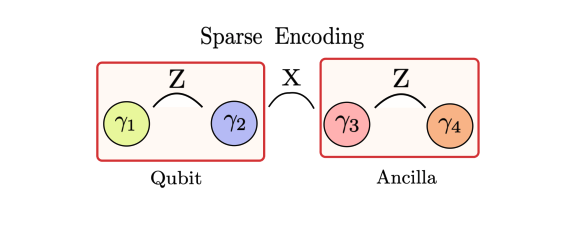
Researchers are developing methods to build quantum computers using Majorana zero modes, which possess unique properties that could protect quantum information from errors. These modes emerge in specially engineered networks of ultra-thin superconducting wires, and manipulating them forms the basis of a promising approach to topological quantum computation. A key challenge lies in efficiently encoding and controlling qubits, the fundamental units of quantum information, using these Majorana modes. Two primary encoding strategies have been investigated: sparse and dense. The sparse encoding assigns each logical qubit its own accompanying “ancilla” qubit, designed to maintain overall system parity during operations.
However, this approach surprisingly restricts the ability to create entanglement between logical qubits, effectively limiting computational power. Any braiding operations would only produce product states, lacking the interconnectedness needed for complex calculations. In contrast, the dense encoding offers a pathway to full entanglement. This method utilizes all available Majorana modes to represent the qubits, with a single ancilla serving to conserve parity across the entire system. Through detailed analysis, researchers have demonstrated that braiding operations within the dense encoding can directly implement logical quantum gates, including single-qubit Clifford gates, essential building blocks for quantum algorithms. Specifically, braiding certain pairs of Majorana modes corresponds to applying rotations on the logical qubits, allowing for precise control over their quantum states. This dense encoding scheme allows for the implementation of a complete set of single-qubit Clifford gates and opens the door to universal quantum computation if combined with other operations.
Achieving Universal Computation via Combined Braiding and Measurement
Achieving Universal Computation via Combined Braiding and Encoding
Braiding and Encoding Expand Quantum Computation
This work details key components for achieving universal topological quantum computation using Majorana zero modes in networks of nanowires. Researchers demonstrated how combining Majorana braiding with transitions between sparse and dense qubit encodings, enabled by projective parity measurements, extends computational possibilities beyond what braiding alone can achieve. To support further investigation, they also introduced a computationally efficient method, based on the time-dependent Pfaffian formalism, for simulating the dynamics of these complex systems, allowing for modelling of realistic device architectures. The significance of this research lies in providing both a theoretical overview and a practical computational tool for exploring topological quantum computing platforms. By outlining the necessary ingredients and offering a scalable simulation method, the work advances the field towards realizing the potential of Majorana zero modes for robust quantum computation. The authors acknowledge limitations in their current simulations, specifically the lack of explicit modelling of the architecture required for parity measurements, but highlight the framework’s potential for future expansion to include such features and even stochastic modelling of measurement errors.
🗞 Majorana braiding simulations with projective measurements
🧠 ArXiv: https://arxiv.org/abs/2508.10106
See today’s quantum computing news on Quantum Zeitgeist for the latest breakthroughs in qubits, hardware, algorithms, and industry deals.