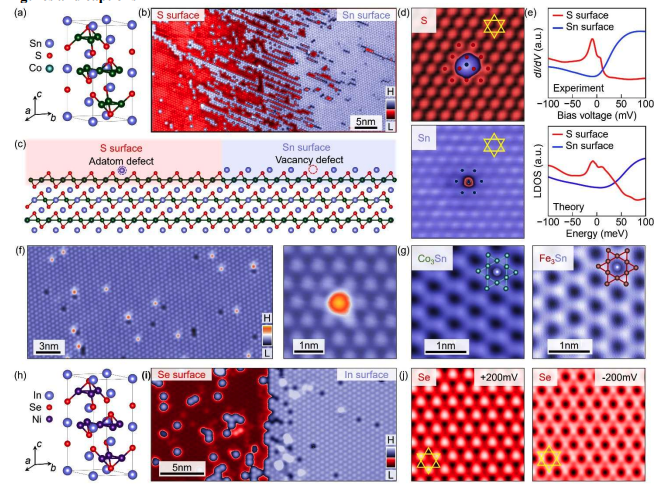
Kagome metals, materials structured with a unique pattern of corner-sharing triangles, are generating considerable excitement in physics due to their potential for unconventional electronic and magnetic properties, and a team led by Guowei Liu and Wei Song of Southern University of Science and Technology, alongside Titus Neupert of the University of Zurich and M. Zahid Hasan of Princeton University, has now provided a detailed atomic-scale investigation of one such material, cobalt tin sulfide (Co3Sn2S2). Their work focuses on how the material’s unusual electronic structure, possessing both magnetism and topological characteristics, manifests at the level of individual atoms, utilising advanced scanning tunneling microscopy. This research is significant because it not only clarifies the interplay between topology, magnetism, and electron behaviour within Co3Sn2S2, but also establishes a robust methodology for studying similar materials, potentially paving the way for novel electronic devices and a deeper understanding of quantum materials. By directly visualising the material’s electronic states, the team reveals crucial details about its magnetic properties and topological edge states, offering insights previously inaccessible through conventional measurements.
Among these, Co3Sn2S2 stands out, uniquely combining intrinsic ferromagnetism with a Dirac-like electronic band structure and strong spin-orbit coupling. This combination creates a rich landscape of correlated electronic phenomena, making it a promising platform for exploring novel quantum phases of matter. Therefore, this work investigates the electronic structure and correlated behaviour of Co3Sn2S2, aiming to elucidate the fundamental mechanisms governing its exotic properties and to provide insights into the broader field of topological quantum materials.
Chemical Markers Identify Kagome Surface Termination
Researchers employ scanning tunneling microscopy to investigate the properties of the kagome metal, Co3Sn2S2, and its unique electronic behavior. This approach allows observation of the material’s atomic structure and electronic states with exceptional precision, revealing the interplay between topology, magnetism, and electron interactions. A key challenge lies in definitively identifying the surface structure after cleavage, as different arrangements exhibit distinct electronic characteristics. To address this, the team utilizes specifically designed chemical markers, layers that selectively bind to different surface arrangements, to provide conclusive identification.
By analyzing the arrangement of atoms and the resulting electronic structure, researchers can distinguish between different surface arrangements, specifically identifying surfaces decorated with tin atoms or those exhibiting vacancies. Atomic-step geometry imaging maps the surface, revealing the arrangement of terraces and steps, and providing a general method applicable to several kagome materials. Beyond surface identification, the team investigates the material’s unusual electronic states, including the presence of Weyl topology and flat bands, which contribute to its unique magnetic properties. They explore how these states manifest at the atomic scale, looking for evidence of boundary states known as Fermi arcs, and analyze quasiparticle interference patterns to map the electronic structure and confirm the presence of these topological features. Furthermore, the researchers examine the behavior of quantum impurity states, localized electronic states created by defects, under external fields, utilizing spin-polarized tunneling spectroscopy to understand their connection to the material’s topology and magnetism. This comprehensive approach aims to unravel the intricate interplay of factors governing the behavior of this fascinating material.
Flat Bands and Orbital Magnetism Confirmed
Recent research employing scanning tunneling microscopy has significantly advanced understanding of the material, Co₃Sn₂S₂, which possesses kagome lattices with unusual electronic properties. This material stands out due to its combination of intrinsic ferromagnetism and topologically nontrivial electronic states. Researchers have developed refined methods for accurately identifying the material’s surface, utilizing designer chemical markers for reliable analysis. Investigations reveal the presence of flat bands, energy levels where electrons have limited mobility, and their connection to orbital magnetism, a phenomenon where electron orbits themselves contribute to magnetic behavior.
This orbital magnetism generates an unconventional Zeeman effect, causing energy shifts that differ from those expected in traditional magnetism, and are symmetrical regardless of the magnetic field direction. Furthermore, the material exhibits boundary states arising from its Weyl topology, but detecting these states directly has proven challenging, requiring careful analysis of quasiparticle interference patterns. Detailed studies have uncovered spin-orbit-coupled impurity states, localized electronic states influenced by both electron spin and orbital motion, and linked them to both the Weyl topology and the flat band magnetism. These impurity states exhibit unusual spin polarization, aligning anti-parallel to the bulk magnetization, and demonstrate a negative effective moment, indicating unconventional magnetic behavior. The splitting observed in these impurity states, reaching 50 meV, aligns with predictions based on spin-orbit coupling and supports the existence of a spin-orbit-split magnetic nodal line. These findings demonstrate the power of scanning tunneling microscopy in unraveling the complex interplay between topology, magnetism, and electron correlations at the atomic scale, and provide a methodology applicable to other topological materials.
Kagome Magnetism and Topological Surface States Revealed
Scanning tunneling microscopy investigations of Co3Sn2S2 have provided significant advances in understanding the material’s surface properties, local topological states, and electron correlation effects at the atomic scale. Researchers have distinguished between different surface arrangements, identifying characteristic defect configurations and electronic structures, and propose robust methods for surface identification using both step edge geometry imaging and designer layer-selective chemical markers. Importantly, observations confirm the presence of kagome-derived flat band magnetism, demonstrating the dominant role of Berry curvature induced orbital moments and a deviation from conventional Zeeman behavior. These findings reveal a strong interplay between topology, magnetism, and correlations within Co3Sn2S2, and suggest pathways for defect-engineered control of these properties.
The observation of spin-orbit-coupled impurity states, tunable through defect clustering, highlights the potential for manipulating magnetism and topology. Future research should focus on systematically sweeping magnetic fields to further investigate spin flip processes and explore correlated topological phenomena by driving the flat band to the Fermi level. Additionally, the recent discovery of chiral phonons and their coupling to magnetic and electronic degrees of freedom warrants further investigation using quasiparticle interference techniques to fully understand this complex interplay.
🗞 Atomic perspective on the topological magnetism in kagome metal Co3Sn2S2
🧠 ArXiv: https://arxiv.org/abs/2508.11140
See today’s quantum computing news on Quantum Zeitgeist for the latest breakthroughs in qubits, hardware, algorithms, and industry deals.