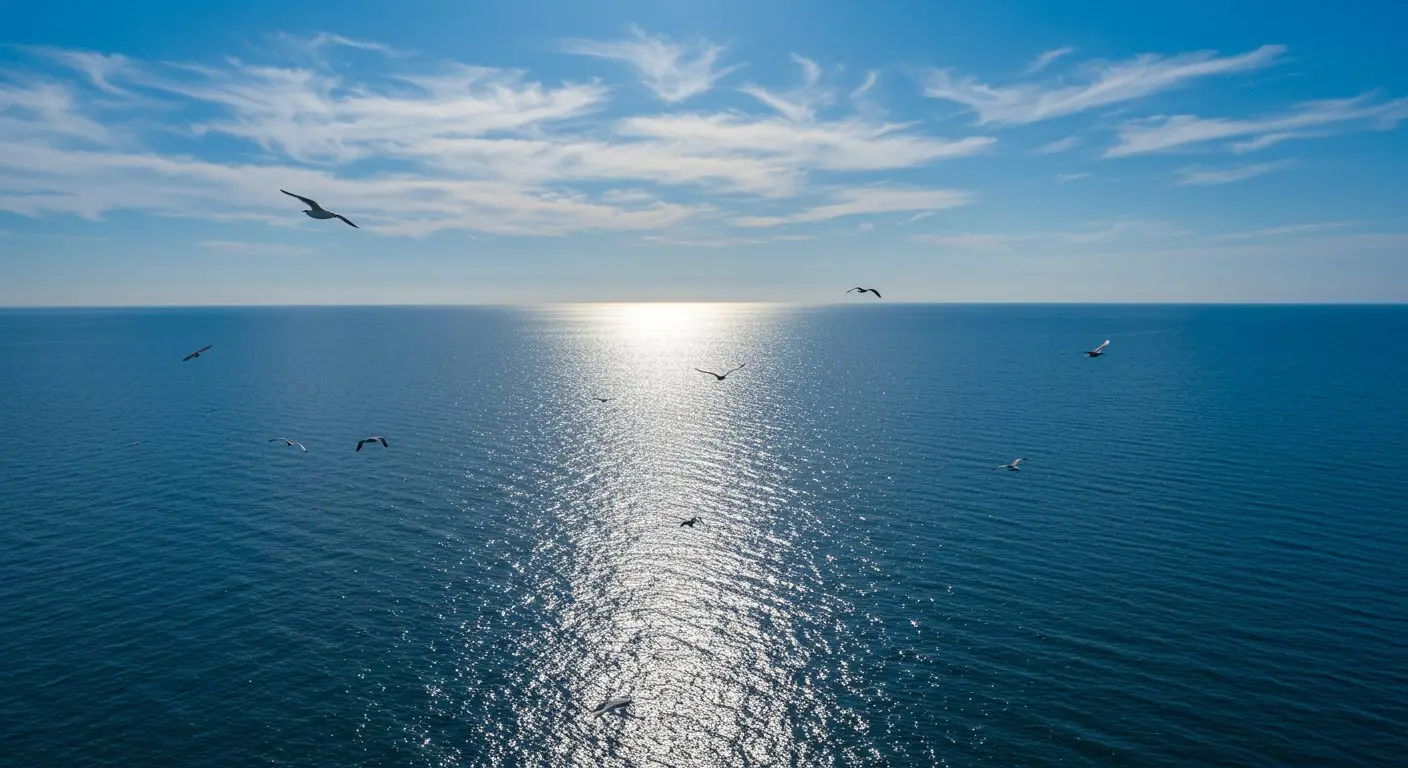
Secure communication across vast distances remains a significant challenge, particularly for underwater systems like those used by submarines. Researchers at the Universidade de Santiago de Compostela, led by Jesús Liñares, Xesús Prieto-Blanco, and Alexandre Vázquez-Martínez, alongside Eduardo F. Mateo from NEC, now present a novel approach to quantum cryptography designed specifically for these challenging environments. Their work details a multichannel hybrid system that extends the reach of secure key distribution beyond the limitations of current quantum key distribution technologies. By combining multiple optical channels and layering additional security measures, the team addresses the unique vulnerabilities of submarine communication, paving the way for more robust and secure underwater networks.
This system envisions each party located on a coastline, leveraging the difficulty of simultaneous access to multiple optical submarine channels. The optical links extending from the coastline to the edge of the continental platform operate under the principles of quantum optics, governed by an autocompensating high-dimensional discrete-modulation continuous variable QKD protocol. This hybrid approach combines several secret keys derived from the multiple channels and introduces additional layers of security, both passive and/or active, to the non-quantum optical links located beyond this continental margin.
Autocompensating DM-CV-QKD for Submarine Links
This research proposes a hybrid Quantum Key Distribution (QKD) approach designed to enhance the security of submarine optical communication networks. It addresses the limitations of current QKD technologies over long distances by combining quantum and classical cryptographic methods, along with physical layer security measures. The system combines high-dimensional, autocompensating Discrete Modulation Continuous Variable QKD (DM-CV-QKD) on continental platforms with classical key processing and distribution over longer distances, leveraging the strengths of both quantum and classical cryptography. Autocompensating techniques aim to reduce the complexity and cost of implementing QKD by minimising the need for precise hardware control and compensation for signal degradation.
Utilizing high-dimensional quantum states increases the key rate and enhances security against eavesdropping. The system proposes various network topologies to distribute keys and create layers of security, and explores additional security layers based on physical phenomena, including passive and active methods for detecting tapping attempts on the buried segments of submarine cables. The system incorporates a quantum layer on continental platforms, where DM-CV-QKD generates secret keys. These keys are then processed and distributed over longer distances using classical communication channels. Multiple layers of security are incorporated, including classical encryption of the keys, strategic network topologies to increase the complexity for an attacker, and physical layer security techniques like Distributed Acoustic Sensing (DAS) and monitoring for optical fiber disturbances to detect tapping attempts.
Passive security is achieved by utilizing the inherent security of buried cables, while active security employs techniques to detect and respond to tapping attempts. Proposed physical layer security methods include utilizing few-mode fibers to detect tapping attempts, employing multi-core fibers to increase the difficulty of tapping, using DAS to detect vibrations caused by tapping attempts, and monitoring for changes in optical fiber characteristics that could indicate tapping. The research aims to create a practical and secure communication system for submarine optical networks, overcoming the distance limitations of current QKD technologies and providing robust protection against eavesdropping and attacks. The hybrid approach, combined with multiple layers of security, offers a promising solution for securing critical underwater communication infrastructure.
Multi-Channel QKD Secures Submarine Communications
This research presents a novel approach to secure communication over long distances, specifically submarine optical links, exceeding the limitations of current quantum key distribution (QKD) systems. The team developed a hybrid QKD method that combines multiple optical channels, leveraging the difficulty of simultaneously accessing them to enhance security. This system is designed for coast-to-coast communication, utilizing the properties of light as it travels through submarine cables and employing advanced techniques to compensate for signal degradation. The core of this advancement lies in a high-dimensional discrete-modulation continuous variable QKD protocol, which allows for the creation of secret keys across multiple channels.
By combining these keys and adding layers of security, the system significantly improves resilience against eavesdropping attempts. Importantly, the research demonstrates that increasing the dimensionality of the encoding process directly increases the security of the key exchange and extends the possible communication distance. The team found that a two-dimensional system outperforms two independent single channels, achieving a higher key rate and greater efficiency. A key innovation is the implementation of an “autocompensating” technique to counteract the disturbances that naturally occur during signal transmission through optical fibers.
Rather than relying on complex active compensation systems, the researchers utilized a passive method involving a Half Wave Plate to restore the quantum states of the signal. This approach simplifies the technology required, making the system more practical and robust. The autocompensation system effectively corrects for polarization disturbances, ensuring the integrity of the quantum signal even over long distances and through challenging environments. The results demonstrate a substantial improvement in secure communication capabilities, offering a pathway to establish highly secure links across vast oceanic distances. By combining multi-channel communication, high-dimensional encoding, and passive quantum state restoration, this research overcomes significant hurdles in long-distance QKD and paves the way for future secure global communication networks.
Hybrid QKD Extends Submarine Communication Range
This hybrid approach addresses the challenges of secure communication over vast distances, where purely quantum methods become impractical. The protocol employs product states of coherent light, transmitted through multiple optical fibres or a multi-core fibre, to encode information and establish a secure key. The authors acknowledge that the practical implementation of this system requires further investigation into the specific physical layers of security applicable to the non-quantum channels. Future work will likely focus on optimising these layers and assessing their resilience against potential attacks.
🗞 Multichannel Hybrid Quantum Cryptography for Submarine Optical Communications
🧠 ArXiv: https://arxiv.org/abs/2508.10521

See today’s quantum computing news on Quantum Zeitgeist for the latest breakthroughs in qubits, hardware, algorithms, and industry deals.