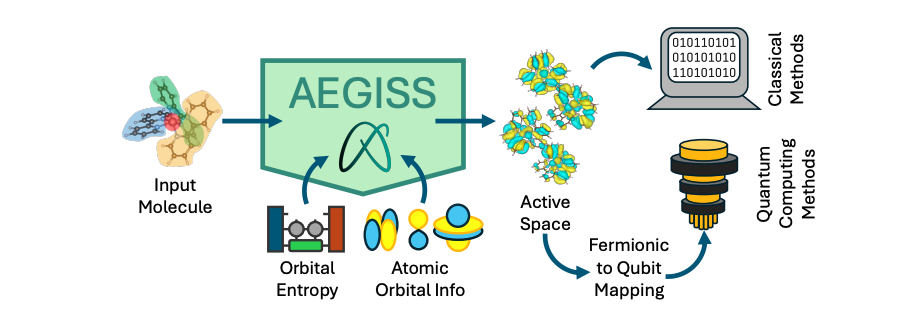
Selecting the appropriate set of orbitals for complex chemical calculations remains a significant challenge in modern quantum chemistry, yet it is crucial for accurately modelling molecules with strong electronic interactions. Fabio Tarocco from the University of L’Aquila, Pi A. B. Haase from Cleveland State University, and Fabijan Pavošević from Algorithmiq Ltd., alongside their colleagues, present a new automated workflow, called AEGISS, designed to address this problem. The team’s method combines analysis of orbital entropy with atomic orbital projections, creating a more robust and flexible way to identify the most important orbitals for calculations. Validating their approach on ruthenium complexes, molecules relevant to photodynamic therapy and known for their complex electronic structure, the researchers demonstrate that AEGISS reliably generates compact and chemically meaningful orbital selections, offering a valuable tool for both traditional chemistry and emerging quantum computing applications.
Active Space Selection for Correlated Systems
Conventional methods for modeling chemical systems face limitations when dealing with strong electron correlation, situations where electrons interact in complex ways, and excited states, hindering accurate predictions for crucial phenomena like photoactivation and bond breaking. While wavefunction-based approaches offer improvements by incorporating electron interactions, they become computationally expensive, scaling rapidly with system size. Multi-reference methods, like CASSCF, address this by focusing on a selected set of important electron orbitals, known as the active space, to build a more accurate description of the electronic structure. However, defining this active space remains a significant challenge, requiring a balance between accuracy and computational feasibility., The selection of an appropriate active space is critical because it directly impacts both the accuracy and efficiency of these calculations. An inadequately chosen active space can lead to inaccurate results, while an overly large space quickly becomes computationally intractable, even with powerful computers.
Researchers have developed various methods to guide this selection, but a unified, robust, and fully automated framework that reliably performs across diverse molecular systems has remained elusive. This is particularly important for complex systems like transition metal complexes, where electron correlation is strong and traditional methods often fail., This research introduces a new approach to active space selection, building upon existing methods like AVAS and AutoCAS. The team’s method integrates orbital entropy analysis, a measure of electron distribution, with projections of atomic orbitals to identify chemically meaningful and physically relevant active spaces. By combining these concepts, the method aims to provide a more consistent and flexible selection process while retaining the benefits of automation and scalability. This allows researchers to focus on the chemistry rather than the intricacies of computational setup., To validate their approach, the researchers applied it to a set of ruthenium complexes, molecules known to exhibit strong electron correlation and structural complexity, and relevant to photodynamic therapy. The results demonstrate that the method reliably identifies compact active spaces that accurately capture the essential physics governing these
Minimal Orbitals Capture Strong Electron Correlation
The team’s innovation addresses a long-standing problem: identifying the minimal set of orbitals needed to capture the essential physics of a molecule without overwhelming computational resources., The method combines two existing strategies, analysing orbital entropy and projecting atomic orbital contributions, into a unified framework. This integration allows for a more consistent and flexible selection of orbitals, ensuring the chosen set is both chemically meaningful and computationally manageable. Validation of the approach focused on ruthenium complexes, molecules known to exhibit strong electron correlation and structural complexity, making them ideal test cases for demanding computational methods. The results demonstrate the method reliably identifies compact active spaces, meaning it can achieve accurate results with a relatively small number of orbitals., This is particularly important as the computational cost of these calculations grows rapidly with the number of orbitals included. By streamlining the selection process, researchers can tackle larger and more complex systems than previously possible. The new method is not only effective but also practical, packaged as a user-friendly tool that integrates seamlessly with both conventional chemistry software and emerging quantum computing platforms. This accessibility broadens the potential impact of the research, allowing a wider community to explore and apply these advanced computational techniques., The development is especially timely given the increasing interest in using quantum computers to solve complex chemical problems. While current quantum hardware has limitations, the ability to efficiently select a relevant active space is crucial for mapping molecular simulations onto qubits, the fundamental units of quantum information. This work represents a significant step towards harnessing the power of quantum computing for tackling previously intractable chemical challenges and designing innovative technologies. The method’s ability to balance accuracy and computational efficiency promises to accelerate progress in fields ranging from materials science to drug discovery
Automated Active Space Selection for Chemistry
This research presents a new method, termed AEGISS, for selecting active spaces in multi-reference electronic structure calculations, a crucial step for accurately modelling complex chemical systems. The method combines analysis of orbital entropy with atomic orbital projections to identify compact and chemically meaningful active spaces, which are essential for capturing the essential physics of molecular systems. Validated on ruthenium complexes relevant to photodynamic therapy, the results demonstrate that AEGISS reliably identifies active spaces suitable for both classical and emerging quantum computing applications., The development of AEGISS addresses a significant challenge in computational chemistry by providing a more automated and flexible approach to active space selection. The authors acknowledge that the size of the resulting Hamiltonian remains a limitation, particularly for quantum simulations, but highlight the potential of their entropy-based pre-screening to guide qubit allocation and reduce computational demands. Future work will likely focus on further refining the method and integrating it seamlessly into quantum computing pipelines, paving the way for more efficient and accurate modelling of complex chemical processes. The code and data supporting this research are publicly available to facilitate further investigation and development within the scientific community
🗞 AEGISS — Atomic orbital and Entropy-based Guided Inference for Space Selection — A novel semi-automated active space selection workflow for quantum chemistry and quantum computing applications
🧠 ArXiv: https://arxiv.org/abs/2508.10671




See today’s quantum computing news on Quantum Zeitgeist for the latest breakthroughs in qubits, hardware, algorithms, and industry deals.