Creating entanglement between distant quantum processors represents a major hurdle in building a practical quantum internet, and researchers are now exploring novel ways to boost the connections between these nodes. Xiaoshui Lin from Washington University, Yefeng Mei from Washington State University, and Chuanwei Zhang from Washington University and University of Texas at Dallas, demonstrate a new architecture that uses cold atomic ensembles as ‘quantum antennas’ to efficiently link arrays of single atoms. This innovative approach overcomes the weak interactions that typically plague long-distance quantum communication, achieving significantly higher entanglement efficiency and generation rates than existing technologies. By combining the strengths of single-atom qubits for processing with the networking capabilities of these cold ensembles, the team’s work offers a promising pathway towards scalable, distributed quantum computing and sensing networks with integrated quantum memory.
Rydberg Ensemble Memory, Detailed Calculations Provided
This supplemental material provides detailed explanations and calculations supporting the main findings of the research, addressing potential concerns about the experimental setup and the validity of the approximations used. It aims to demonstrate the rigor and careful consideration given to the work, building upon previous research demonstrating efficient quantum memory for single-photon polarization qubits and the generation of indistinguishable single photons using Rydberg ensembles. This demonstrates a strong understanding of the underlying physics. The authors address potential interactions between atoms within the ensemble, acknowledging that the main text simplifies the model by considering only the interaction between a communication atom and the ensemble as a whole.
They argue that these internal interactions are negligible due to a large detuning and the limited number of Rydberg excitations, and that the Rydberg blockade effect is not essential given the ensemble size. This justification strengthens the validity of the simplified model, and they model the probability of an atom escaping the optical trap, finding it to be very small, demonstrating well-controlled experimental conditions and a reliable quantum memory. Overall, this supplemental material is thorough and well-written, providing clear explanations and calculations to support the research claims. This level of detail is essential for convincing reviewers and readers of the work’s rigor and careful consideration.
Entangling Atoms via Collective Atomic Emission
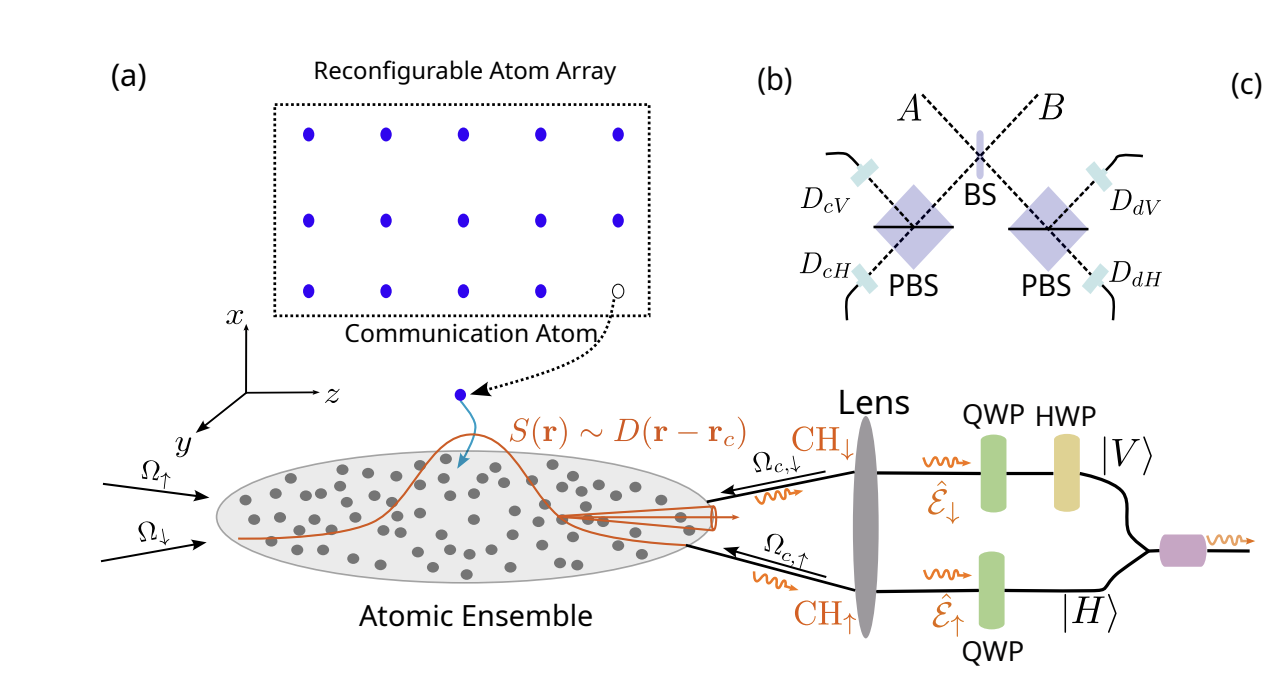
Researchers have developed a novel approach to distributed quantum networking that utilizes cold atomic ensembles as “quantum antennas” to interface single-atom qubits, overcoming limitations inherent in traditional methods. This architecture addresses the challenge of weak atom-light coupling by leveraging the strong interaction between atoms and light within the ensembles, conceptually functioning like radio antennas in classical communication, efficiently transmitting quantum information between nodes. The core innovation lies in establishing entanglement not directly between atoms, but between atoms and the ensembles, then using photons to connect the ensembles across distances. This process begins by entangling a single “communication atom” with the atomic ensemble, effectively converting the atom’s quantum state into a collective excitation within the ensemble.
This excitation is then retrieved as a photon, acting as a carrier of quantum information. By repeating this process at both ends of a potential quantum link, researchers can establish a pathway for remote entanglement. The team estimates a probability of around 6% for successfully entangling remote atom qubits, a performance comparable to, and in some cases exceeding, existing technologies. Furthermore, the researchers estimate a remote entanglement generation rate of approximately 16. 6 kHz, significantly higher than rates achieved with alternative approaches. This improvement stems from optimizing the entire process, including minimizing heating effects and incorporating periodic state preparation and cooling cycles, demonstrating a pathway towards scalable and efficient distributed quantum networking.
Efficient Entanglement Distribution Using Atomic Antennas
Researchers have developed a novel approach to building a distributed quantum network, utilizing the unique properties of both single atoms and larger atomic ensembles to efficiently create entanglement over significant distances. This system functions by employing cold atomic ensembles as “quantum antennas”, effectively bridging the connection between individual atom-based qubits and flying photons, the particles that carry quantum information. The design overcomes limitations found in traditional methods, where weak interactions between atoms and light hinder the reliable distribution of entanglement. The core of this advancement lies in the ability to create strong, efficient links between single atoms and the atomic ensembles.
By carefully controlling laser interactions, the team demonstrates a high probability of successfully preparing the system for entanglement, achieving efficiencies approaching 99% in initial stages. This process doesn’t rely on techniques like Rydberg blockade, offering greater flexibility in experimental design. The system then converts this atomic state into a single photon, effectively encoding the quantum information for transmission. Crucially, this method allows for the generation of entanglement between two distant atomic nodes at a rate of kilohertz, significantly outperforming existing technologies.
Comparative analysis reveals that this quantum antenna approach offers a substantial improvement in both the probability of successful entanglement and the speed at which it can be established. Furthermore, the system incorporates a quantum memory, enabling the storage of quantum information and enhancing its potential for use in complex quantum repeater designs. This combination of efficient entanglement generation and robust storage represents a significant step towards building scalable, long-distance quantum communication networks and distributed quantum computing.
Neutral Atoms Achieve High-Speed Entanglement Networking
This research presents a novel quantum network architecture that utilizes neutral atoms as both memory and communication qubits, coupled with atomic ensembles functioning as quantum antennas. By combining these elements, the team demonstrates a high entanglement generation rate of 16. 6 kHz, exceeding the performance of existing methods. This approach offers advantages in simplicity, tunability, and experimental accessibility, while also integrating a long-lived quantum memory to mitigate link delays and enhance performance. The demonstrated architecture paves the way for scalable distributed quantum computing and sensing by effectively bridging local qubit operations with long-distance networking. While acknowledging that practical entanglement rates are affected by atom preparation and cooling cycles, the team highlights the potential for further improvements through the use of higher Rydberg states or shortcuts-to-adiabaticity protocols. Future work could extend the architecture to incorporate multiple communication atoms, enabling larger-scale quantum computation, and the incorporation of a bad cavity to further optimize photon generation.
🗞 Cold atomic ensembles as quantum antennas for distributed networks of single-atom arrays
🧠 ArXiv: https://arxiv.org/abs/2508.08439


See today’s quantum computing news on Quantum Zeitgeist for the latest breakthroughs in qubits, hardware, algorithms, and industry deals.