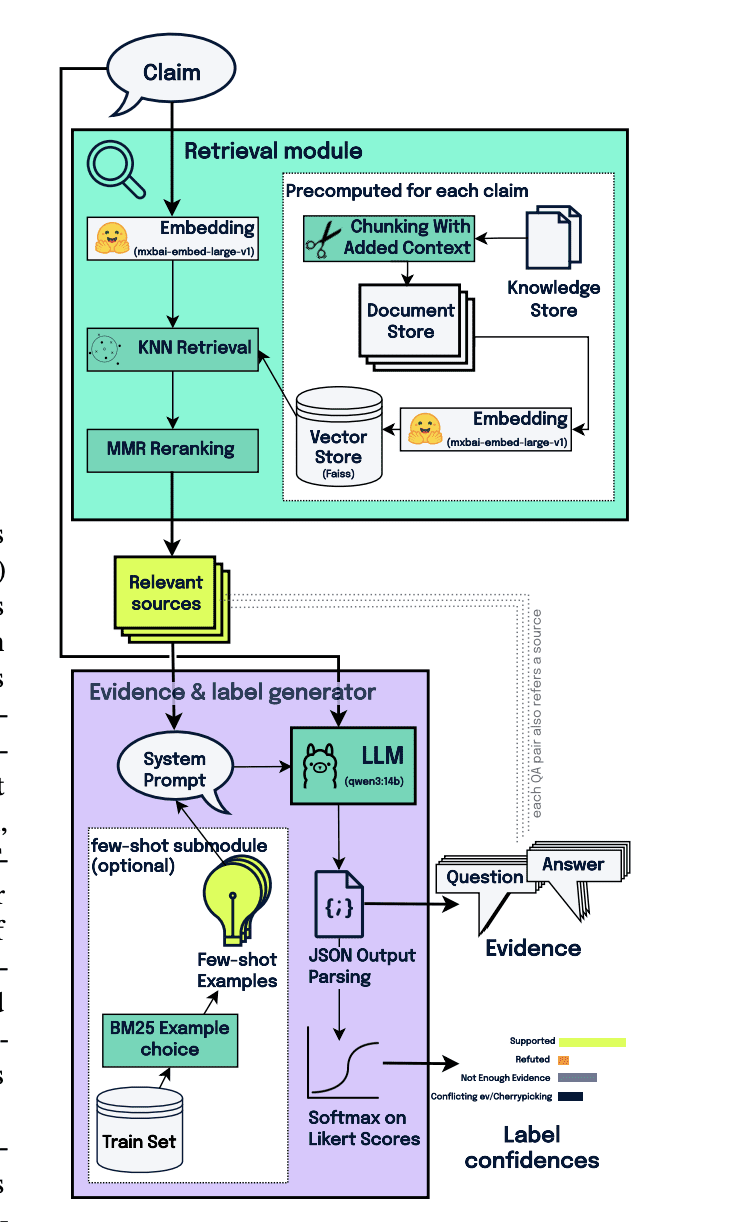
Automated fact-checking represents a crucial step towards combating misinformation, and a new system developed by Herbert Ullrich and Jan Drchal at the AI Center @ CTU FEE achieves state-of-the-art performance in this challenging field. Their research details a streamlined fact-checking pipeline, building on previous work, that successfully verifies claims using a technique called Retrieval-Augmented Generation. Importantly, the team demonstrates that this high level of accuracy can be achieved even with limited computational resources, running effectively on a single graphics card within a strict time constraint. This on-premise capability, unlike many cloud-dependent systems, significantly expands the potential for widespread, accessible fact-checking applications and represents a substantial advance in the field.
The pipeline can be redeployed on-premise, achieving state-of-the-art fact-checking performance even with the constraint of a single Nvidia A10 GPU, 23GB of graphical memory and 60 seconds of running time per claim. Recent advancements, such as the Automated Verification of Textual Claims (AVeriTeC) shared task, demonstrate that automated fact-checking of real-world claims is increasingly viable, addressing the growing need to combat misinformation and ensure information accuracy in today’s digital landscape.
Retrieval-Augmented Generation for Automated Fact Verification
This research presents a system, AIC CTU, designed for automated fact verification, demonstrating that a relatively simple Retrieval-Augmented Generation (RAG) approach can achieve strong performance. The system relies on a RAG pipeline, retrieving relevant documents as evidence from a knowledge source and then using a Large Language Model (LLM) to generate a verification response. The authors primarily use Qwen3, a powerful open-source LLM, highlighting its reasoning capabilities. A crucial aspect of their approach is a carefully designed system prompt, instructing the LLM to formulate questions to validate the claim, answer those questions using the retrieved evidence, and evaluate the veracity of the claim, assigning a rating of Supported, Refuted, Not Enough Evidence, or Conflicting Evidence.
The system incorporates few-shot learning, providing the LLM with example question-answer pairs to guide its reasoning, and experimented with “thinking tokens” to encourage explicit articulation of the reasoning process. The results demonstrate that the AIC CTU system achieves competitive results on the AVeriTeC and FEVER datasets, highlighting the reasoning abilities of the Qwen3 LLM. This research has significant implications, as the simplicity of the approach makes it more accessible to researchers and developers with limited resources. The use of an open-source LLM promotes transparency and reproducibility, reinforcing the effectiveness of the RAG paradigm for knowledge-intensive tasks like fact verification.
Fact Verification Achieves Leading Performance with RAG
The research team developed a fact-checking system that achieved first place in the FEVER 8 shared task, demonstrating that a streamlined RAG pipeline, optimized for efficient resource utilization and large context processing, can achieve leading performance in automated fact verification. The system efficiently retrieves and re-ranks information from a knowledge store, selecting the most relevant sources to support its fact-checking process. The system outperformed other submissions, including a strong baseline, despite its relatively simple design, achieving a new AVeriTeC score of 0. 50, a significant margin above the second-place competitor.
This suggests the system possesses strengths particularly well-suited to the specific characteristics of the unseen test data. While the inclusion of “thinking tokens” did not demonstrably improve performance, the system’s overall architecture proved highly effective. The system’s success highlights the importance of both effective information retrieval and the ability to leverage large language models for complex reasoning tasks, offering a promising approach for tackling the growing challenge of misinformation.
Efficient Fact Verification with Retrieval Generation
This research presents a fact-checking pipeline that achieved first place in the FEVER 8 shared task, demonstrating strong performance under computational constraints. The system employs a retrieval-augmented generation (RAG) approach, successfully combining information retrieval with a large language model to verify claims, and the team has released the code and resources needed to reproduce their submission. The success of the pipeline is attributed to the use of document-level retrieval and the strategic deployment of a large language model that effectively utilizes available computational resources. The authors acknowledge limitations, emphasizing that the system is intended to assist, not replace, human fact-checkers and that it reflects the biases present in the training data. Future work could explore integrating live search APIs to enhance real-world applicability and further investigate differences between scoring methods to refine both the system and evaluation metrics.
🗞 AIC CTU@FEVER 8: On-premise fact checking through long context RAG
🧠 ArXiv: https://arxiv.org/abs/2508.04390
See today’s quantum computing news on Quantum Zeitgeist for the latest breakthroughs in qubits, hardware, algorithms, and industry deals.