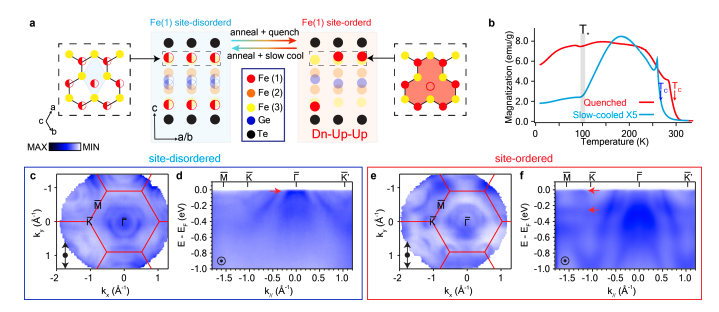
Flat bands, regions in a material where electrons have limited movement, represent a fertile ground for discovering new quantum phenomena, and researchers are increasingly focused on harnessing their unique properties. Han May, Birgeneau, and colleagues at the University of California, Berkeley, alongside Pengcheng Dai from Rice University and Xiaodong Xu from the University of Washington, now report the surprising discovery of two distinct types of these flat bands existing within the same material, the van der Waals ferromagnet FeGeTe. This is significant because flat bands typically arise from fundamentally different mechanisms, and have, until now, only been observed in separate materials, hindering direct comparison. By carefully examining FeGeTe, the team demonstrates that these contrasting flat bands originate from either strong electron interactions or geometrical frustration, offering a unique opportunity to explore how flat bands influence magnetism, topology, and other complex material properties, with the arrangement of iron atoms acting as a crucial control parameter.
Kagome Lattices and 2D Magnetic Heterostructures
This research investigates two-dimensional materials and structures created by stacking them, known as van der Waals heterostructures, with a focus on magnetism and achieving room-temperature ferromagnetism, crucial for future technologies. Researchers explore materials with Kagome lattice structures, characterized by corner-sharing triangles, as these lattices exhibit unique electronic and magnetic properties and often display strong interactions between electrons, leading to complex behaviors. The team investigates compounds containing iron, germanium, and tellurium, alongside materials exhibiting topological properties, where electrons behave in unusual ways. They employ neutron diffraction, a technique that reveals atomic arrangement and magnetic order, alongside angle-resolved photoemission spectroscopy, which maps the electronic structure, and apply machine learning to automate data analysis. Key findings include the discovery of materials exhibiting robust room-temperature magnetism and the identification of unique electronic states within Kagome lattices, alongside studies of how phases like charge density waves interact with magnetism and superconductivity. The stacking order of layers in van der Waals materials is found to significantly influence their properties, aiming to understand and control these interactions to develop new materials with tailored electronic and magnetic characteristics.
Two Flat Bands Observed in Single Material
Researchers have successfully observed and directly compared two distinct types of flat bands within a single van der Waals ferromagnet composed of iron, germanium, and tellurium. Flat bands are electronic states where electrons have very limited movement, potentially leading to exotic electronic behaviors, and traditionally arise through different mechanisms. This research demonstrates that both types of flat bands can coexist within the same material by controlling the arrangement of iron atoms, exhibiting two phases: one with ordered iron atoms and another with randomized positions. The ordered phase gives rise to flat bands created by geometrical frustration, while the disordered phase produces flat bands stemming from strong electron interactions, allowing for a side-by-side comparison of their spectral properties. The observed differences in how these flat bands evolve with temperature provide crucial insights into their origins, with electron interaction-driven flat bands exhibiting localized electron behavior and geometrically-driven flat bands displaying characteristics of freely moving electrons, clarifying their roles in influencing the material’s electronic properties and opening avenues for designing materials with tailored electronic behaviors.
Switchable Flat Bands Control Magnetism and Electrons
This research demonstrates the observation of two distinct types of flat bands within a single van der Waals ferromagnet, where flat bands are electronic states with limited electron movement. One type originates from strong interactions between electrons, leading to localized behavior, while the other stems from the geometrical arrangement of atoms within the material’s structure, and researchers were able to switch between these types of flat bands by controlling the ordering of iron atoms. The discovery highlights the significant role of flat bands in influencing material properties, particularly in relation to magnetism and electronic behavior, with the flat band arising from electron interactions exhibiting altered energy levels and reduced coherence with decreasing temperature, while the geometrically-driven flat band maintains coherence and splits into spin-up and spin-down states as the material becomes ferromagnetic. This control over flat band formation offers a pathway to understanding and potentially tailoring materials with specific magnetic and electronic characteristics, and further research is needed to fully explore the implications of these findings, particularly regarding the interplay between flat bands, topology, and lattice geometry, potentially leading to the development of novel electronic devices.
🗞 Dichotomy of flat bands in the van der Waals ferromagnet Fe GeTe
🧠 ArXiv: https://arxiv.org/abs/2508.03029




See today’s quantum computing news on Quantum Zeitgeist for the latest breakthroughs in qubits, hardware, algorithms, and industry deals.