Superconducting circuits are becoming increasingly complex as researchers strive to build more powerful quantum computers, and understanding how these components interact is crucial for success. Oleh Ivakhnenko from the B. Verkin Institute, Christoforus Dimas Satrya and Yu-Cheng Chang from Aalto University, and colleagues demonstrate a detailed investigation into a superconducting circuit strongly linked to a quantum resonator. The team’s experiments reveal how strong interactions between these components distort energy levels, leading to quantum interference effects that differ from previously understood behaviour, specifically deviating from standard Landau-Zener-Stückelberg-Majorana interferometry. This research provides valuable insight into the behaviour of complex quantum systems and represents a step forward in designing and controlling the building blocks of future quantum technologies.
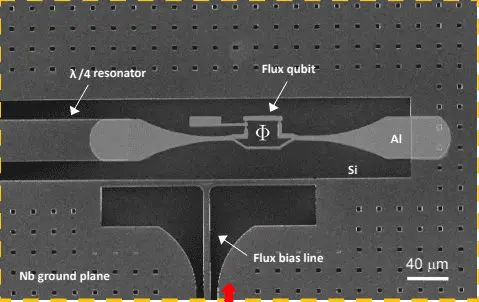
Researchers investigated a strongly driven qubit strongly connected to a quantum resonator, revealing how their interaction alters expected quantum behaviour. The measured system comprised a superconducting flux qubit coupled to a coplanar-waveguide resonator, probed with a weak signal. Observations and theoretical descriptions focused on quantum interference effects, which deviate from typical single-qubit behaviour because the strong coupling significantly distorts the qubit’s energy landscape.
Superconducting Qubit Control and Circuit Interactions
This body of work comprehensively explores superconducting qubits, quantum circuits, and related phenomena. It focuses on superconducting qubits, particularly flux and transmon qubits, covering their fabrication, control, and coherence properties. A central theme is circuit quantum electrodynamics (cQED), which examines the coupling of qubits to resonators, enabling amplification, control, and exploration of quantum interactions. The research extensively covers non-adiabatic transitions and Landau-Zener-Stückelberg-Majorana (LZSM) interferometry, utilizing rapid parameter changes to induce transitions between qubit states and create interference effects for quantum control and logic.
Further investigations explore Floquet engineering, employing time-periodic driving to manipulate qubit states and create novel quantum phenomena, and quantum thermodynamics, focusing on building quantum heat engines and refrigerators. The collection also details quantum control and measurement techniques, alongside studies of open quantum systems and the effects of noise on qubit performance. Quantum simulation, using superconducting qubits to model other quantum systems, is a recurring theme, alongside the importance of software tools like the QuTiP Python framework for simulating and analysing quantum circuits. Detailed studies cover qubit fundamentals and fabrication, including techniques for improving qubit coherence and control.
Investigations into qubit-resonator interactions explore strong coupling regimes, amplification, and quantum non-demolition measurements. A key focus lies on LZSM interferometry, analysing interference patterns, implementing quantum logic gates, and exploring topologically protected qubits. Research into quantum thermodynamics includes building and analysing quantum heat engines and refrigerators, studying heat transfer, and measuring entropy production. The work also explores Floquet theorem, time-periodic driving, and effective Hamiltonians for driven quantum systems. The collection suggests potential research directions, including improving the robustness of LZSM-based gates, developing scalable architectures for LZSM circuits, combining superconducting qubits with other quantum systems, and developing quantum error correction codes. Further research could focus on quantum metrology, quantum sensing, exploring novel driving schemes, and developing more efficient quantum heat engines and refrigerators. This comprehensive collection reflects the vibrant and rapidly evolving field of superconducting qubits and quantum information processing, highlighting the importance of LZSM interferometry and pointing to exciting new research directions in quantum thermodynamics, simulation, and sensing.
Rabi Splitting Reveals Strong Qubit-Resonator Coupling
Researchers have demonstrated strong interaction between a superconducting qubit and a quantum resonator, revealing quantum interference effects that differ from previously observed phenomena. The team investigated a system where a qubit is strongly coupled to a resonator, driven by both a magnetic flux and a weak probe signal. This strong coupling distorts the energy levels of the system, leading to unique interference patterns not seen in traditional interferometry. The experiments reveal a clear interaction between the qubit and resonator, evidenced by a shift in the resonator’s resonance frequency when the qubit is activated.
Specifically, the team observed a splitting of the resonance, known as Rabi splitting, with a coupling strength of approximately 177 MHz. This indicates a substantial energy exchange between the qubit and the resonator. Theoretical modelling accurately reproduces these experimental findings, confirming the validity of the approach and allowing for detailed analysis of the system’s behaviour. Further investigation involved sweeping the driving power and probe frequency, revealing how the qubit population changes and affects the resonance. At higher driving powers, the qubit becomes overpopulated, shifting the resonance back to its original frequency, a phenomenon successfully replicated in simulations.
Two-tone spectroscopy confirmed the interaction of qubit energy levels with the resonator, demonstrating that the qubit energy follows a predictable parabolic curve and intersects the resonator energy at a specific frequency. Importantly, the team observed that the shape of the resonance lines differs between transmission measurements and the qubit’s population level, a direct consequence of the quantum coupling. This subtle difference highlights the complex interplay between the qubit and resonator. The research provides a foundation for understanding and controlling strongly coupled qubit-resonator systems, potentially paving the way for novel quantum technologies such as quantum heat engines and refrigerators where strong coupling is a key requirement. The theoretical framework developed in this work accurately describes the system’s behaviour and can be used to optimize performance in these emerging applications.
Strong Coupling Alters Quantum Interference Patterns
This research investigates the interaction between a strongly driven flux qubit and a quantum resonator, demonstrating quantum interference effects that differ from standard predictions. The team measured the transmission of signals through this hybrid system, observing deviations from typical interferometry due to the strong coupling between the qubit and resonator. These differences are particularly noticeable at lower driving field amplitudes, where the impact of strong coupling dominates. The study successfully employs an ‘instant adiabatic basis’, a theoretical approach that accounts for the system’s response to driving forces, to achieve good agreement between experimental results and simulations. Precise calibration of theoretical parameters was achieved through qubit spectroscopy, and increasing the coupling strength was shown to further distort the system’s resonances. This work provides a framework for understanding the behaviour of strongly coupled qubit-resonator systems, potentially paving the way for applications such as quantum heat engines and refrigerators operating in this regime.
🗞 Probing strongly driven and strongly coupled superconducting qubit-resonator system
🧠 ArXiv: https://arxiv.org/abs/2508.03188




See today’s quantum computing news on Quantum Zeitgeist for the latest breakthroughs in qubits, hardware, algorithms, and industry deals.