The pursuit of artificial intelligence increasingly demands specialised hardware capable of handling vast, complex datasets, yet conventional computer technology faces limitations in scalability and energy efficiency. Soumen and colleagues, at institutions including [institution names not provided in source], address this challenge by developing novel electronic devices based on the interfaces between oxide materials. Their research demonstrates that manipulating electrons within layered structures of lanthanum aluminate and strontium titanate creates devices exhibiting multiple functionalities, acting as both transistors, memristors, and memcapacitors, within a single component. This breakthrough enables the creation of circuits that mimic the behaviour of biological synapses, offering potential for energy-efficient computing and advanced applications such as complex decision-making tasks and real-time data processing in healthcare, ultimately paving the way for a new generation of scalable, silicon-compatible AI hardware.
Memristive Logic Circuits with Persistent States
Researchers have created circuits using memristors and transistors that perform logic operations while also retaining memory of those operations. These circuits can perform AND, OR, and NOT functions, and importantly, they remember the last state, enabling more complex functionality than traditional logic gates. This ability to mimic synaptic plasticity, the way connections between brain cells strengthen or weaken, suggests potential applications in neuromorphic computing, a field aiming to build computers inspired by the human brain. By controlling input pulse characteristics, the team successfully transitioned between short-term and long-term memory states.
The team demonstrated that the memristor’s response can be tuned to control its switching behavior. Circuits were also created to perform OR and AND operations, and the memory effect was confirmed in a two-transistor-one-memristor circuit. This work utilizes memristors, resistive switching devices that retain information about past resistance, and transistors, which amplify or switch electronic signals. The research contributes to the growing field of neuromorphic computing and demonstrates the potential for creating more efficient and versatile electronic circuits.
Polymorphic Circuits from Oxide Heterostructures
Researchers have developed a new approach to computing hardware by leveraging the unique properties of oxide materials, specifically the interface between lanthanum aluminate and strontium titanate. This heterostructure allows for the creation of devices exhibiting multiple electronic functions, including transistor, memristor, and memcapacitor behavior, within a single platform. By manipulating electron flow using lateral gates, the team programmed the device to behave in different ways, creating a versatile building block for complex circuits. A key innovation is the ability to combine these functionalities, enabling both short-term and long-term memory within the same system.
This is achieved by integrating transistor and memcapacitor elements, resulting in circuits that exhibit non-linear behavior and can store information temporarily, mimicking aspects of biological synapses. Further integration of memristors with transistors allows for more complex operations, including logic functions and the storage of logical outputs. The researchers designed circuits capable of performing reconfigurable synaptic logic, allowing for complex decision-making processes, such as patient monitoring in healthcare applications. By building circuits directly within the oxide material, the team avoids the need for separate components and connections, leading to a more compact, energy-efficient, and scalable computing platform. This approach offers a promising alternative to traditional computing architectures, potentially overcoming limitations in energy efficiency and scalability.
Single Material Exhibits Transistor, Memristor, Memcapacitor Functionality
Researchers have developed a new type of electronic device based on a layered structure of lanthanum aluminate and strontium titanate. This device exhibits the remarkable ability to function as three different electronic components, a transistor, a memristor, and a memcapacitor, all within a single physical structure. This versatility stems from manipulating the flow of electrons at the interface between the two materials using precisely positioned side-gates. The device operates effectively at room temperature, overcoming a limitation of many similar technologies that require extremely cold conditions.
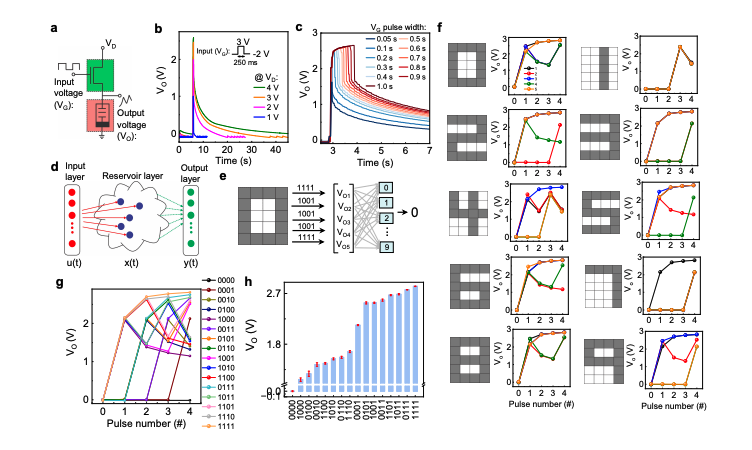
When configured as a transistor, it demonstrates the ability to control the flow of electrical current. Switching to memristor mode, the device exhibits a high resistance ratio, indicating a strong ability to ‘remember’ its previous state. Furthermore, the device displays a distinct hysteresis effect in its capacitance, meaning its ability to store electrical charge changes depending on its history, a characteristic crucial for memory applications. Researchers have successfully demonstrated its use in reservoir computing, a type of non-conventional computation inspired by the human brain, by integrating the transistor and memcapacitor functionalities. Crucially, they have also created a circuit combining transistors and memristors capable of performing logic operations, AND and OR gates, while simultaneously storing the results within the circuit itself, a concept known as ‘logic-in-memory’. This reconfigurable logic-in-memory capability allows for complex decision-making tasks, such as patient monitoring in healthcare, and represents a significant step towards more efficient and powerful computing systems.
Oxide Interfaces Enable Multifunctional Circuitry
This research demonstrates the creation of polymorphic electronic devices based on oxide interfaces, offering functionalities typically associated with transistors, memristors, and memcapacitors within a single platform. By manipulating the flow of electrons at the interface between lanthanum aluminate and strontium titanate, the team successfully built circuits exhibiting both short-term and long-term memory, alongside logic operations. Notably, an integrated circuit incorporating these functionalities was used to model complex decision-making processes, such as those relevant to patient monitoring in healthcare. These findings represent a step towards more efficient and versatile electronic systems, potentially overcoming limitations associated with conventional silicon-based technology. The devices are compatible with existing silicon manufacturing processes and offer a path towards monolithic integration, reducing energy consumption and increasing circuit density.
🗞 Oxide Interface-Based Polymorphic Electronic Devices for Neuromorphic Computing
🧠 ArXiv: https://arxiv.org/abs/2508.03515



See today’s quantum computing news on Quantum Zeitgeist for the latest breakthroughs in qubits, hardware, algorithms, and industry deals.