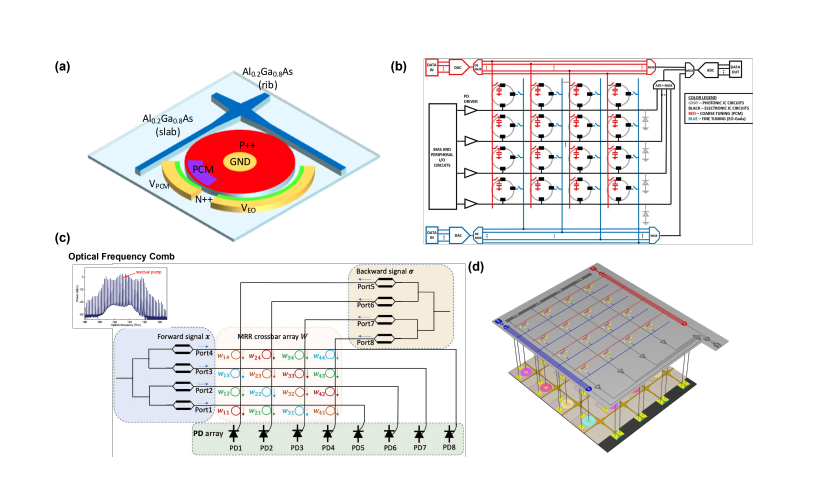
Photonic computing promises to revolutionise data processing, and a team led by Georgios Charalampous from University of California Davis, Rui Chen from University of Washington, and Mehmet Berkay On from University of California Davis, now demonstrates a significant step towards that future. Researchers have developed a new approach to in-memory computing using three-dimensional electronic-photonic integrated circuits, achieving unprecedented precision and scalability. This innovative system combines phase-change materials with advanced silicon photonics to perform complex calculations with exceptional energy efficiency, exceeding 12-bit precision and potentially handling over a million operations simultaneously. By leveraging light instead of electrons, the team’s design overcomes limitations of traditional computing, offering a pathway to solve high-dimensional scientific problems far more quickly and efficiently than currently possible.
This paper proposes a revolutionary photonic in-memory computing architecture that addresses fundamental limitations of traditional von Neumann computers, particularly for applications requiring massive parallelism like neural networks and partial differential equation (PDE) solvers. The authors aim to overcome the inefficiencies of centralized processing architectures by developing 3D-integrated photonic-electronic circuits that leverage the inherent speed and parallelism of light-based computation. The system targets applications with strict latency and energy constraints, such as autonomous systems and supersonic flows, where current solutions like Physics-Informed Neural Networks can take over 20 hours to train on high-performance GPUs.
The core innovation centers on hybrid Phase-Change-Material (PCM) AlGaAs memory resonators that enable mixed-precision computing through a novel two-tier approach. The PCM layer (using materials like Sb2S3) provides non-volatile, coarse-precision tuning (5-bit MSB) through phase transitions between amorphous and crystalline states, while the electro-optic AlGaAs p-i-n structure enables fine-precision volatile tuning (8-bit LSB) through voltage bias. This combination achieves over 12-bit precision with minimal optical loss (0.01 dB/cm) and high Q-factors (>10^6), addressing the critical challenge of maintaining both high precision and low power consumption in photonic computing systems.
The system architecture employs a crossbar configuration of
The system architecture employs a crossbar configuration of PCM-AlGaAs mem-resonators integrated with CMOS electronic circuits through Direct Bond Interconnect (DBI®) technology. The design incorporates optical frequency comb (OFC) sources generating multiple wavelengths (32+ combs) at high efficiency (>65% conversion), wavelength interleavers for signal multiplexing, and sophisticated electronic control circuits including DACs, ADCs, and trans-impedance amplifiers. The modular scaling approach enables expansion from basic 32×32 tensor cores to massive 1024×1024 arrays through wavelength, spatial, and temporal domain multiplexing, with the tensor-train decomposition method reducing component count by 582 times compared to fully-connected architectures.
The proposed system targets unprecedented performance metrics: precision exceeding 12-bits, scalability beyond 1024×1024 array dimensions, extreme parallelism supporting over 1 million parallel processes, and ultra-low power consumption of less than 1 Watt per PetaOPS. These specifications represent orders of magnitude improvement over current electronic and photonic computing systems. The architecture is specifically designed for scientific computing applications, particularly PDE solvers, where the mixed-precision iterative refinement approach can dramatically accelerate computations while maintaining accuracy. If successful, this technology could enable real-time processing for critical applications like autonomous vehicle safety verification and complex fluid dynamics simulations that are currently computationally prohibitive.
👉 More information🗞Mixed Precision Photonic Computing with 3D
🗞 Mixed Precision Photonic Computing with 3D Electronic-Photonic Integrated Circuits
🧠 ArXiv: https://arxiv.org/abs/2508.03063
See today’s quantum computing news on Quantum Zeitgeist for the latest breakthroughs in qubits, hardware, algorithms, and industry deals.