Coherent anti-Stokes Raman scattering (CARS) imaging provides label-free chemical contrast, making it a powerful technique across physics and biology, but its ultimate resolution limits have remained unclear. Giacomo Sorelli from Fraunhofer IOSB, Manuel Gessner from the Instituto de Física Corpuscular, and Frank Schlawin, affiliated with both the Max Planck Institute for the Structure and Dynamics of Matter and the University of Hamburg, investigate these fundamental limits by applying principles from information theory. Their work identifies optimal measurement strategies, demonstrating that existing techniques like spatial mode demultiplexing can significantly improve imaging sensitivity, and introduces a novel imaging scheme using vortex beams predicted to enhance resolution and information content further. These findings establish a clear pathway for advancing nonlinear imaging, bridging current microscopy capabilities with emerging technologies and promising substantial improvements in image clarity and analytical power.
CARS Source Separation Using Fisher Information
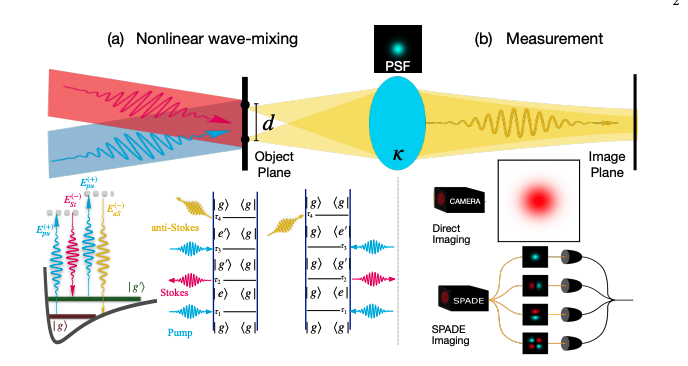
This research investigates the fundamental limits of determining the separation between two closely spaced sources using coherent anti-Stokes Raman scattering (CARS) microscopy. Researchers focused on quantifying the information contained within the detected signal to establish the ultimate precision achievable in these measurements. The study compares different measurement strategies, evaluating how effectively they can pinpoint the distance between these sources. The investigation centres on comparing direct detection of the signal with a more sophisticated technique called spatial-mode demultiplexing (SPADE).
SPADE separates the light into different spatial modes, effectively capturing more information about the sample. Using a theoretical framework based on Fisher Information and Quantum Fisher Information, the team assessed the performance of each strategy, with the Quantum Fisher Information representing the absolute maximum precision possible. The results demonstrate that SPADE is an optimal measurement strategy, capable of achieving the same precision as the Quantum Fisher Information when a sufficient number of spatial modes are measured. This means SPADE extracts the maximum possible information from the signal, providing the most accurate estimate of the source separation. The study highlights the importance of aligning the measurement basis, such as the spatial modes, with the sources to maximise information capture. This rigorous theoretical analysis provides valuable insights into the limits of precision in CARS microscopy. It demonstrates the potential of SPADE as a powerful tool for high-resolution imaging and sensing, with implications for biological imaging and materials science.
Information Limits in CARS Microscopy
Researchers explored the fundamental limits of resolution in CARS microscopy, a powerful technique for label-free chemical imaging. Recognizing that the wave nature of light limits conventional methods, the team sought strategies to surpass these boundaries and achieve higher resolution by analyzing how information is encoded in the emitted light signal. The investigation focused on optimizing light detection, moving beyond simple intensity measurements to exploit the full potential of light’s properties. Specifically, the researchers explored spatial mode demultiplexing (SPADE), a technique that separates light into different spatial modes, effectively increasing the amount of information captured and significantly improving sensitivity.
This method is readily implementable with current experimental setups. Building on this, the team proposed an innovative imaging scheme utilizing vortex beams, light beams with a twisted phase, predicted to enhance the information content of the final light state, leading to both higher resolution and improved sensitivity. By applying these quantum-inspired approaches, the researchers aim to push the boundaries of microscopy and unlock new possibilities for visualizing complex biological and material systems.
CARS Imaging Reaches Quantum Precision Limits
CARS microscopy is a widely used imaging technique because it provides chemical contrast without requiring labels. Researchers have now investigated the fundamental limits of precision in CARS imaging using principles from information theory, revealing pathways to significantly enhance its capabilities. They demonstrate that current experimental techniques, specifically spatial mode demultiplexing, can already achieve these theoretical limits and even improve upon the sensitivity of conventional imaging methods. The study establishes a framework for understanding how much information can be extracted from the CARS signal, considering the quantum nature of light and matter.
By treating the imaging process as a parameter estimation problem, the team identified optimal measurement strategies to distinguish between closely spaced molecular emitters. Their analysis reveals that subdiffraction imaging, achieving resolution beyond the classical diffraction limit, is indeed possible when using shaped light beams, such as vortex beams, to illuminate the sample. Importantly, the research highlights the benefits of spatial mode demultiplexing, a technique that analyzes the different spatial modes of light. This approach was shown to enhance signal strength and robustness, offering a practical way to improve existing CARS microscopes without requiring major hardware changes. Compared to standard intensity measurements, spatial mode demultiplexing provides a substantial advantage in resolving closely spaced structures.
CARS Imaging Precision Limits and Enhancement Strategies
This research establishes fundamental precision limits for CARS microscopy, a label-free technique widely used in multiple scientific disciplines. By applying principles from information theory, the study identifies optimal measurement strategies. It demonstrates that spatial mode demultiplexing, a technique already available in current experimental setups, can improve the sensitivity of conventional CARS imaging. Furthermore, the team proposes an advanced imaging scheme utilizing vortex beams, predicting that this approach will enhance image information and achieve even higher resolution and sensitivity. These findings bridge the gap between established microscopy methods and emerging optical quantum technologies, offering a clear path for enhancing nonlinear imaging techniques.
The research also reveals that the CARS signal behaves as a coherent state, consistent with theoretical expectations, and suggests this principle extends to other nonlinear coherent imaging techniques like second- and third-harmonic generation. While acknowledging the current study focuses on coherent excitation scenarios, the authors highlight the potential for future research to explore the use of nonclassical states of light, which could offer new opportunities for signal extraction and background suppression. Further experimental validation is needed to fully realize the potential of these advanced techniques in practical applications.
🗞 Ultimate resolution limits in coherent anti-Stokes Raman scattering imaging
🧠 ArXiv: https://arxiv.org/abs/2508.01026
See today’s quantum computing news on Quantum Zeitgeist for the latest breakthroughs in qubits, hardware, algorithms, and industry deals.