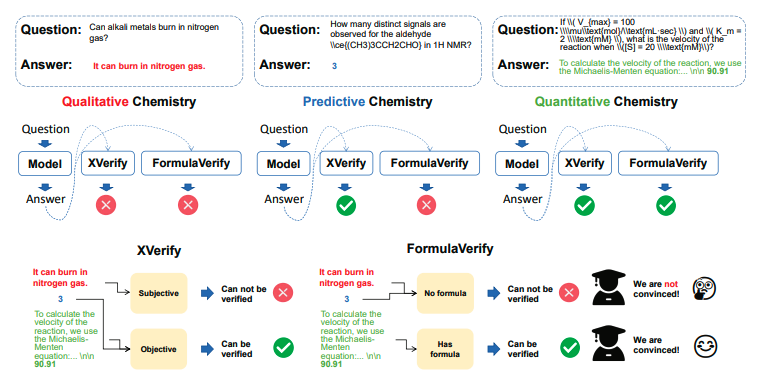
Quantitative reasoning forms the bedrock of modern chemical research, allowing scientists to predict molecular behaviour and material properties accurately. However, despite recent advances in artificial intelligence, the ability of large language models to perform precise, step-by-step quantitative calculations remains largely untested. To address this gap, Jiaqing Xie from the Shanghai Artificial Intelligence Laboratory, Weida Wang from Fudan University, Ben Gao from Wuhan University, and colleagues introduce QCBench, a new benchmark designed to rigorously evaluate the mathematical reasoning skills of these models. This comprehensive assessment, comprising 350 problems across seven key chemical disciplines and three difficulty levels, reveals a significant disparity between a model’s linguistic fluency and its capacity for accurate scientific computation, paving the way for targeted improvements in domain-specific artificial intelligence.
LLM Chemistry Performance and Reproducibility Assessment
This research explores the performance of large language models (LLMs) on chemistry tasks, focusing on their ability to solve complex problems and the importance of ensuring research is reproducible. The study categorizes content into research paper excerpts, experimental results, a detailed reproducibility checklist, and methodological details, investigating how techniques like Chain-of-Thought (CoT) prompting affect performance and highlighting the need for transparency in AI research. The findings demonstrate that applying Chain-of-Thought prompting does not consistently improve performance, and can even decrease accuracy in some cases. The effectiveness of CoT varies significantly depending on the specific area of chemistry, boosting performance in some fields like quantum and bio/organic chemistry, but hindering it in others like analytical chemistry.
The study emphasizes that the underlying capabilities of the model, its scale and training, are the most important factors, with prompting techniques serving as secondary optimizations. The extensive reproducibility checklist underscores the importance of transparency and rigor in AI research, covering essential elements for verification and further development. This work provides valuable insights into the strengths and limitations of LLMs in chemistry and promotes best practices for AI research.
Quantitative Chemistry Benchmark for Language Models
Researchers developed QCBench, a new benchmark to rigorously assess the quantitative reasoning abilities of large language models (LLMs) in chemistry. This benchmark comprises 350 problems spanning seven key areas of chemistry, ranging in difficulty from basic to expert level, and focuses on problems requiring explicit numerical computation. The design minimizes opportunities for models to rely on memorization, instead demanding step-by-step numerical derivations based on established chemical principles. The methodology incorporates both expertly curated problems and adapted examples from existing benchmarks, ensuring novelty and connection to established resources.
Problems underwent rigorous annotation to ensure accuracy and clarity, and the evaluation framework employs a robust answer verification process to confirm the correctness of model outputs. By systematically assessing model performance across different subfields and difficulty levels, QCBench provides a detailed diagnostic of computational weaknesses and limitations, paving the way for targeted improvements in model design and training strategies. QCBench offers a valuable tool for advancing artificial intelligence and accelerating progress in chemistry research.
LLMs Struggle with Complex Chemistry Problems
Researchers have developed QCBench, a new benchmark to rigorously evaluate the quantitative reasoning abilities of large language models (LLMs) within chemistry. This benchmark comprises 350 problems spanning seven key areas of chemistry, ranging in difficulty from basic to expert level, and assesses step-by-step numerical problem-solving, rather than simply testing for memorized facts. Evaluations of 19 LLMs reveal a consistent decline in performance as problem complexity increases, highlighting a gap between language fluency and accurate scientific calculation. The benchmark demonstrates that a higher number of parameters within a model does not automatically translate to improved performance on these quantitative tasks, suggesting that simply scaling up model size is not enough to achieve robust computational abilities.
Notably, the results indicate that current LLMs struggle most with Analytical and Polymer Chemistry. Grok-3 emerges as the strongest overall performer, achieving the highest average score across all chemistry areas, while DeepSeek-R1 stands out as the leading open-source model. Interestingly, Grok-3 demonstrates a counter-intuitive strength, performing better on medium and difficult problems than on easy ones, suggesting a sophisticated reasoning capability. In contrast, some models show a marked decline in accuracy as problem difficulty increases. Quantum Chemistry, despite containing a high proportion of difficult questions, achieves one of the highest accuracy scores overall, suggesting that certain specialized areas may be more amenable to current computational approaches. The development of QCBench provides a valuable tool for assessing and improving the quantitative reasoning capabilities of LLMs, paving the way for more reliable and accurate computational tools in the field of chemistry.
LLMs Struggle With Quantitative Chemistry Reasoning
QCBench, a new benchmark comprising 350 quantitative problems across seven areas of chemistry, systematically assesses the mathematical reasoning abilities of large language models (LLMs). The framework categorizes problems by difficulty, basic, intermediate, and expert, and distinguishes between qualitative, predictive, and quantitative task types, allowing for a detailed analysis of model strengths and weaknesses. The research highlights that simply increasing model scale does not guarantee improved performance; instead, specialized strengths and efficient reasoning are crucial. Notably, the study identified a ‘verification gap’, where strict evaluation processes sometimes penalize correct answers presented in non-standard formats, suggesting that evaluation tools must also evolve alongside the models themselves. QCBench, therefore, offers a dynamic diagnostic framework to guide the development of more scientifically reliable AI, rather than simply providing a static leaderboard.
🗞 QCBench: Evaluating Large Language Models on Domain-Specific Quantitative Chemistry
🧠 ArXiv: https://arxiv.org/abs/2508.01670



See today’s quantum computing news on Quantum Zeitgeist for the latest breakthroughs in qubits, hardware, algorithms, and industry deals.