The pursuit of ultra-low power computing is driving innovation in cryogenic electronics, and a team led by Md Mazharul Islam, Diego Ferrer, and Shamiul Alam at the University of Tennessee, Knoxville, alongside colleagues at Sandia National Laboratories, has reimagined the possibilities for voltage-controlled logic at extremely low temperatures. Current superconducting components struggle with scalability in complex circuits, but this research addresses this limitation by harnessing the potential of Josephson Junction Field Effect Transistors (JJFETs). The team’s work demonstrates how newly designed JJFETs, incorporating advanced materials, achieve enhanced performance and gain, paving the way for practical, cascadable logic circuits. By integrating these JJFETs with a superconducting thermal switch, the researchers successfully simulate fundamental logic gates, including a versatile majority gate and a functional XOR gate, demonstrating a significant step towards building complex, energy-efficient computing systems for the future.
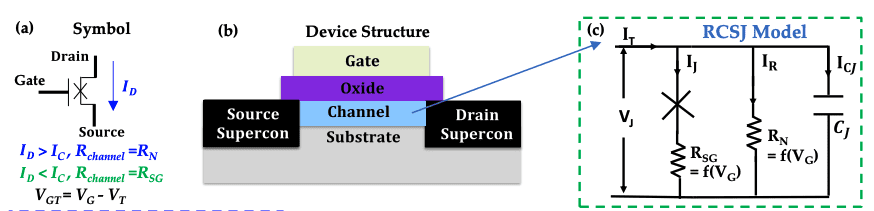
The team demonstrates the feasibility of building basic logic gates, NOT, NAND, NOR, and a full adder, using this technology. The core building block, the JJFET, combines the properties of a Josephson junction, enabling superconductivity, with a field-effect transistor, allowing voltage control. Simulations utilize a Resistively and Capacitively Shunted Junction (RCSJ) model to accurately simulate the JJFET’s behaviour, a standard approach for modelling Josephson junctions, and emphasize the use of majority logic gates to potentially simplify circuit design and improve performance.
The JJFET’s characteristics are crucial to its function, incorporating superconducting source and drain contacts with an InAs/GaSb channel. Simulations show how the gate voltage controls the channel resistance, switching it between superconducting and normal states, and modulates the critical current of the JJFET, influencing the flow of supercurrent. Detailed simulations demonstrate the switching behaviour of the transistor, and the team also investigated the switching of a superconducting nanowire, termed an nTron, characterizing its switching current and voltage. This device addresses a critical limitation in current superconducting circuits, the inability to easily connect and cascade multiple components, by offering significantly improved control over the flow of supercurrent. The key breakthrough lies in the material’s ability to sharply alter its electrical properties with a change in voltage, enabling a much stronger and more controllable switching effect than previously possible, and inducing a transition to an excitonic insulator state that dramatically changes how easily current flows, resulting in a gain factor over 50 times greater than conventional JJFETs. While not yet reaching the ideal gain for perfect switching, the researchers demonstrate that this improved sensitivity is sufficient to build functional logic circuits.
This is achieved through a highly nonlinear response, allowing the device to effectively switch between conducting and non-conducting states. The team successfully designed and simulated several fundamental logic gates, NOT, NAND, NOR, and a 3-input majority gate, using these enhanced JJFETs, and incorporated a multilayered heater nanocryotron, a superconducting nanowire-based thermal switch, to ensure signals can be effectively passed between stages of a circuit. This addresses the challenge of limited output voltage in superconducting devices, allowing for reliable fanout, and the researchers simulated a 2-input XOR gate constructed from their JJFET-based logic gates, confirming that the circuits can be cascaded and operate reliably in more complex configurations. The research demonstrates the successful implementation of fundamental logic gates, NOT, NAND, NOR, and a 3-input majority gate, using this hybrid architecture, and validated the cascadability of these gates by constructing a functional 2-input XOR gate, confirming the potential for building complex multistage logic circuits. The key innovation lies in the combination of JJFETs, which exhibit improved gate tunability due to an InAs/GaSb heterostructure, and nTrons, which restore logic levels and enable voltage amplification, addressing longstanding challenges in superconducting logic, namely the lack of fanout capability and absence of voltage gain. The developed Verilog-A compact model accurately simulates the JJFET’s behaviour, facilitating circuit-level design and analysis. While the simulations demonstrate promising results, the authors acknowledge that future work will focus on the experimental realization of these logic topologies and optimization of the JJFET-nTron interface to further reduce energy consumption and delay, and further research will explore the potential for scaling up these devices into larger, more complex logic systems.
👉 More information
🗞 Reimagining Voltage-Controlled Cryogenic Boolean Logic Paradigm with Quantum-Enhanced Josephson Junction FETs
🧠 ArXiv: https://arxiv.org/abs/2508.00295