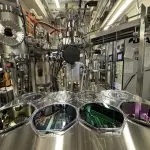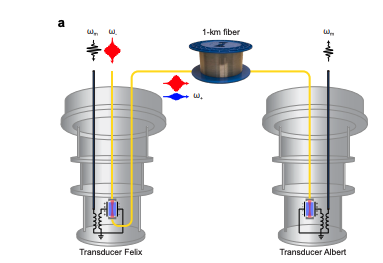
Scaling up superconducting quantum processors, a leading technology for building practical quantum computers, faces a fundamental limitation: the physical size and cooling demands of the refrigerators that house them. Researchers at Yale University, led by Yiyu Zhou, Yufeng Wu, and Chunzhen Li, now demonstrate a crucial step towards overcoming this challenge by establishing a coherent photonic link between superconducting circuits residing in separate dilution refrigerators. The team achieves this breakthrough using specially designed electro-mechanical transducers connected by a kilometer of standard telecom fibre, enabling low-loss signal transmission over a significant distance. This demonstration, which boasts a substantial improvement in efficiency compared to existing technologies, provides essential design principles for building scalable quantum networks and represents a major advance in the quest to connect and expand the capabilities of quantum computing.
Computation algorithms increasingly demand larger numbers of qubits, but scaling superconducting quantum processors beyond hundreds of qubits faces limitations imposed by the physical size and cooling power of dilution refrigerators. This constraint motivates the construction of a quantum network to interconnect qubits hosted in separate refrigerators, requiring microwave-to-optical transducers for low-loss signal transmission over long distances.
Quantum Signal Transfer Between Dilution Refrigerators
Researchers have successfully demonstrated a crucial step towards scalable quantum networks by establishing a coherent signal transfer between superconducting circuits housed in separate dilution refrigerators. This achievement overcomes a significant hurdle in quantum computing, as scaling up the number of qubits is limited by the physical size and cooling demands of current refrigeration technology. The team’s approach utilizes aluminum nitride electro-optic transducers connected by a kilometer-long telecom fiber, effectively extending the reach of quantum information. The core of this breakthrough lies in the design of highly efficient transducers that convert quantum information between microwave signals, used by superconducting qubits, and optical signals, ideal for long-distance transmission.
Existing methods, such as using electro-optic modulators, suffer from substantial signal loss, but this new system achieves a remarkable improvement in transduction efficiency compared to those conventional approaches. This translates to a significantly stronger and clearer signal after traveling through the fiber optic cable, essential for maintaining the delicate quantum states of qubits. The transducers function by precisely matching the frequencies of microwave and optical signals, a process requiring meticulous engineering of the device’s physical structure. The team employed a unique “double-ring” design in their aluminum nitride transducers, allowing for fine-tuning of both the microwave and optical resonances.
This precise frequency matching, combined with careful control of the optical path, minimizes signal degradation during the conversion and transmission process. Characterization of the system revealed exceptionally low signal loss, paving the way for practical quantum networks. The ability to reliably transfer quantum information over a kilometer represents a substantial leap forward, suggesting that complex quantum systems can be interconnected and expanded beyond the limitations of a single refrigerator. This advancement promises to unlock the potential of distributed quantum computing and secure quantum communication networks, bringing the realization of powerful quantum technologies closer than ever before.
Efficient Microwave-to-Optical Quantum Transduction
This work demonstrates the successful transfer of quantum signals between superconducting circuits located in separate dilution refrigerators, connected by a 1-kilometer optical fiber. The researchers achieved this by employing aluminum nitride electro-mechanical transducers at each end of the link, enabling efficient conversion between microwave and optical signals. The demonstrated system surpasses the performance of conventional electro-optic modulators by a significant margin in terms of transduction efficiency, representing a substantial advancement for scalable quantum technologies. This achievement establishes critical design guidelines for building larger superconducting quantum networks interconnected by photonic links.
While the current study focuses on signal transfer, the authors highlight the potential for generating remotely entangled microwave photons, bypassing existing limitations in quantum link efficiency. The researchers acknowledge that further improvements in transducer design, specifically reducing mode volumes and enhancing quality factors, could further boost performance. Future work will likely focus on integrating this photonic link into more complex quantum network architectures and exploring its capabilities for distributed quantum computing and communication.
Photonic Quantum Link Between Dilution Refrigerators
Researchers have successfully demonstrated a crucial step towards scalable quantum networks by establishing a coherent signal transfer between superconducting circuits housed in separate dilution refrigerators. This achievement overcomes a significant hurdle in quantum computing, as scaling up the number of qubits is limited by the physical size and cooling demands of current refrigeration technology. The team’s approach utilizes aluminum nitride electro-optic transducers connected by a kilometer-long telecom fiber, effectively extending the reach of quantum information. The core of this breakthrough lies in the design of highly efficient transducers that convert quantum information between microwave signals, used by superconducting qubits, and optical signals, ideal for long-distance transmission.
Existing methods, such as using electro-optic modulators, suffer from substantial signal loss, but this new system achieves a remarkable improvement in transduction efficiency compared to those conventional approaches. This translates to a significantly stronger and clearer signal after traveling through the fiber optic cable, essential for maintaining the delicate quantum states of qubits. The transducers function by precisely matching the frequencies of microwave and optical signals, a process requiring meticulous engineering of the device’s physical structure. The team employed a unique “double-ring” design in their aluminum nitride transducers, allowing for fine-tuning of both the microwave and optical resonances.
This precise frequency matching, combined with careful control of the optical path, minimizes signal degradation during the conversion and transmission process. Characterization of the system revealed exceptionally low signal loss, paving the way for practical quantum networks. The ability to reliably transfer quantum information over a kilometer represents a substantial leap forward, suggesting that complex quantum systems can be interconnected and expanded beyond the limitations of a single refrigerator. This advancement promises to unlock the potential of distributed quantum computing and secure quantum communication networks, bringing the realization of powerful quantum technologies closer than ever before.
🗞 A kilometer photonic link connecting superconducting circuits in two dilution refrigerators
🧠 ArXiv: https://arxiv.org/abs/2508.02444



See today’s quantum computing news on Quantum Zeitgeist for the latest breakthroughs in qubits, hardware, algorithms, and industry deals.