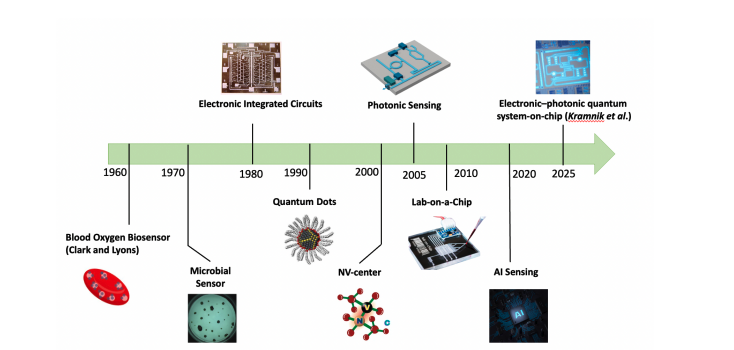
Biosensors represent a significant leap forward in detection technology, promising to overcome the limitations of current methods for identifying biochemical signals. Yasaman Torabi, Shahram Shirani, and James P. Reilly, all from the Electrical and Computer Engineering Department at McMaster University, lead a comprehensive review of this rapidly evolving field, charting a course towards future chip-scale devices. The researchers explore key biosensing approaches, including quantum dots and nitrogen-vacancy centres, and critically assess their potential integration with both electronic and photonic integrated circuits. This work uniquely connects these diverse technologies, offering a systematic overview of how compact, scalable, and high-performance biosensing systems can be realised, and clarifying the technological path towards next-generation diagnostics and monitoring.
Photonic Biosensors and Integrated Quantum Technologies
Researchers are developing highly sensitive biosensors using Photonic Integrated Circuits, aiming to create compact, efficient, and potentially low-cost devices for detecting biomolecules in healthcare, environmental monitoring, and beyond. This work represents a progression from fundamental photonic components to complex systems incorporating quantum technologies. At the core of this innovation lie Photonic Integrated Circuits, or PICs, which use waveguides to guide light within a chip. Key components include Mach-Zehnder Interferometers, which detect changes in refractive index caused by biomolecule binding, and ring resonators, which shift resonant wavelengths to signal detection.
Advanced fabrication techniques are essential for creating these complex circuits, and materials like silicon, silicon nitride, and glass are being explored for their unique properties. To further enhance sensitivity and functionality, researchers are integrating hybrid plasmonic waveguides, which combine light and metallic nanostructures, and slotted waveguides, which improve light confinement. Microfluidics are also being incorporated to deliver samples and control the environment, and designs are moving beyond planar circuits to create more complex three-dimensional devices. The next step involves incorporating quantum technologies, such as single-photon sources that generate individual photons for enhanced sensitivity.
Superconducting Nanowire Single-Photon Detectors and Germanium-Silicon Avalanche Photodiodes are being used to detect these individual photons. Researchers are also leveraging quantum interference and integrating quantum light sources and circuits onto single chips. These advancements enable label-free detection, eliminating the need for fluorescent tags, and multiplexed detection, allowing simultaneous analysis of multiple biomolecules. Real-time monitoring of biomolecule concentrations is also becoming possible, paving the way for point-of-care diagnostics, environmental monitoring, and precise refractometry. However, several challenges remain, including minimizing light loss within the PIC, simplifying fabrication processes, integrating PICs with other components, reducing costs, ensuring robust packaging, and maintaining quantum coherence for quantum sensing applications.
Quantum Biosensing with Plasmonics, Dots, and NV Centers
Researchers are pioneering a new generation of biosensors by integrating quantum technologies with microelectronics and photonics, overcoming the limitations of conventional detection methods. This approach harnesses the unique properties of quantum mechanics, superposition, entanglement, and quantum coherence, to detect biochemical signals at extremely low concentrations. This innovation centers on three primary quantum sensing techniques: quantum plasmonic sensors, which detect molecular interactions by monitoring changes in light interacting with metal nanoparticles; quantum dots, which utilize size-dependent fluorescence for detection; and nitrogen-vacancy (NV) centers, defects within diamond offering nanoscale bioimaging through optically readable spin states. These techniques are being actively integrated onto silicon chips, combining electronic, photonic, and quantum components.
A significant aspect of this research involves surpassing the Standard Quantum Limit, where precision scales inversely with the number of measurements. By utilizing quantum entanglement, researchers aim to achieve the Heisenberg Limit, dramatically improving precision and allowing for the detection of fainter signals. This enhanced sensitivity is crucial for detecting weak neural activity or identifying biomarkers at early stages of disease. The development of this technology relies on fundamental quantum principles, including superposition, where a quantum bit can exist in multiple states simultaneously, and the time evolution of quantum systems governed by the Schrödinger equation. Researchers are manipulating quantum states to achieve “squeezed states”, reducing noise and enhancing sensor sensitivity. This integration of quantum principles with microfabrication techniques represents a significant step towards creating compact, scalable, and high-performance biosensing systems for future healthcare applications.
Chip-Scale Biosensors Detect Biomolecules with Light
Biosensors are rapidly advancing beyond traditional biochemical detection methods, offering unprecedented sensitivity and specificity. Researchers are now focused on integrating these biosensors onto chip-scale platforms, combining microelectronic and photonic technologies to create compact, scalable, and high-performance devices, transforming areas like diagnostics, environmental monitoring, and biological research. A key technology driving this progress is the Mach-Zehnder Interferometer (MZI), a device that splits light and measures changes in its interference pattern. When biomolecules bind to the MZI’s surface, they alter the way light travels through the device, creating a measurable signal.
Recent MZI-based sensors demonstrate remarkable sensitivity, detecting refractive index changes as small as 6. 8 x 10⁻⁶ RIU, and achieving a limit of detection around 1 nanogram per milliliter for specific biomolecules. Ring resonators offer a complementary approach, trapping light in a circular path and shifting resonant frequency in response to biomolecular binding. Some designs now achieve femtomolar sensitivity, detecting a single molecule in a quadrillion, and can detect SARS-CoV-2 with remarkable speed and accuracy. Arrays of these ring resonators are being developed to simultaneously profile multiple antibodies, offering a powerful tool for complex biological analysis.
Researchers are pushing the boundaries of integration by combining photonic sensors with electronic circuitry on a single chip, enabling automated analysis and reducing device size and power consumption. Looking ahead, the field is exploring the potential of integrated quantum photonics, using quantum properties of light to further enhance sensitivity and create entirely new sensing modalities. While still a scientific challenge, successful integration of quantum components promises to unlock even more powerful and versatile biosensing capabilities in the future.
Integrated Quantum Biosensors and Photonic Scaling
Quantum biosensors offer significant advantages over conventional sensing platforms, notably in achieving rapid response, high sensitivity, single-molecule resolution, and reduced noise. This review systematically connected various quantum sensing technologies with the development of microelectronic and photonic chip-based devices, clarifying a potential technological trajectory towards compact and scalable biosensing systems. The study compared different quantum sensors and evaluated their integration with both electronic and photonic technologies, highlighting limitations related to scaling, fabrication, and signal interference. Integrated quantum photonics (IQP) emerges as a promising pathway to overcome these limitations through the use of discrete quantum states and enhanced measurement precision.
While IQP devices are still in early stages of development, addressing challenges in material uniformity, optical loss, and device complexity will be crucial for realising their full potential. Future progress in device layouts, packaging strategies, and compatible fabrication flows with silicon photonics could ultimately transform quantum biosensing from a laboratory concept into a practical solution for clinical and industrial applications. Further research is needed to fully address these challenges and unlock the potential of this emerging field.
🗞 Quantum Biosensors on Chip: A Review from Electronic and Photonic Integrated Circuits to Future Integrated Quantum Photonic Circuits
🧠 ArXiv: https://arxiv.org/abs/2508.01663