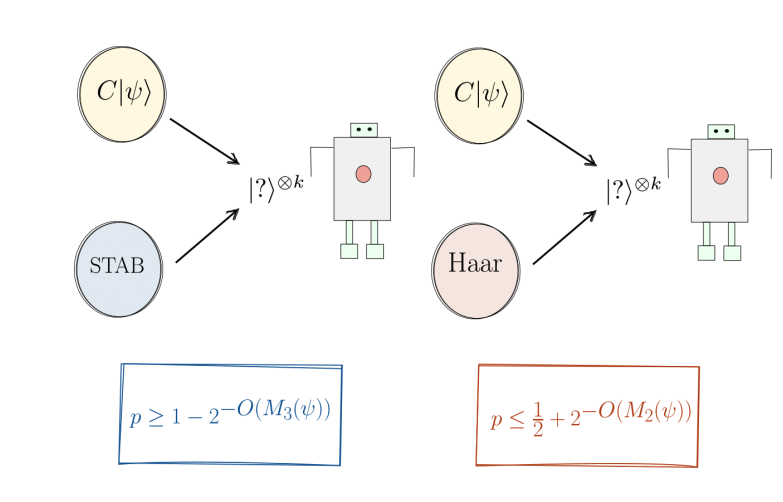
The challenge of quantifying ‘magic’, the non-classical resources that enable quantum computation, has driven significant advances in physics and chemistry, but a clear understanding of how to measure this resource operationally has remained elusive. Lennart Bittel and Lorenzo Leone, at the Dahlem Center for Complex Quantum Systems, Freie Universität Berlin, alongside their colleagues, now provide a robust interpretation of the stabilizer entropy, a key measure of this ‘magic’. Their work demonstrates that the stabilizer entropy directly quantifies how quickly a quantum state loses its distinct, non-classical character, becoming indistinguishable from a completely random state, and establishes a link between this loss of character and the ability to accurately identify the state as non-classical. This breakthrough offers a comprehensive understanding of the stabilizer entropy, not simply as a mathematical tool, but as a quantifiable resource governing the transition between ordered, controllable quantum states and the randomness essential for universal quantum computation.
This work provides a clear operational interpretation for a key measure of quantum magic, the stabilizer entropy, revealing its significance as a quantifiable resource. Researchers demonstrate that the higher the stabilizer entropy of a quantum state, the more difficult it becomes to distinguish that state from a truly random quantum state, yet simultaneously, the easier it is to distinguish it from a simple “stabilizer” state, one governed by easily controlled operations. This discovery addresses a long-standing question in quantum information theory: what does the stabilizer entropy actually mean in practical terms?
Previously, while the entropy could be calculated and measured, its physical significance remained unclear. The new findings establish that it precisely characterizes the transition from readily controllable, stabilizer states to complex, universal quantum states capable of performing powerful computations. This is achieved through analyzing how well a state can be distinguished from both a random ensemble and the set of stabilizer states, with the success of this distinction directly linked to the stabilizer entropy. The implications of this research extend to diverse areas of quantum physics. By providing a quantifiable measure of “magic”, scientists can better understand the resources required for advanced quantum technologies.
The research demonstrates that the stabilizer entropy governs the rate at which a quantum state’s behavior diverges from that of a simple stabilizer state, and converges towards the behavior of a completely random state. This allows for a precise characterization of the boundary between classical and quantum behavior, and offers new insights into the potential for quantum computation and simulation. Furthermore, the accessibility of the stabilizer entropy, it is both efficiently computable and experimentally measurable, makes it a powerful tool for studying quantum systems with a large number of components, exceeding the limitations of previously known measures. This opens up possibilities for investigating “magic” in complex systems with up to one hundred qubits, providing a deeper understanding of quantum phenomena in diverse fields like many-body physics, nuclear physics, and quantum chemistry.
Generalized Stabilizer Purity Bounds and Averages
Recent advances in quantum information theory focus on understanding the properties of quantum states, particularly how they differ from classical states. Researchers have been investigating generalized stabilizer purities, a way to measure the “mixedness” of a quantum state, and comparing how these purities change under different types of transformations. The team compared the average purity of a state under completely random transformations with its average purity under a specific set of transformations known as the Clifford group, which are important for quantum computation. This difference provides valuable information about the state’s structure and its potential for quantum processing.
The research establishes rigorous mathematical bounds on this difference, revealing how much the purity can change under these transformations. These bounds are expressed in terms of the state’s properties and the number of quantum bits, or qubits, it contains. The results are closely connected to the stabilizer formalism, a powerful tool for describing quantum states with symmetries. Researchers also demonstrated these bounds using specific examples, including a well-studied quantum state known as the Golden state, and identified situations where the established relationships do not always hold true.
The team proved that generalized purities behave predictably when combining multiple quantum systems, a property known as multiplicativity. They also explored how these purities add up when considering composite systems. This detailed analysis provides a deeper understanding of the mathematical properties of these purities and their relevance to quantum algorithms. The work highlights the importance of understanding the properties of quantum states for developing and improving quantum technologies.
Stabilizer Entropy Quantifies Quantum State Complexity
This research provides a comprehensive characterization of stabilizer entropies within the framework of magic-state resource theory, deepening our understanding of how quantum states differ from classical ones. The team demonstrated that these entropies accurately quantify the transition from easily-simulated stabilizer states to more complex, universal states, establishing a clear operational meaning for these important mathematical tools. Specifically, the research shows that the rate at which a quantum state’s behavior becomes indistinguishable from a random state is governed by its stabilizer entropy, and this entropy also determines how effectively one can identify whether a state is a stabilizer state or not. The findings highlight the precise role of stabilizer entropy in quantifying the “resourcefulness” of quantum states, offering new avenues for harnessing this “magic” in quantum systems.
However, the authors acknowledge limitations in their approach, particularly concerning the scalability of their results. Their analysis currently assumes a fixed number of quantum copies, and extending the work to scenarios where the number of copies scales with the system size presents a significant challenge. Future research directions include investigating whether efficient, albeit biased, methods exist for measuring stabilizer purities, and exploring whether the current limitations on additive measurable monotones hold more generally across different quantum systems.
🗞 Operational interpretation of the Stabilizer Entropy
🧠 ArXiv: https://arxiv.org/abs/2507.22883




See today’s quantum computing news on Quantum Zeitgeist for the latest breakthroughs in qubits, hardware, algorithms, and industry deals.