The pursuit of increasingly precise measurements drives innovation across numerous scientific fields, and quantum metrology offers the potential to surpass the limitations of traditional techniques. Marco Barbieri from Dipartimento di Scienze, Universitá degli Studi Roma Tre, and Marco Barbieri from Istituto Nazionale di Ottica, CNR, present a comprehensive tutorial exploring how non-classical light sources can dramatically improve measurement accuracy. This work details the fundamental principles underpinning this enhanced precision, examining how quantum effects allow for more efficient information processing and a superior balance between measurement sensitivity and invasiveness. By reviewing both the theoretical foundations and current advancements, this tutorial illuminates the path towards next-generation measurement technologies with applications ranging from fundamental physics to practical sensing.
This tutorial presents how this advantage is brought about by nonclassical light, examining the basic principles of parameter estimation and reviewing the state of the art. Measurements are physical processes, and their power is constrained by requirements and limitations, no more and no less than the phenomena they observe. Numerous occurrences illustrate this point; the internal resistance of an ammeter should be small compared to the load, while that of a voltmeter should be large, and the heat capacity of a thermometer should be small. These considerations highlight inherent constraints on measurement precision and efficiency
Quantum Precision Limits and Non-Classical States
This extensive collection of references details research in quantum metrology, sensing, estimation, and imaging. The work covers foundational concepts, specific sensing applications, advanced techniques, and theoretical frameworks. A central theme is surpassing the standard quantum limit and approaching the ultimate precision allowed by quantum mechanics. Squeezed light and other non-classical states of light are frequently explored as resources for enhancing precision, alongside methods for estimating multiple parameters simultaneously. The bibliography also highlights research into optical interferometry, quantum imaging, super-resolution imaging, waveform estimation, and gravitational wave detection.
Advanced concepts covered include quantum non-demolition measurements, continuous-variable quantum information, and the use of entanglement to improve precision. Researchers are also investigating distributed quantum sensing, quantum Kalman filtering, cryptographic quantum metrology, and the application of quantum machine learning to quantum data. Key theoretical tools include the quantum Fisher information, the quantum Cramér-Rao bound, and the Bell-Ziv-Zakai bound. Prominent researchers in the field are pioneering quantum-enhanced measurements, developing quantum estimation theory, and advancing quantum metrology and interferometry. In summary, this bibliography provides a comprehensive overview of the field, covering both fundamental theoretical developments and a wide range of applications. It demonstrates the potential of quantum mechanics to overcome classical limits in precision measurement and imaging.
Shot-Noise Limit Persists with Quantum Light
Researchers are investigating how quantum technologies can improve measurements, particularly when precise information is crucial. Conventional measurement techniques are limited by inherent noise, but utilizing the principles of quantum mechanics offers the potential to achieve greater precision. This research focuses on understanding how non-classical light sources can enhance measurement accuracy compared to traditional light. The study begins by examining a simple interferometer, a device that splits a beam of light and recombines it to detect changes in phase. Surprisingly, the fundamental limit of precision using standard light, known as the shot-noise limit, remains the same whether the light consists of individual photons or a continuous beam.
This suggests that simply using quantum light isn’t enough to guarantee improvement; the way the light is used is equally important. Researchers then introduce the quantum Cramér-Rao bound, a mathematical tool for determining the ultimate limit of precision for any measurement strategy. This bound relies on describing how a quantum state changes in response to a parameter being measured. By optimizing the initial quantum state and the measurement process, researchers can maximize the information gained from the measurement. Applying this approach to the interferometer example, the study demonstrates that a balanced configuration, where the light is split equally between the two paths, yields the highest possible precision.
The key to achieving quantum enhancement lies in carefully engineering the quantum state of the light and tailoring the measurement to extract the maximum information. For pure quantum states, the research reveals that the quantum Fisher information, a measure of the sensitivity of the state to changes in the measured parameter, can be maximized. This allows for a measurement strategy that, in principle, can reach the ultimate limit of precision dictated by the quantum Cramér-Rao bound. The findings suggest that quantum technologies offer a pathway to surpass the limitations of classical measurement techniques, opening possibilities for more sensitive and accurate sensing applications.
Single Photon Detection Schemes Compared
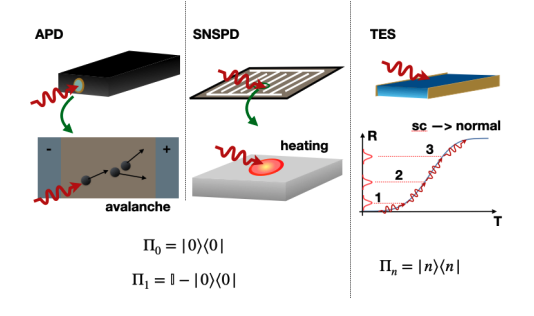
This work examines the principles underpinning quantum-enhanced information treatment, specifically focusing on the advantages offered by photonic methods over classical approaches to measurement. The investigation details various photon detection schemes, beginning with linear intensity detection via photodiodes, which are limited by inherent noise and unable to resolve single photons. Avalanche photodiodes address this limitation through an internal amplification process, providing a detectable signal from single photons, though at the cost of losing photon number information; these devices function as on/off event detectors, registering only the presence or absence of a photon. Further exploration covers superconducting nanowire single-photon detectors and transition edge sensors, both of which rely on the disruption of superconductivity to register photon arrival.
These detectors, like avalanche photodiodes, can be described by measurement operators indicating an on/off response in ideal conditions. The intrinsic quantum efficiency of silicon avalanche photodiodes in the visible spectrum is approximately 60%, though this decreases to around 20% for longer wavelengths; these detectors also exhibit dark counts, registering thermal activations at a rate of around 1000 events per second. The authors acknowledge that detector performance is crucial, and that limitations such as dark counts and spectral characteristics influence measurement precision. While the study focuses on the principles of these detection methods, it lays the groundwork for understanding how non-classical light sources can be effectively utilized in quantum metrology and information processing. Future work will likely focus on mitigating detector limitations and optimizing these systems for specific applications.
See today’s quantum computing news on Quantum Zeitgeist for the latest breakthroughs in qubits, hardware, algorithms, and industry deals.