The terahertz frequency range promises revolutionary advances in high-speed data processing, but controlling these electromagnetic fields efficiently remains a significant hurdle, requiring innovative approaches to signal manipulation. Chao Shen, Carla Verdi, and Serafim Babkin, along with colleagues at the Institute of Science and Technology Austria and The University of Queensland, demonstrate a new pathway using a unique class of materials called quantum paraelectrics. Their research establishes these materials as a versatile platform for manipulating terahertz waves, leveraging strong nonlinearities to enable reconfigurable signal control at incredibly small scales. By directly observing how these waves propagate within strontium titanate, the team uncovers soliton-like behaviour, paving the way for next-generation terahertz photonics and potentially ultrafast information processing technologies.
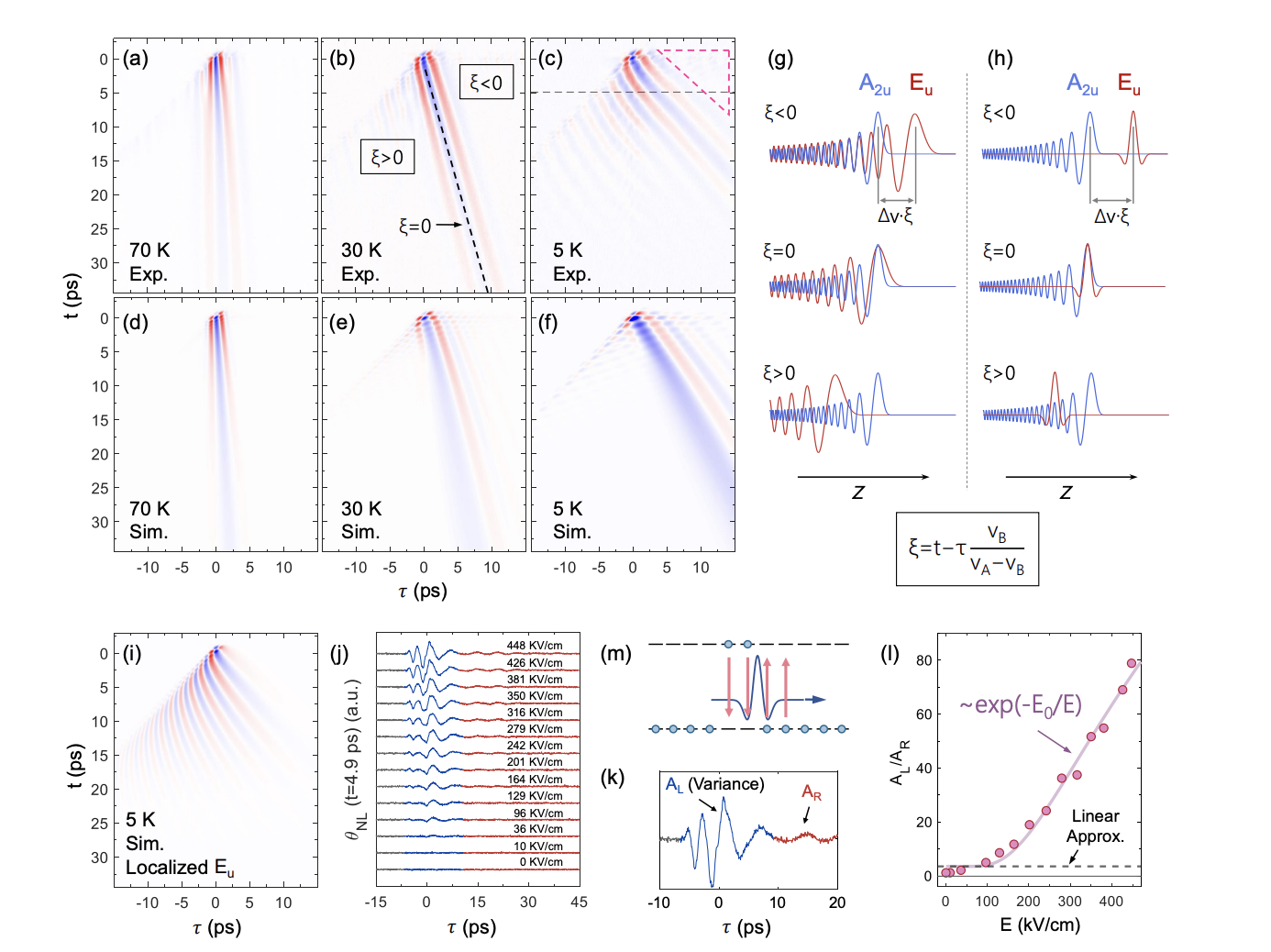
Researchers are now exploring polaritonic engineering, which uses hybrid light-matter excitations to manipulate THz fields at sub-wavelength scales. This work introduces quantum paraelectric materials, such as strontium titanate, as a powerful new platform for THz phonon-polaritonics, exploiting the pronounced nonlinearities present in these materials. These nonlinearities enable strong self- and cross-coupling between polaritons, thereby facilitating all-optical, reconfigurable THz signal control. Using a novel imaging technique, researchers directly observe the ballistic propagation of bulk phonon-polaritons in strontium titanate, and uncover soliton-like behaviour.
Strontium Titanate Confines and Amplifies Terahertz Waves
Researchers have demonstrated a new pathway for controlling terahertz (THz) electromagnetic fields using strontium titanate (SrTiO₃) and a phenomenon known as phonon-polaritonics. This addresses a key challenge in the field, the efficient and tunable manipulation of THz radiation, crucial for advancing high-speed data processing and communication technologies. The team discovered that by leveraging the special properties of this material near a critical temperature, they could create robust, self-confined THz excitations that propagate with minimal signal loss.
The key to this breakthrough lies in the material’s quantum paraelectric state, where atomic motions are highly anharmonic. When an intense THz pulse interacts with this material, it hybridizes with these atomic motions, forming a novel excitation called a phonon-polariton. Remarkably, these polaritons behave like solitons, self-reinforcing waves that maintain their shape and energy over considerable distances, overcoming the typical dispersion that limits signal transmission in other materials. This soliton-like behaviour allows for the creation of long-lived, stable signals within the material.
Using a sophisticated imaging technique that combines THz pulses with near-infrared light, researchers directly observed the ballistic propagation of these phonon-polaritons. This means the excitations travel through the material without scattering or losing energy, a feat rarely achieved with THz radiation. The observed dynamics closely resemble those of a decaying soliton, confirming the stability and robustness of these excitations. Importantly, the observed decay rates do not align with expected energy loss mechanisms, further supporting the unique nature of these polaritons.
This discovery opens exciting possibilities for developing next-generation THz photonics and ultrafast information processing technologies. By harnessing the unique properties of this material, researchers can potentially create compact,.
👉 More information
🗞 Nonlinear Terahertz Polaritonics in a Quantum Paraelectric
🧠 DOI: https://doi.org/10.48550/arXiv.2507.19358
See today’s quantum computing news on Quantum Zeitgeist for the latest breakthroughs in qubits, hardware, algorithms, and industry deals.