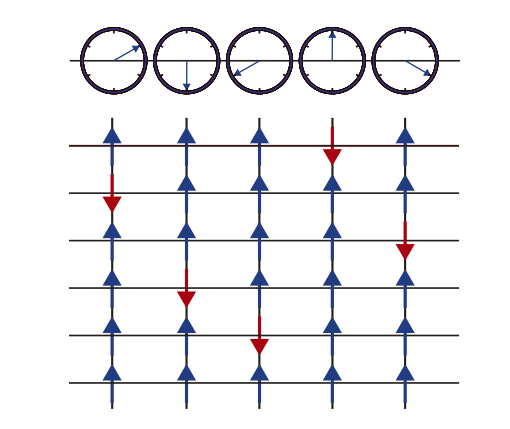
The quest to understand complex physical systems increasingly focuses on utilising near-term quantum devices, and a crucial step is efficiently representing these systems as qubits. Muhammad Shaeer Moeed, James Brown, and Alexander Ibrahim, from the University of Waterloo and qBraid Co., alongside Estevao Vilas Boas De Oliveira and Pierre-Nicholas Roy, investigate novel ways to encode the behaviour of planar rotor lattices, systems with rotating components, onto qubits. Their work centres on two distinct encoding schemes, one based on binary decomposition and the other on a unary mapping, allowing researchers to represent the complex interactions within these lattices using quantum bits. By verifying these approaches with computational simulations, the team demonstrates a pathway towards simulating these challenging systems on emerging quantum hardware, potentially unlocking new insights into complex physical phenomena.
Near term quantum devices are attracting significant interest as tools for investigating complex physical systems, particularly those in many-body physics. This work explores two methods for representing a system of interacting planar rotors, essentially tiny rotating magnets arranged in a lattice, using qubits, the fundamental units of quantum information. These rotor lattices model diverse phenomena, from the behaviour of water molecules within crystals to the ordering of molecules on surfaces, and understanding their properties presents a significant challenge in materials science.
Bosonic Encoding and Sparse Operator Simulation
The research details a sophisticated method for simulating interacting rotor systems, employing two primary encoding techniques. One approach, termed bosonic encoding, represents the rotor states using qubits, offering flexibility and potential scalability. The other relies on a sparse linear operator implementation, a computational technique designed to efficiently handle the large computational space that arises from the qubit representation. The team meticulously maps the continuous rotation of each rotor onto a discrete qubit representation, establishing a crucial link between the physical system and the quantum computer.
This mapping involves defining a total Hilbert space for the qubit system and carefully projecting out unphysical states to ensure accurate physics. The interaction between rotors is then represented using qubit operators, effectively translating the physical interactions into a quantum language. A key innovation is the use of a sparse matrix to represent the system’s Hamiltonian, the operator describing its energy. Because each rotor only interacts with a limited number of neighbours, most elements of the Hamiltonian are zero, allowing for significant computational savings. The team employs a linear operator that efficiently calculates the action of the Hamiltonian on any given state, dramatically reducing memory and computational requirements.
Quantum Simulation of Interacting Planar Rotors
Researchers are exploring new ways to simulate complex physical systems using quantum devices, focusing on systems of interacting planar rotors. Current computational methods struggle with the complexity of these systems, particularly in higher dimensions or when approaching critical points where the system undergoes phase transitions. This work introduces two novel methods for representing these rotor systems on a quantum computer, effectively translating the problem into a language that quantum hardware can understand. The core idea is to map the continuous rotation of each rotor onto the quantum state of a qubit.
Both methods were rigorously tested using classical simulations on small systems, confirming their accuracy in representing the original physical model. The researchers then investigated the computational resources needed to simulate these rotor lattices using Quantum Phase Estimation and Variational Quantum Eigensolver, algorithms designed to find the ground state, the lowest energy configuration, of the system. The results demonstrate the feasibility of simulating these systems on near-term quantum devices, although significant computational demands remain. This work provides a pathway to overcome limitations of classical simulations, potentially unlocking a deeper understanding of complex materials and phenomena.
Rotor Systems Encoded for Quantum Simulation
This research investigates two distinct methods for representing a system of interacting planar rotors using qubits. The team successfully demonstrates that both approaches accurately encode the rotor system’s behaviour. This encoding is crucial because it allows researchers to simulate the complex interactions within the rotor lattice using near-term quantum devices, which are still limited in size and capability. The study validates these encodings through simulations on small chains, establishing their viability for quantum computation. The findings are significant because they offer potential pathways to explore challenging problems in condensed matter physics, specifically those involving strong correlations between magnetic dipoles.
By effectively mapping the rotor system onto qubits, researchers can leverage the power of quantum algorithms to investigate its properties and potentially discover new phases of matter. The work also includes an assessment of the computational resources required to simulate these systems, providing valuable insights for designing future quantum experiments. While the simulations were limited to small system sizes, this work represents a crucial step towards harnessing the power of quantum computation to solve challenging problems in condensed matter physics and materials science.
🗞 Qubit encodings for lattices of dipolar planar rotors
🧠 DOI: https://doi.org/10.48550/arXiv.2507.17952


See today’s quantum computing news on Quantum Zeitgeist for the latest breakthroughs in qubits, hardware, algorithms, and industry deals.