Understanding how complex quantum systems evolve in time presents a major challenge for physicists, and recent advances in neural networks offer promising new tools to tackle this problem. Hrvoje Vrcan and Johan H. Mentink, both from the Radboud University Institute of Molecules and Materials, and their colleagues investigate a critical issue that arises when simulating these dynamics using a computationally efficient approach. Their work reveals a surprising instability in the calculations when systems undergo rapid changes, known as strong quenches, even though the underlying physics appears stable, and this instability occurs across multiple simulation methods. This discovery highlights a fundamental limitation in current techniques and underscores the need for new algorithms to accurately model the behaviour of strongly driven quantum systems using neural network-based approaches.
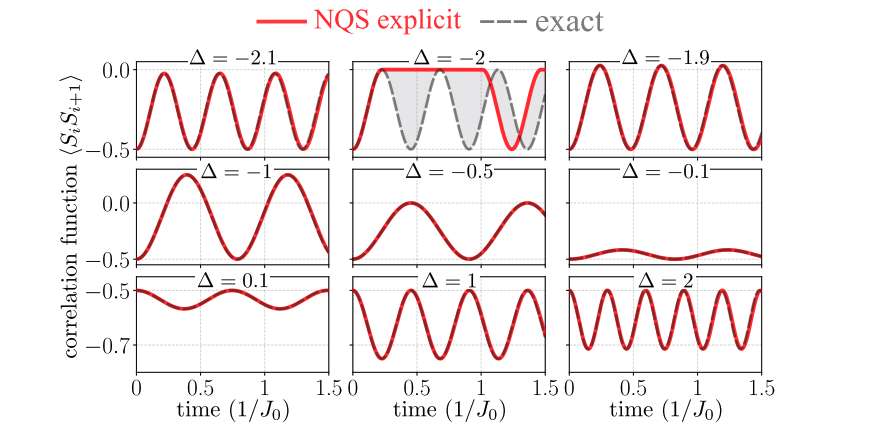
Studying strongly driven quantum dynamics with neural networks presents significant challenges. This work assesses sources of numerical instabilities that can appear in the simulation of quantum dynamics based on the time-dependent variational principle with a computationally efficient explicit time integration scheme. Researchers compare solutions obtained by this method with analytical solutions and implicit methods as a function of the driving force strength, investigating the limits of accuracy and stability. The team uncovered a specific driving strength that leads to numerical breakdown, despite the physical properties of the system remaining stable, suggesting a fundamental limitation in the numerical approach itself.
Neural Networks Represent Quantum Many-Body Systems
This collection of references focuses on utilising deep neural networks to represent the wavefunctions of quantum many-body systems, aiming to develop efficient and accurate methods for approximating solutions to the Schrödinger equation for complex systems. A significant portion of the references deal with magnetic materials at the quantum level, particularly ultrafast phenomena and spin dynamics. The collection also highlights computational tools used to solve these problems, including numerical methods, matrix decompositions, and optimization techniques, demonstrating the broader application of machine learning techniques to physics. Antiferromagnetism is frequently mentioned, indicating a focus on materials where neighboring spins align in opposite directions.
The overarching research direction is combining neural network quantum states with ultrafast magnetism. The goal is to use neural networks to simulate the ultrafast dynamics of quantum magnetic materials, a challenging task due to the complexity of interactions and the need to accurately capture time evolution. The citations suggest a focus on improving the efficiency and accuracy of neural network quantum state methods, exploring different network architectures and optimization algorithms. This research aims to understand and predict the behaviour of magnetic materials under extreme conditions, with potential applications in data storage, spintronics, and quantum computing.
Machine learning techniques are also used to analyze experimental data from ultrafast magnetism experiments, identifying patterns and validating theoretical models. This collection of references supports a wide range of research activities, including theoretical physics, computational physics, materials science, data science, and software development. It provides strong justification for funding proposals in areas like quantum materials, computational physics, and machine learning. Some citations relate to mathematical tools used in solving equations that arise in quantum mechanics and machine learning, while others focus on efficient quantum algorithms for time evolution and the development of advanced numerical methods for quantum dynamics using neural networks. The ULTRAFAST code is a software package developed for simulating ultrafast dynamics.
Neural Networks Stabilize Driven Quantum Dynamics
Recent research investigates the potential of neural networks to model complex quantum dynamics, pushing beyond the limitations of traditional computational methods. These “Neural Quantum States” offer a promising route to understanding the behaviour of many-body quantum systems, but simulating strongly driven dynamics has proven particularly challenging. Researchers have focused on identifying sources of numerical instability that arise when using the time-dependent variational principle with neural networks. The study systematically examines factors that can lead to inaccurate results, including mathematical “regulators” designed to stabilize calculations, and the way the equations of motion are formulated.
They found that, even without noise, the explicit time integration scheme within the time-dependent variational principle can break down at certain driving strengths, leading to incorrect predictions of system behaviour. This breakdown occurs despite the physical properties of the system remaining stable, indicating a purely numerical issue. The researchers explored methods like focusing calculations on a regular subspace of the system and utilizing the geometry of the quantum state, but the breakdown persisted. Further analysis of the quantum geometric tensor revealed no obvious connection between the instability and any inherent physical singularity. This research emphasises the importance of carefully evaluating the numerical stability of computational methods when addressing complex quantum problems.
Explicit Time Integration Instabilities in Quantum Dynamics
This research investigates numerical instabilities that arise when simulating strongly driven quantum dynamics using neural networks and the time-dependent variational principle. The team discovered that explicit time integration methods exhibit a breakdown in accuracy at certain driving strengths, even when physical observables remain stable. This breakdown occurs consistently across different formulations of the time-dependent variational principle, including those designed to mitigate known issues. The findings suggest that the observed instabilities are not due to random noise or regularization techniques, but represent a fundamental limitation of using explicit time integration for strongly nonequilibrium dynamics with neural-network quantum states. The authors acknowledge that current methods struggle to accurately simulate these systems and highlight the need for alternative approaches to leverage the computational benefits of explicit time integration.
🗞 Instability of explicit time integration for strongly quenched dynamics with neural quantum states
🧠 DOI: https://doi.org/10.48550/arXiv.2507.17421