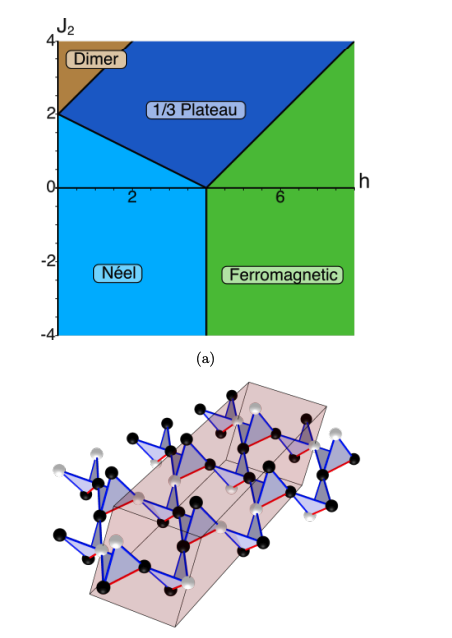
Frustrated magnetic systems present a significant challenge to physicists seeking to understand complex material behaviour, and finding exactly solvable examples is exceptionally rare, particularly in three dimensions. Kelvin Salou-Smith, from CNRS and the Universit ́e de Bordeaux, alongside Arnaud Ralko of the Institut N ́eel at the Universit ́e Grenoble Alpes, and Ludovic D.C. Jaubert, also from CNRS and the Universit ́e de Bordeaux, now present a novel three-dimensional model inspired by the well-studied Shastry-Sutherland model. Their work introduces a geometrically modified pyrochlore lattice that retains the key features of the 2D Shastry-Sutherland system, unexpectedly allowing for analytical solutions to the ground state. The researchers demonstrate that this model not only replicates known phases, such as a distinctive magnetization plateau, but also exhibits a remarkably stable dimer singlet ground state, potentially even more robust than its two-dimensional counterpart, offering a unique opportunity to investigate the effects of dimensionality on magnetic frustration and the emergence of exotic quantum phases.
This research introduces a three-dimensional analogue of the Shastry-Sutherland (SS) lattice, a system known for its unique magnetic properties and exactly solvable ground state. The team constructed this new lattice by modifying the pyrochlore structure to preserve the local geometry of the two-dimensional SS system. Despite the increased dimensionality and altered arrangement, the behaviour of classical and quantum spins remains surprisingly predictable, closely mirroring the characteristics of the 2D version, including the presence of a specific magnetization level and unusual spin arrangements. Notably, for quantum spins, the initial ground state persists as a stable solution over a defined region of the system’s parameters. The researchers used computational methods to demonstrate this stability extends to the three-dimensional structure.
Three-Dimensional Shastry-Sutherland Lattice Investigations
This research explores the extension of the well-known Shastry-Sutherland (SS) lattice, a model for frustrated magnetism, into three dimensions. By extending this model, the researchers aim to uncover new and potentially more complex magnetic states and understand how the characteristics of the two-dimensional SS lattice are affected by the addition of a third dimension. The work provides a theoretical foundation for understanding three-dimensional frustrated magnets and suggests that extending the SS lattice could lead to the discovery of new quantum magnetic phases. The authors constructed a three-dimensional lattice that maintains the essential connectivity of the two-dimensional SS lattice and investigated both the classical and quantum properties of this new structure using analytical calculations and numerical simulations.
The Shastry-Sutherland model, originally proposed to describe the magnetic behaviour of SrCu(BO3)2, features orthogonal spin chains with frustrating interactions between them. This frustration arises from the antiferromagnetic coupling between spins on neighbouring chains, preventing them from simultaneously minimizing their energy, and leading to a highly degenerate ground state. Extending this to three dimensions presents a significant challenge, as simply stacking 2D layers introduces additional interactions and complexities. The researchers addressed this by constructing a lattice based on the pyrochlore structure, a three-dimensional network of corner-sharing tetrahedra, and carefully modifying it to preserve the key features of the 2D SS lattice, namely the orthogonal dimerised spin chains. This construction ensures that the local geometry, and therefore the fundamental frustration, is maintained in the extended structure.
These simulations allowed them to explore the stability of various magnetic phases, including states with multiple possible configurations and specific magnetization levels. The results demonstrate that the three-dimensional lattice exhibits stable, highly degenerate phases, suggesting potential for interesting behaviour at higher temperatures. For quantum systems, the simulations indicate a more robust dimer singlet phase in three dimensions compared to the two-dimensional version. The non-centrosymmetric nature of the lattice allows for the presence of Dzyaloshinskii-Moriya interactions, which could lead to the emergence of topological magnetic states with unique properties. Dzyaloshinskii-Moriya interactions (DMI) arise from spin-orbit coupling and asymmetric exchange interactions, favouring non-collinear spin arrangements and giving rise to phenomena like skyrmions, which are topologically protected spin textures with potential applications in spintronics.
The stability of the dimer singlet phase, where spins pair up to form singlets, is particularly noteworthy. In two dimensions, this phase is susceptible to fluctuations and can be easily destabilized. However, the three-dimensional structure provides additional constraints, effectively suppressing these fluctuations and enhancing the robustness of the singlet phase. This increased stability has implications for the potential observation of this phase in real materials and opens up possibilities for exploring its properties in greater detail. Furthermore, the researchers investigated the impact of varying the strength of the interactions between the spin chains, revealing a rich phase diagram with multiple magnetic phases and transitions between them.
Future research directions include investigating the stability and properties of quantum spin liquids, exploring the role of Dzyaloshinskii-Moriya interactions, and considering more realistic models that include additional interactions found in materials like pyrochlore lattices. Quantum spin liquids are exotic states of matter where spins remain disordered even at absolute zero temperature, exhibiting long-range entanglement and fractionalized excitations. Investigating the emergence of such states in the three-dimensional SS lattice could provide valuable insights into the fundamental principles governing quantum magnetism. Further investigation into the behaviour of the lattice at finite temperatures will also be crucial, as real materials are always subject to thermal fluctuations. Understanding how these fluctuations affect the magnetic properties of the lattice will be essential for bridging the gap between theory and experiment. This paper presents a theoretical exploration of a novel three-dimensional frustrated magnet, laying the groundwork for future investigations into its potential exotic magnetic properties.
🗞 Exact ground state on the 3D analogue of the Shastry-Sutherland model
🧠 DOI: https://doi.org/10.48550/arXiv.2507.13877



See today’s quantum computing news on Quantum Zeitgeist for the latest breakthroughs in qubits, hardware, algorithms, and industry deals.