D-Wave Systems has commercially deployed annealing quantum computers for over two decades, offering solutions to complex optimization problems. The company strategically focused on this approach in 1999, prioritising error robustness and scalability, and leveraging existing semiconductor fabrication facilities. In 2025, D-Wave demonstrated quantum computational supremacy by completing a magnetic materials simulation in minutes, a task estimated to require one million years on a classical supercomputer, and research suggests its processors outperform even theoretically perfect gate-model systems for certain applications. This has resulted in six generations of production-ready computers, including the Advantage2™ system, delivering value to businesses and researchers.
Strategic Origins and Technological Focus
In 1999, D-Wave undertook an assessment of various physical platforms and quantum computing models, including gate, quantum annealing, and topological approaches, to determine the most viable path forward. The evaluation criteria centred on sensitivity to errors, scalability, and applicability to practical problems, ultimately leading to a strategic decision to pursue annealing quantum computing. This choice was predicated on the belief that annealing quantum computing offered greater robustness to errors and a better suitability for solving complex optimization problems.
D-Wave distinguished itself by prioritizing commercialization from its earliest stages, assembling a collaborative, interdisciplinary team with expertise in science, engineering, and product development. This approach differed from many other quantum computing companies founded primarily by academic researchers lacking experience in large-scale technology deployment. The company also recognized the importance of leveraging existing semiconductor fabrication facilities, rather than developing entirely new manufacturing techniques, to facilitate rapid scaling and commercialization.
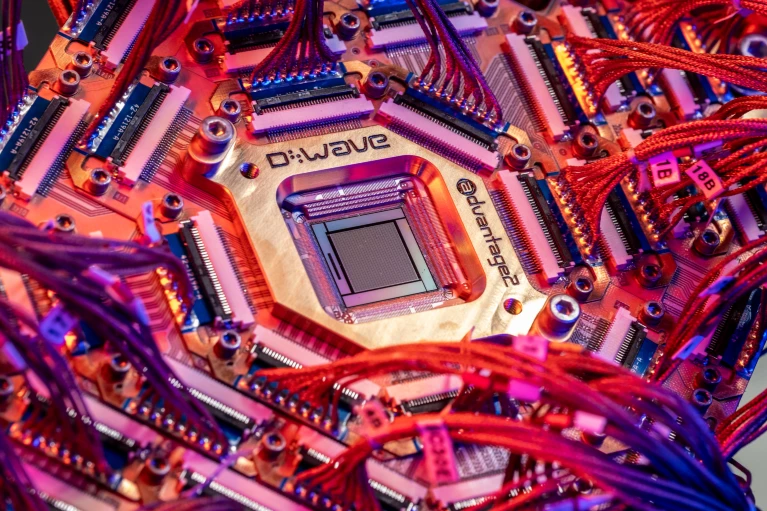
The D-Wave Advantage2™ system represents the company’s sixth-generation annealing quantum computer and is currently production-ready, addressing use cases in optimization, materials simulation, and artificial intelligence. Research conducted by D-Wave indicates that annealing quantum computing offers fundamental advantages over classical methods, with peer-reviewed studies demonstrating the presence of quantum effects such as tunnelling and qubit entanglement. In 2025, the company published research validating its achievement of quantum computational supremacy on a real-world problem – a magnetic materials simulation – completed in minutes, a task estimated to require nearly one million years using a classical supercomputer and the world’s annual electricity consumption.
Recent empirical and theoretical work suggests that gate-model quantum computing may not compete with D-Wave annealing quantum computers for optimization problems, even at scale. Los Alamos National Laboratory research projects that a perfect, error-free gate-model system would be orders of magnitude slower than current D-Wave processors. This combination of a first-mover advantage, relevance to optimization problems, and proven technology has provided lasting value to businesses, researchers, and governments, with the company’s initial observations from two decades ago remaining valid.
Commercialisation and Performance Validation
D-Wave’s commitment to commercialization has resulted in six generations of quantum computers, with the D-Wave Advantage2™ system currently in production. These systems are capable of outperforming classical counterparts and delivering customer value in areas such as optimization, materials simulation, and artificial intelligence.
The company validated the achievement of quantum computational supremacy in 2025 by completing a magnetic materials simulation in minutes, a task estimated to require nearly one million years and the world’s annual electricity consumption using a classical supercomputer. Research from Los Alamos National Laboratory suggests that even a perfect, error-free gate-model system would be orders of magnitude slower than current D-Wave processors when addressing optimization problems.
D-Wave’s initial assessment from two decades ago continues to hold true: its annealing quantum computers are commercial today and rival state-of-the-art classical systems in solving real-world problems, with proven fabrication processes accelerating scaling and a culture blending science, engineering, and product development driving innovation in quantum annealing applications.
Sustained Advantage and Future Prospects
This sustained advantage is underpinned by decades of investment in semiconductor fabrication processes, accelerating scaling and enabling the delivery of six generations of quantum computers. D-Wave’s approach, blending science, engineering, and product development, has resulted in systems capable of outperforming classical counterparts and delivering demonstrable customer value.
In 2025, D-Wave validated its achievement of quantum computational supremacy by completing a magnetic materials simulation in minutes, a task estimated to require nearly one million years and the world’s annual electricity consumption using a classical supercomputer. Research from Los Alamos National Laboratory indicates that even a perfect, error-free gate-model system would be orders of magnitude slower than current D-Wave processors when applied to optimization problems, further reinforcing the potential of quantum annealing applications.
D-Wave’s initial observations from two decades ago remain valid: its annealing quantum computers are commercial today and rival state-of-the-art classical systems in solving real-world problems. This is supported by proven fabrication processes and a collaborative culture focused on delivering quantum annealing applications.
More information
External Link: Click Here For More




See today’s quantum computing news on Quantum Zeitgeist for the latest breakthroughs in qubits, hardware, algorithms, and industry deals.