The behaviour of complex magnetic materials, known as spin chains, dramatically changes when subjected to random disturbances and external observation. Siddharth Tiwary from the University of California, Berkeley, and Joel E. Moore, affiliated with both the University of California, Berkeley and Lawrence Berkeley National Laboratory, investigate how continuous monitoring affects these disordered systems. Their work explores the interplay between standard magnetic interactions and the impact of repeated measurements, revealing a surprising shift in the material’s fundamental properties. The team’s analysis, employing a refined technique called real-space renormalization group, uncovers previously unknown critical behaviours and expands our understanding of how observation itself can alter the state of matter, potentially influencing the design of future quantum technologies.
Random Measurements in Disordered Quantum Spin Chains
Systems exhibiting disorder present complex behaviors, crucial for advancements in materials science and quantum technologies. This research addresses a gap in understanding how random measurements influence disordered quantum systems, specifically a chain of interacting quantum spins, moving beyond analyses focused on static systems. The team focuses on a disordered chain where both interactions and measurement probabilities are randomly distributed, creating a complex landscape requiring new analytical tools. To tackle this problem, the researchers developed an extension of the real-space renormalization group, tailored for systems undergoing continuous measurement, termed RSRG-X.
This method allows systematic simplification of complex interactions while accounting for observation, mapping the measured spin chain to a spin ladder with complex interactions. This analysis reveals the emergence of new, strongly disordered states not present in systems without measurement, suggesting observation fundamentally alters the system’s behavior. The findings demonstrate that continuous measurement can induce novel phases and transitions in disordered quantum systems, characterized by long-range correlations and unique properties. This analytical technique offers a powerful approach to studying strongly disordered systems, often computationally intractable, and is particularly valuable given the difficulty of simulating these systems even with quantum computing.
Renormalization Group for Monitored Quantum Spin Chains
Researchers employed a sophisticated renormalization group (RRG) technique to investigate disordered spin chains subject to continuous monitoring, where measurements fundamentally alter the dynamics. This approach adapts the RRG, typically used for equilibrium systems, to handle this open-system scenario where energy is not conserved. The methodology maps the monitored spin chain onto a non-Hermitian spin ladder, representing the impact of measurements as complex couplings. This allows leveraging mathematical tools for non-Hermitian systems, while carefully considering how measurements affect the energy landscape.
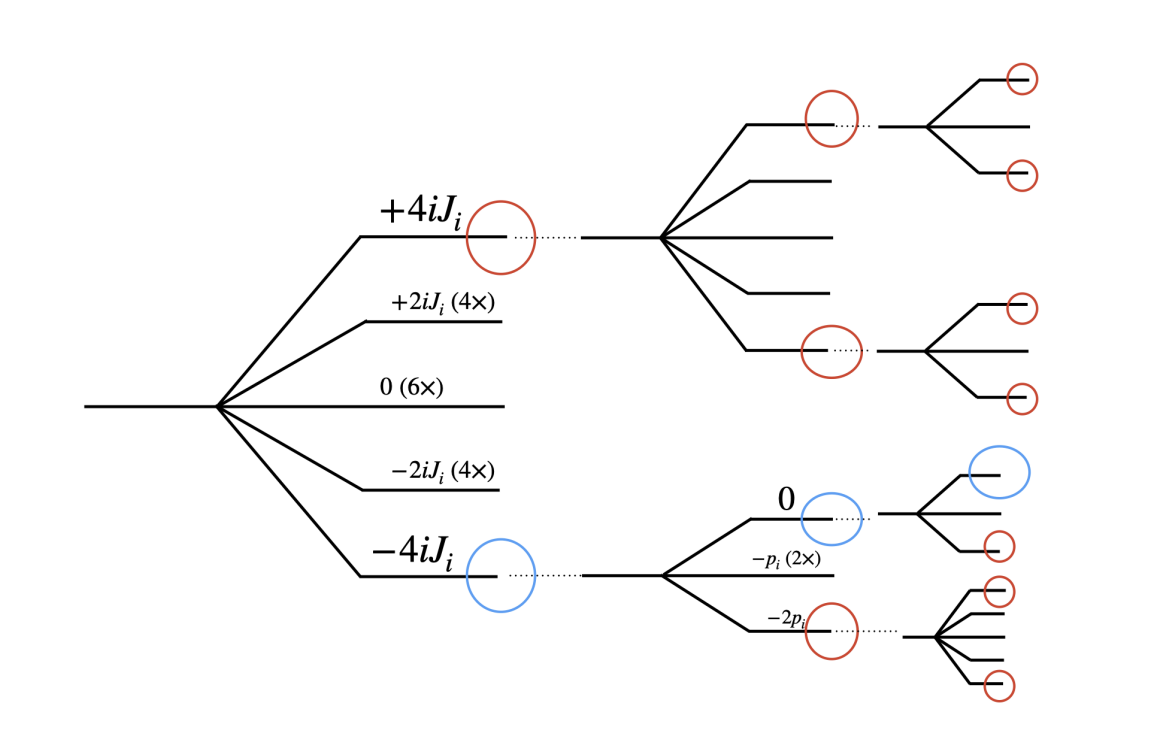
The team then developed a modified RRG, RSRG-X, specifically designed to handle the non-unitary nature of the system. RSRG-X explores multiple pathways during renormalization, choosing to eliminate the strongest coupling but selecting between different eigenstates. This introduces arbitrariness, allowing efficient navigation of the complex energy landscape, prioritizing states with longer lifetimes and greater stability. As the RRG progresses, the spin ladder undergoes transformation, generating unit cells distinguished by unique combinations of couplings, revealing the underlying critical behavior and the emergence of new fixed points.
Monitored Spin Chains Reveal Novel Criticality
Researchers have uncovered novel critical behavior in disordered quantum systems, specifically spin chains subjected to continuous monitoring and random measurements. Introducing random measurements fundamentally alters the system’s dynamics, leading to the emergence of new, strongly disordered fixed points not observed in closed or standard dissipative systems. The team mapped the complex interactions onto a non-Hermitian spin ladder, developing a specialized renormalization group approach for these open quantum systems where information is constantly extracted. Analysis revealed that the rate of measurements significantly influences the system’s behavior, driving transitions between newly discovered fixed points and establishing long-range correlations.
The method is robust enough to also apply to reflection-symmetric spin ladders, broadening its potential applications. The results demonstrate that even when measurement outcomes are discarded, the act of observation profoundly impacts the system’s quantum state. The discovered fixed points are stable states emerging under strong disorder and continuous measurement, representing fundamentally different phases of matter. This provides valuable insight into strongly disordered systems, often intractable for even powerful quantum computers.
Measurements Drive Long-Range Order in Spin Chains
This research investigates disordered spin chains subjected to continuous, random measurements, revealing new critical phenomena. By mapping the complex interactions onto a non-Hermitian spin ladder, the team developed a renormalization group approach, uncovering a novel phase characterized by long-range order that emerges specifically due to the presence of measurements. The study extends the analytical tools to disordered reflection-symmetric spin ladders, simplifying the path to reach this phase and broadening the scope of the research. Exploring other states and extending the analysis to higher dimensions represents a promising avenue for future research, with potential for realizing these dynamics in experimental platforms.
🗞 Measurement-Induced Phase Transition in a Disordered XX Spin Chain: A Real-Space Renormalization Group Study
🧠 DOI: https://doi.org/10.48550/arXiv.2507.11957




See today’s quantum computing news on Quantum Zeitgeist for the latest breakthroughs in qubits, hardware, algorithms, and industry deals.