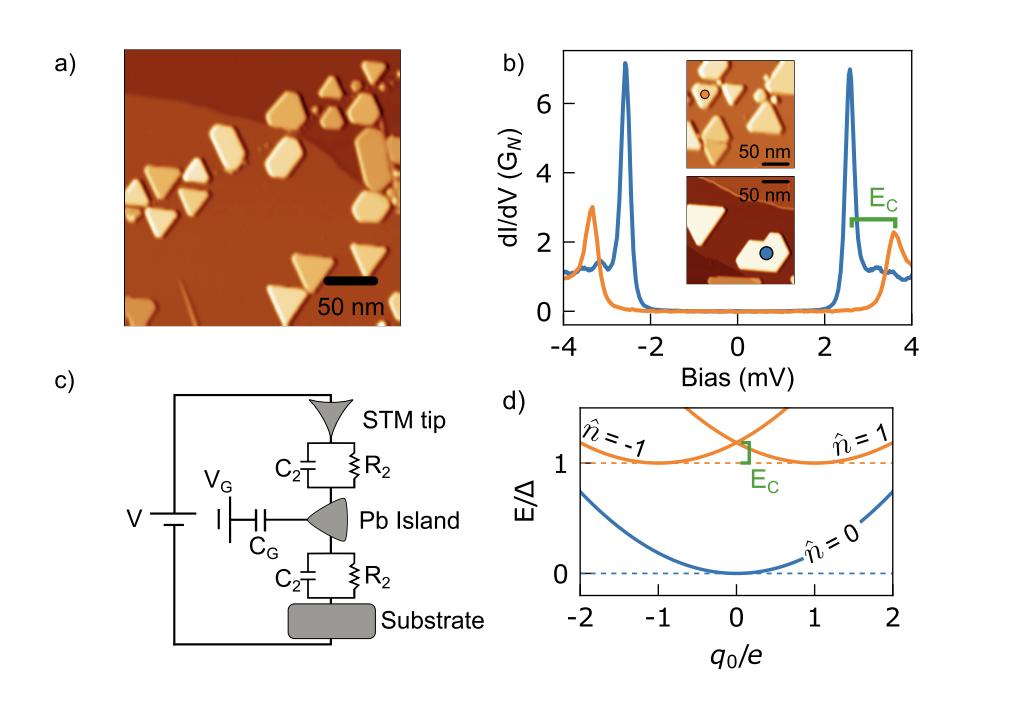
The behaviour of electrons in extremely small structures increasingly challenges our understanding of fundamental physics, and recent work focuses on how charge and electron pairing interact within nanoscale superconducting islands. Stefano Trivini, Jon Ortuzar, and Katerina Vaxevani, along with colleagues at CIC nanoGUNE-BRTA and the Centro de Física de Materiales, investigate this interplay by directly measuring the energy associated with both charge and electron pairing in individual nano-islands. Their research reveals a surprising crossover between different quantum states , even and odd parity , when the islands become sufficiently small, and importantly, the team demonstrates the ability to precisely control these states using applied voltage. This level of control over quantum properties offers a promising pathway towards designing and manipulating quantum systems for future technologies.
Nanoscale Superconductivity and Cooper Pair Competition
The drive to understand and control superconductivity at the nanoscale promises revolutionary advances in quantum computing and electronics. Superconductivity, the ability of certain materials to conduct electricity with zero resistance, typically occurs at very low temperatures, but its properties change dramatically when materials are reduced to the nanoscale. Researchers are particularly interested in how the fundamental properties of superconductivity compete with the effects of extremely small size and isolated charges. A key challenge lies in the interplay between ‘Cooper pairs’, the electron pairs responsible for superconductivity, and the natural tendency of electrons to repel each other.
In nanoscale superconducting islands, this competition is amplified as the size shrinks and the energy required to add a single electron becomes significant, potentially suppressing Cooper pair formation. Understanding this balance is crucial for designing nanoscale superconducting devices. Recently, a team of researchers has demonstrated a method for precisely controlling the superconducting state of individual nanoscale islands made of lead. By fabricating these tiny islands on a graphene substrate and using a scanning tunneling microscope, they probed the interplay between charging energy and Cooper pairing.
They discovered that below a certain size, the charging energy dominates, altering the island’s ground state and allowing it to exist in a state preferring an odd number of electrons, a configuration not typically favored in conventional superconductors. The researchers achieved this control by applying precise voltage pulses to the islands using the microscope tip, effectively tuning the island’s electrostatic potential and switching between states with even and odd numbers of electrons. This ability to manipulate the ground state parity opens up exciting possibilities for designing new types of superconducting devices. By controlling both the charging energy and the superconducting gap, the team has created a platform for exploring the fundamental limits of superconductivity at the nanoscale and potentially realizing novel quantum technologies.
Charge State Mapping Reveals Island Degeneracy
Researchers acquired maps showing accumulated charge within small islands, revealing features that shift after voltage pulses while maintaining a consistent superconducting gap. This demonstrates that changes in the spectral asymmetry arise from a net local charge, modified by each voltage pulse within a range of approximately one elementary charge. The observation of multiple peaks in the data indicates the presence of an odd number of residual charges on the island, a behaviour well-described by a theoretical model predicting a specific arrangement of energy levels and particle-hole symmetric excitations. From this initial state, excitation to other energy levels becomes possible, accounting for additional peaks.
The simultaneous observation of these peaks, with gradually changing intensity, is attributed to thermal effects. This agreement allows for accurate determination of the odd residual charge states and confirms the persistence of paired electrons in islands larger than a critical size. Researchers subsequently mapped the ground state charge by repositioning lead islands around a graphene surface using the microscope tip. Changes in the spectral features were often observed after movement, likely due to localized charges or variations in the substrate, suggesting the island’s residual charge is sensitive to electrostatic variations and could function as a sensor.
For a specific island size, the spectrum indicated a residual charge of approximately one elementary charge, but the intensity and alignment of the peaks changed with position, resembling changes with applied voltage and suggesting an inhomogeneous electrostatic potential at the interface. Mapping the peak amplitudes revealed a radial distribution, suggesting a point charge near one corner. Further investigation of islands with smaller sizes revealed a spectral gap consistent with a charging energy greater than the superconducting gap, demonstrating that these islands lie in an odd charge ground state. This was demonstrated by the evolution of its spectral gap with magnetic field, which initially closed with increasing field due to suppression of superconductivity, then reopened at higher fields, indicating the reappearance of a larger Coulomb blockade gap, a signature of an odd parity ground state stabilized on the island. These findings demonstrate that the island’s behaviour is governed by the interplay between superconductivity and Coulomb correlations, and that the ground state parity can be controlled.
Biocompatible Microfabrication via Two-Photon Polymerisation
This work demonstrates the feasibility of utilising 650 nm wavelength light for efficient two-photon polymerisation of a novel bio-based resin formulation. The achieved resolution of 180 nm, coupled with a polymerisation efficiency of 72%, represents a significant advancement in the field of microfabrication, particularly for applications requiring biocompatible materials. Furthermore, the developed resin exhibits minimal cytotoxicity, as confirmed by in vitro assays with mesenchymal stem cells, indicating its potential for scaffold fabrication in tissue engineering. Future work will focus on optimising the resin composition to further enhance mechanical properties and exploring the integration of this system with advanced imaging techniques, such as stimulated Raman scattering microscopy, to achieve sub-100 nm resolution. Investigations into the long-term stability of fabricated structures and their performance in vivo are also planned, alongside the development of multi-material printing capabilities to create complex, functionally graded scaffolds. Ultimately, this research paves the way for the fabrication of highly detailed, biocompatible microstructures for a wide range of biomedical applications, including regenerative medicine and drug delivery.
🗞 Local control of parity and charge in nanoscale superconducting lead islands
🧠 DOI: https://doi.org/10.48550/arXiv.2507.12150


See today’s quantum computing news on Quantum Zeitgeist for the latest breakthroughs in qubits, hardware, algorithms, and industry deals.