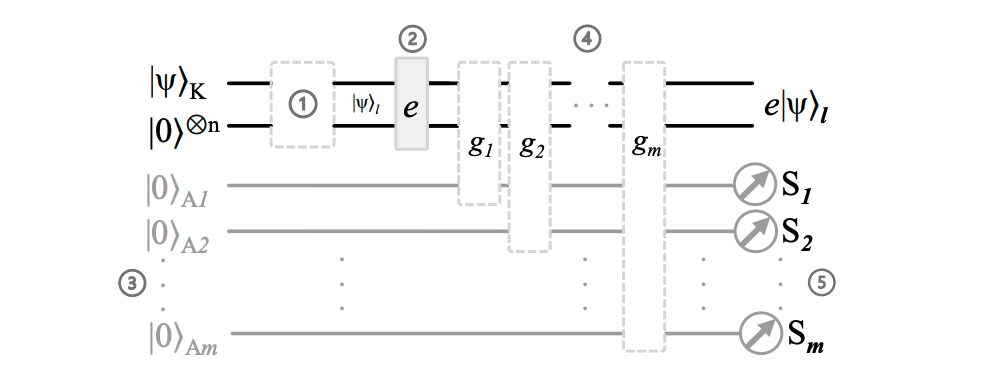
Quantum error correction represents a fundamental challenge in building practical quantum computers, as the delicate quantum states are highly susceptible to errors, and maintaining reliable operation requires mitigating these disturbances. Archisman Ghosh from Pennsy, alongside Avimita Chatterjee and Swaroop Ghosh et al., address this critical need with a comprehensive investigation into automating the design of quantum error correction systems. Their work recognises that current approaches demand substantial numbers of qubits and inefficient hardware, and proposes a pathway towards reducing these limitations through automated circuit synthesis, optimisation, and verification. By streamlining the design process, this research significantly advances the prospect of building scalable, fault-tolerant quantum computers capable of tackling complex computational problems.
Automating Quantum Error Correction Design Workflows
Quantum error correction (QEC) is fundamental to realizing practical, fault-tolerant quantum computing. Unlike classical bits, qubits are incredibly fragile and susceptible to errors arising from noise, decoherence, and imperfections in quantum gates. These errors pose a significant challenge as quantum computers scale, threatening the reliability of computations. QEC addresses this fragility by encoding quantum information into multiple entangled physical qubits, allowing for the detection and correction of errors without directly measuring and disturbing the quantum state itself. However, implementing QEC is resource-intensive and complex, motivating the development of automated design workflows.
Classical error correction techniques are not directly applicable to quantum systems. These classical codes rely on copying data and repeatedly measuring it, both prohibited by the principles of quantum mechanics. The no-cloning theorem prevents copying unknown quantum states, and measurement inevitably collapses the quantum superposition. Furthermore, quantum errors are more complex than simple bit flips, requiring codes capable of handling a wider range of disturbances and coherent errors. Stabilizer codes represent a powerful approach to QEC, utilizing operators that leave the encoded quantum state unchanged.
These stabilizers define a “codespace” where quantum information is protected, and errors can be detected by monitoring how the stabilizers are affected. The effectiveness of a stabilizer code depends on carefully selecting the stabilizers and the number of physical qubits used for encoding. Automating the design of these codes, including stabilizer selection, qubit layout optimization, and efficient error-correction strategies, is crucial for achieving scalability and performance. Recent advancements focus on automating various aspects of the QEC process, from circuit optimization and code selection to decoder design and syndrome-based correction.
This automation is not merely a convenience; it is essential for managing the complexity of large-scale quantum systems and pushing the boundaries of fault-tolerant computation. By streamlining the design and implementation of QEC, researchers aim to reduce the overhead associated with error correction and unlock the full potential of quantum computing. The development of automated QEC pipelines, integrated with scalable hardware platforms, represents a significant step towards building reliable and powerful quantum computers.
Automated Design Cuts Qubit Overhead Significantly
This work details how automating the design process, including circuit synthesis, layout, and verification, can significantly reduce the number of physical qubits needed to implement error-corrected computations. Researchers demonstrate that a dynamic resource allocation method achieves substantial reductions in logical error rates for complex computations, outperforming existing static approaches. The findings highlight the importance of streamlining QEC design to overcome the substantial qubit overhead currently hindering the development of large-scale quantum computers. While the presented methods show promising results in reducing error rates and qubit requirements, further improvements are needed in optimization techniques and runtime efficiency. Future research directions include adapting these automated design pipelines to accommodate diverse qubit technologies, incorporating error models that account for real-world imperfections in quantum hardware, and accelerating decoding algorithms using specialized hardware. These advancements are seen as crucial steps towards realizing practical, fault-tolerant quantum computation.
Automated Design Boosts Quantum Error Correction
Quantum computers promise revolutionary computational power, but their core building blocks, qubits, are incredibly fragile. Maintaining the integrity of quantum information requires sophisticated error correction, a process complicated by the fundamental nature of quantum mechanics and the limitations of current hardware. Recent research focuses on automating the design of these error correction systems, streamlining the process and improving their effectiveness. A key challenge lies in the difference between classical and quantum error correction. Classical systems can directly read and correct bit values, but measuring a qubit fundamentally alters its state, destroying the quantum information it holds.
Quantum error correction, therefore, relies on indirect measurements and clever encoding schemes to detect and correct errors without directly observing the qubits. This is achieved through stabilizer codes, which define a subspace of quantum states protected from errors, and rely on identifying errors through their effect on these stabilizer measurements. Stabilizer codes work by defining a set of operators that remain unchanged when applied to the encoded quantum information. Errors are detected by observing how they affect these stabilizers; any error will cause a change in the measurement outcome, revealing its presence.
Constructing these codes involves carefully designing the stabilizers to detect specific types of errors, such as bit-flips or phase-flips, and ensuring they can distinguish between different error scenarios. Automating this design process is crucial for scaling quantum computers. Researchers are developing techniques to automatically synthesize, optimize, and verify error-correcting circuits. This includes algorithms that minimize the number of qubits required for encoding, and methods for efficiently implementing the complex measurements needed to extract error syndromes. One approach involves using ancilla qubits, auxiliary qubits used for measurement, and carefully designed circuits to detect errors without directly measuring the data qubits.
These automated design pipelines are not just theoretical exercises. They are being integrated into scalable hardware platforms, allowing researchers to test and refine these techniques in real-world systems. The goal is to create robust, efficient error correction schemes that can protect quantum information and enable the development of fault-tolerant quantum computers, bringing the promise of quantum computation closer to reality.
🗞 Design Automation in Quantum Error Correction
🧠 DOI: https://doi.org/10.48550/arXiv.2507.12253




See today’s quantum computing news on Quantum Zeitgeist for the latest breakthroughs in qubits, hardware, algorithms, and industry deals.