Quantum software presents a revolutionary approach to computing, but designing effective systems remains a significant challenge for developers. Researchers MST Shamima Aktar, Peng Liang, and colleagues from institutions including Wuhan University and Tampere University now offer decision models to guide the selection of appropriate architectural patterns and strategies. This work addresses a critical gap in the field, providing much-needed support for engineers grappling with the complexities of quantum systems, specifically in areas such as decomposition, data processing, and fault tolerance. By combining insights from a large-scale analysis of online resources like GitHub and Stack Exchange with expert interviews, the team has created practical tools that demonstrably aid practitioners in navigating the architectural design process and building robust quantum software. The resulting dataset, publicly available, further empowers the community to refine and expand upon these findings, accelerating progress in this rapidly evolving field.
Quantum Software Engineering’s Emerging Challenges and Needs
Quantum computing promises a revolution in computation, harnessing the bizarre principles of quantum mechanics, superposition and entanglement, to solve problems currently intractable for even the most powerful supercomputers. This potential extends beyond scientific discovery into areas like materials science, drug discovery, financial modeling, and advanced machine learning, driving substantial investment and research globally. However, realizing this potential requires a new approach to software development, one that integrates the complexities of quantum mechanics with established software engineering practices. This emerging field, known as Quantum Software Engineering, faces significant hurdles, particularly a lack of established best practices and tools tailored to this unique domain.
Currently, developers building quantum applications often struggle to apply traditional software engineering principles effectively. Quantum software architecture aims to bridge this gap, providing high-level design principles and abstractions for building both fully quantum and hybrid quantum-classical applications. Successfully designing these systems requires careful consideration of how quantum components interact with classical infrastructure, and how to ensure scalability and maintainability. Recognizing this challenge, researchers are now focusing on identifying and formalizing reusable solutions for common quantum design problems.
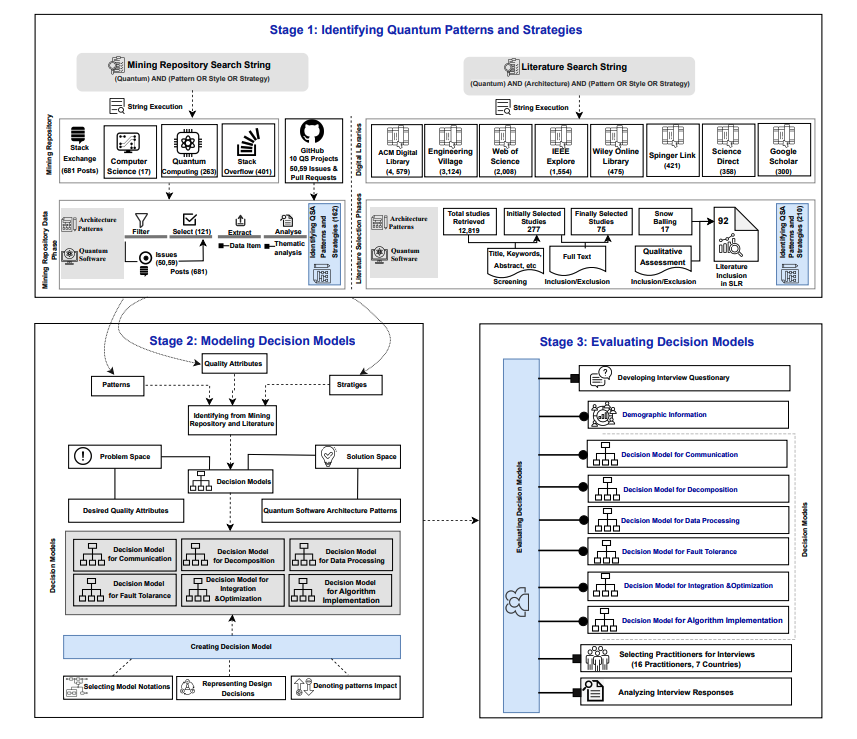
Architectural patterns and strategies offer a structured approach, providing proven solutions to recurring challenges in quantum software development. These patterns, however, are most effective when developers can readily select the appropriate solution for a given situation. To address this, researchers have developed a series of decision models designed to guide developers in selecting the most appropriate architectural patterns and strategies for quantum software systems. These models cover six critical design areas , communication, decomposition, data processing, fault tolerance, integration, optimization, and algorithm implementation , and are informed by both a comprehensive analysis of existing literature and real-world data gathered from platforms like GitHub and Stack Exchange. The team validated these models through interviews with 16 quantum software practitioners, ensuring their practicality and usefulness in addressing the challenges of designing robust and scalable quantum applications.
Adapting Classical Patterns for Quantum Software
The research team adopted a multi-faceted approach to address the challenges of designing quantum software systems, recognizing the need to bridge the gap between established software engineering practices and the novel demands of quantum computing. Rather than proposing entirely new architectural patterns, the researchers focused on adapting existing, well-understood classical patterns to the quantum domain, acknowledging their proven effectiveness while tailoring them to address unique quantum constraints such as resource management and error correction. This strategy allows developers to leverage familiar concepts while navigating the complexities of quantum technologies, promoting both innovation and stability. To identify the most relevant patterns and strategies, the team conducted a comprehensive data mining study, examining repositories like GitHub and Stack Exchange to understand how developers are currently approaching quantum software design.
This was complemented by a systematic literature review, synthesizing existing research on quantum software architecture and identifying established best practices. The combination of real-world implementation data with academic insights provided a robust foundation for developing practical decision models. The core of the methodology involved constructing decision models for six critical design areas within quantum software systems, guiding developers through the selection of appropriate patterns and strategies. These models were not created in isolation; the researchers actively engaged with 16 software practitioners through semi-structured interviews, gathering feedback on the models’ familiarity, understandability, completeness, and overall usefulness.
This iterative process of development and validation ensured the models were both technically sound and readily applicable in real-world development scenarios. Finally, recognizing the importance of reproducibility and collaboration, the team made the dataset used in their research publicly available, allowing other researchers to verify their findings and build upon their work. This commitment to open science fosters innovation and accelerates the development of robust and scalable quantum software systems.
Quantum Software Engineering Faces Unique Challenges
Quantum computing promises a revolution in processing power, moving beyond the limitations of traditional computers by harnessing the principles of quantum mechanics. Unlike classical bits representing 0 or 1, quantum bits, or Qubits, can represent both simultaneously, potentially unlocking solutions to currently intractable problems in fields like drug discovery, materials science, and complex optimization. This potential has spurred significant investment and development in Quantum Software Engineering (QSE), a new discipline focused on building the software that will run on these powerful machines. However, developing quantum software presents unique challenges.
Existing software engineering practices often don’t translate well to the quantum realm, and a lack of established best practices can hinder progress. To address this, researchers are focusing on quantum software architecture, which provides high-level design principles for building both fully quantum and hybrid quantum-classical applications. This work is crucial because architects must design systems that meet specific requirements while effectively integrating quantum capabilities. Recent research has focused on identifying and applying reusable solutions to common quantum design challenges through architecture patterns and strategies.
These patterns offer a structured framework for developing scalable and maintainable quantum software systems, but selecting the right approach can be difficult. To aid developers, researchers have created decision models based on analysis of existing quantum code repositories and a comprehensive review of published literature. These models provide guidance on selecting appropriate patterns and strategies across six critical design areas, including decomposition, data processing, and fault tolerance. Evaluation of these decision models with sixteen quantum software practitioners demonstrated their usefulness and clarity. The models were found to be understandable, complete, and helpful in addressing the challenges of quantum software architecture design, suggesting they can significantly improve the efficiency and effectiveness of quantum software development. This work represents a crucial step towards establishing a robust and mature field of Quantum Software Engineering, paving the way for the widespread adoption of quantum computing technologies.
Quantum Design Decisions for Software Practitioners
This research presents decision models designed to assist software practitioners in selecting appropriate patterns and strategies when developing software systems within the emerging field of quantum computing. By analysing data from both existing code repositories and a systematic review of published literature, the team identified relevant patterns and strategies alongside the quality attributes they address, focusing on key design areas such as decomposition, data processing, and fault tolerance. Evaluation through interviews with sixteen practitioners demonstrates that these decision models can effectively aid in the selection of suitable approaches for architectural design. The study contributes a curated dataset, publicly available for verification and further research, comprising 92 relevant studies identified through both automated searches and a rigorous snowballing technique.
A key aspect of the methodology involved a detailed quality assessment of these studies, using established guidelines and domain-specific criteria to ensure the reliability and relevance of the included data. The authors acknowledge that the automated search process carries a risk of overlooking relevant studies, which they mitigated through the snowballing method. Future work could explore the application of these decision models in real-world quantum software projects and investigate their adaptability as the field of quantum computing continues to evolve.
🗞 Decision Models for Selecting Architecture Patterns and Strategies in Quantum Software Systems
🧠 DOI: https://doi.org/10.48550/arXiv.2507.11671


See today’s quantum computing news on Quantum Zeitgeist for the latest breakthroughs in qubits, hardware, algorithms, and industry deals.