

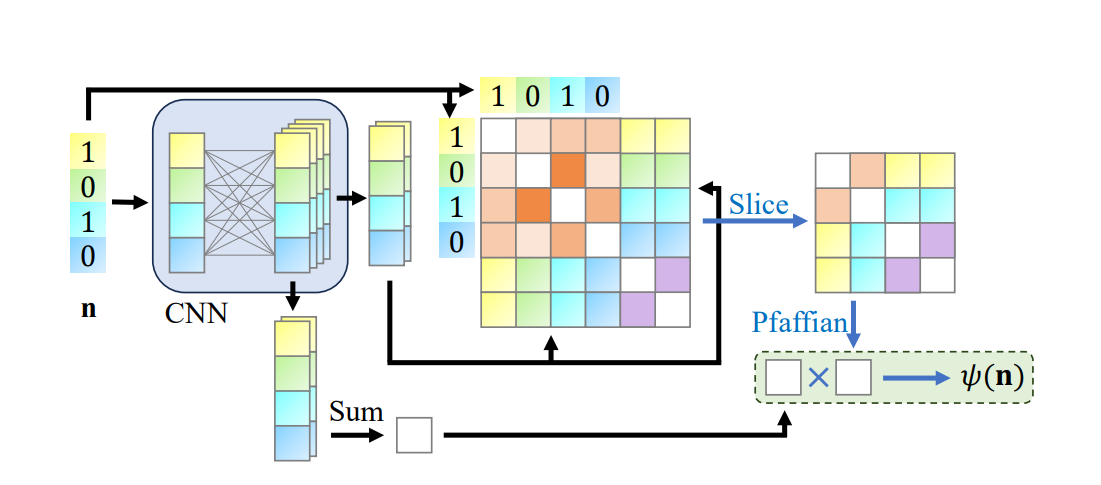
Understanding the behaviour of interacting fermions represents a major challenge in modern physics, with implications for fields such as unconventional superconductivity. Ao Chen, Zhou-Quan Wan, and Anirvan Sengupta, all from the Center for Computational Quantum Physics at the Flatiron Institute, alongside colleagues including Antoine Georges from Collège de France and Christopher Roth, present a new approach to simulating these complex systems. Their work introduces the hidden fermion Pfaffian state, a novel method that uses neural networks to represent the quantum state of interacting fermions, and crucially, accurately captures both unpaired and superconducting phases. This advancement offers a potentially scalable and highly accurate tool for exploring materials exhibiting exotic forms of superconductivity, and promises to significantly improve our understanding of strongly correlated quantum systems.
Strongly Interacting Fermions and Variational Methods
Understanding the behavior of strongly interacting fermions presents a significant challenge in condensed matter physics, particularly when seeking to understand unconventional superconductivity and the complex behavior of quantum materials. These materials often exhibit remarkably sensitive phase transitions, demanding extremely precise computational methods to predict their behavior. Current computational approaches face limitations due to computational cost or inherent approximations. Variational wave-function methods offer a promising alternative, but representing the full many-body wave-function requires clever compression techniques.
Recent advances utilize artificial neural networks to represent these complex wave-functions, offering a more flexible and potentially accurate approach than traditional methods. Applying them to fermionic systems, particularly those with strong interactions, has proven difficult, often resulting in limited improvements. Researchers have now developed a new approach, called hidden fermion Pfaffian states (HFPS), which combines the strengths of neural networks with a mathematical object called a Pfaffian. Pfaffians are well-suited to describe superconducting pairings and can represent a broad range of quantum states.
By incorporating a Pfaffian into a neural network framework, the team has created a wave-function that can flexibly represent both unpaired and superconducting phases, potentially capturing the subtle nuances of strongly correlated materials. This new HFPS architecture offers compatibility with deep neural networks and the potential for large-scale simulations. Numerical experiments demonstrate that HFPS achieves state-of-the-art accuracy in modeling the Hubbard model, a fundamental model of interacting fermions, across a range of conditions. Importantly, the method can accurately capture both conventional and unconventional pairing symmetries, suggesting it could be a valuable tool for understanding the complex physics of unconventional superconductivity and other exotic quantum phases of matter.
Neural Networks Model Fermion Interactions with Pfaffians
Researchers developed a novel computational method to study the complex behavior of interacting fermions, crucial to understanding materials with unusual properties like high-temperature superconductivity. This new method, termed the hidden fermion Pfaffian state (HFPS), leverages the power of artificial neural networks to represent the quantum state of the system, offering a more flexible and accurate way to model these interactions. The core innovation lies in extending existing neural network techniques to the realm of Pfaffians, mathematical functions that naturally describe the pairing of electrons fundamental to superconductivity. Unlike previous neural network approaches for fermions, HFPS is designed to represent both unpaired and superconducting phases within a single framework, streamlining the computational process.
This allows researchers to explore a wider range of potential material behaviors. The method’s strength also resides in its scalability, meaning it can handle increasingly complex systems without a prohibitive increase in computational cost. By encoding the quantum correlations within the neural network, the HFPS effectively compresses the information needed to describe the system, making calculations more manageable. This is a significant advancement over traditional methods which often struggle with the exponential growth in complexity as the system size increases. Furthermore, the HFPS demonstrates exceptional accuracy in modeling the Hubbard model, a simplified representation of interacting electrons in a solid. The researchers demonstrated the ability to capture both s-wave and d-wave pairing, two distinct mechanisms responsible for superconductivity in different materials, suggesting its potential to model a broad range of unconventional superconducting phases. This improved accuracy and flexibility promise to accelerate the discovery and understanding of novel quantum materials with potentially revolutionary properties.
Hidden Fermions Model Strong Electron Correlations
Researchers have developed a new approach to modeling the behavior of strongly interacting fermions, a crucial step towards understanding complex quantum phenomena like unconventional superconductivity. This method, called the hidden fermion Pfaffian state (HFPS), expands upon existing techniques by incorporating a more flexible representation of particle interactions within a mathematical framework called a Pfaffian. The Pfaffian naturally describes the pairing of electrons, essential for superconductivity, and allows for modeling both unpaired and superconducting phases simultaneously. The HFPS works by expanding the computational space to include “hidden” fermions alongside the physical ones, effectively enriching the description of electron correlations.
This allows the method to go beyond simple approximations and capture more nuanced interactions between particles. By projecting the calculations back into the physical space, the HFPS can accurately represent the ground state of complex systems, offering a powerful tool for simulating materials with strong electron interactions. The method leverages the mathematical properties of the Pfaffian to accelerate calculations and enable simulations of larger systems than previously possible. In tests against established methods, the HFPS demonstrates a significant leap in accuracy, often surpassing other approaches by a factor of ten or more.
This improvement is particularly important for resolving subtle energy differences between competing phases of matter, allowing researchers to map out precise phase diagrams of strongly interacting materials. The HFPS has successfully modeled various phases of matter, including conventional superconductors, insulating states, and complex “striped” phases with both spin and charge ordering. Furthermore, the HFPS exhibits excellent scalability, meaning its computational demands increase relatively slowly with system size. This opens the door to studying larger systems with long-range correlations, bringing researchers closer to understanding the mechanisms behind unconventional superconductivity and other exotic quantum phenomena. The method also incorporates symmetries present in many materials, further accelerating calculations and improving efficiency. This combination of accuracy, scalability, and efficiency positions the HFPS as a promising new tool for exploring the frontiers of quantum materials science.
🗞 Neural Network-Augmented Pfaffian Wave-functions for Scalable Simulations of Interacting Fermions
🧠 DOI: https://doi.org/10.48550/arXiv.2507.10705



See today’s quantum computing news on Quantum Zeitgeist for the latest breakthroughs in qubits, hardware, algorithms, and industry deals.



