The challenge of fully characterizing an unknown quantum state, a fundamental problem in quantum information science, receives a novel approach in new research led by Zvika Brakerski, Nir Magrafta, and Tomer Solomon. Building upon the recent development of Classical Shadow Tomography, which creates a classical snapshot of a quantum state for predicting measurable properties, this work shifts the focus from using complex transformations of the state itself to leveraging distributions of states as the core building block. This state-based method offers a potentially simpler and more efficient pathway to constructing these classical snapshots, and crucially, the team demonstrates that using readily computable, or pseudorandom, states is sufficient for accurately estimating the values of commonly measured properties. This represents a significant step forward, as it establishes a foundation for computational classical shadow tomography, an area previously unexplored, and paves the way for shallower, faster quantum state characterization.
Shadow Tomography Simplifies Quantum State Characterization
Characterizing a quantum state presents a fundamental challenge in quantum information science. Unlike classical data, a quantum state isn’t simply a list of numbers; it’s defined by a complex mathematical object requiring a vast amount of information to fully describe.
Traditional methods of fully determining a quantum state, known as state tomography, demand an exponential number of measurements, quickly becoming impractical even for modest systems. However, researchers are exploring ways to relax the requirements for full characterization, seeking methods that can estimate key properties of a quantum state with fewer resources.
One promising approach is shadow tomography, which aims to estimate the outcomes of many potential measurements on a quantum state without fully reconstructing the state itself. Recently, researchers have taken this concept a step further with classical shadows, a method that relies entirely on classical information.
This means the complex quantum state is effectively imprinted onto a set of classical data, allowing researchers to predict measurement outcomes using only classical computation. This is particularly appealing as it bypasses the need for complex quantum algorithms for data processing, opening doors to applications where quantum resources are limited.
Generating these classical snapshots efficiently has been a key area of focus. Current methods typically rely on applying random transformations to the quantum state, demanding increasingly complex quantum circuits. The depth of these circuits, essentially the number of sequential operations, is a critical factor, as deeper circuits are more susceptible to errors in real quantum computers.
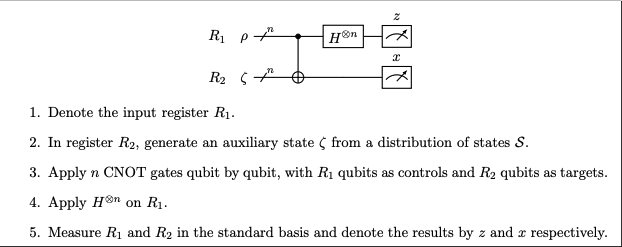
Researchers have introduced a novel approach that shifts the focus from random transformations to distributions over quantum states themselves. By entangling the unknown quantum state with a carefully prepared auxiliary state, they create a snapshot using a simpler, more efficient process.
This state-based method offers a significant advantage in terms of circuit depth. The core operation, generating the snapshot, can be achieved with a constant depth circuit, meaning it requires only a minimal number of sequential operations. Furthermore, their analysis demonstrates that for many practical scenarios, using only pseudorandom states is sufficient to achieve accurate results.
This is a crucial finding, as pseudorandom states are much easier to generate than truly random ones, further simplifying the implementation of classical shadow tomography. This work not only advances the efficiency of classical shadows but also opens new avenues for exploring computational approaches to quantum state characterization, potentially bridging the gap between quantum systems and classical computation.
Classical Shadows Simplify Quantum State Characterization
Researchers have developed a novel technique for characterizing quantum states, offering a potentially significant advancement over existing methods. This approach, termed “state-based classical shadows,” allows scientists to estimate the outcomes of a vast number of measurements on a quantum state using only classical information, dramatically reducing the need for complex quantum processing.
This is particularly important as building and maintaining stable quantum computers remains a substantial challenge. Traditionally, determining the properties of a quantum state requires exponentially increasing resources as the complexity of the state grows.
This new method circumvents this limitation by creating a “classical snapshot” of the state, effectively capturing its essential characteristics in a manageable form. Instead of directly reconstructing the full quantum state, a task demanding immense computational power, the technique focuses on predicting the results of measurements performed on that state.
This is achieved by cleverly entangling the unknown quantum state with an independently prepared auxiliary state and then performing a relatively simple measurement. The breakthrough lies in shifting the focus from complex quantum circuits to utilize properties of states themselves as the building blocks for generating these snapshots.
Previous methods relied on intricate sequences of quantum operations, demanding significant circuit depth, a critical factor in minimizing errors on noisy quantum hardware. This new approach simplifies the process, achieving the snapshot generation with a constant circuit depth, meaning the complexity of the quantum operations remains minimal regardless of the system size.
The implications of this advancement are considerable. By reducing the demand for complex quantum processing, the technique opens doors to more efficient characterization of quantum systems in various applications, including materials science, quantum information theory, and even quantum cryptography.
Furthermore, the method’s reliance on classical information makes it particularly appealing for scenarios where quantum resources are limited or unavailable. The researchers demonstrate that using readily available, even “pseudorandom,” states is sufficient to achieve accurate estimations, further streamlining the process and reducing computational overhead.
This work represents a significant step towards making quantum state characterization more accessible and practical for a wider range of scientific endeavors.
State Distributions Simplify Quantum Tomography
This research presents a novel approach to classical shadow tomography, a technique for efficiently characterizing unknown quantum states. Rather than relying on distributions of unitary transformations, the standard method, the authors demonstrate that distributions of quantum states can serve as equally effective building blocks for creating a classical snapshot of the input state.
This snapshot then allows for prediction of observable properties without directly measuring the original, potentially fragile, quantum system. The key innovation lies in entangling the unknown state with an independently prepared auxiliary state and measuring the resulting combined system, simplifying the computational demands of the process.
The team’s analysis reveals that, for efficiently computable observables, even pseudorandom families of states are sufficient to generate accurate classical shadows. This is a significant finding, as it opens the door to computationally simpler methods for quantum state characterization, and represents the first exploration of computational classical shadow tomography.
Importantly, the online portion of their method, the part interacting with the unknown input, is remarkably efficient, requiring only a measurement in the Bell basis which can be implemented with a minimal number of quantum operations. While the authors acknowledge that a full analytical solution for inverting the quantum channel used in their method remains an open problem, they demonstrate comparable performance to existing techniques when using state designs, and even offer advantages in certain scenarios.
The authors also investigated the accuracy of their method under different levels of approximation for the state designs used, finding that even additive approximations, where the statistical moments of the state distribution are close to those of a random state, can yield meaningful classical shadows. This expands the flexibility of the approach and allows for potentially simpler state preparation procedures.
Future work could focus on a comprehensive analysis of the channel inversion problem, or exploring the limits of approximation achievable without compromising the accuracy of the resulting classical shadows. “`




See today’s quantum computing news on Quantum Zeitgeist for the latest breakthroughs in qubits, hardware, algorithms, and industry deals.