
The quest to see ever-smaller details within cells and tissues drives constant innovation in microscopy. Yongtao Liu, Tianxiao Wu, and colleagues at Nanjing University of Science and Technology, alongside Fan Wang at Beihang University, present a new approach to super-resolution microscopy that dramatically simplifies the process while achieving exceptional clarity. Their research demonstrates a technique called Progressively Emission Saturated Nanoscopy (CPSN), which uses the unique properties of upconversion nanoparticles and the power of deep learning to overcome the limitations of conventional methods. By carefully controlling the excitation light and employing a sophisticated image reconstruction algorithm, the team achieves a spatial resolution of just 33 nanometres – significantly beyond the diffraction limit of light – with a substantial improvement in signal-to-noise ratio, paving the way for simpler, more accessible, and higher-quality super-resolution imaging across a wide range of wavelengths.
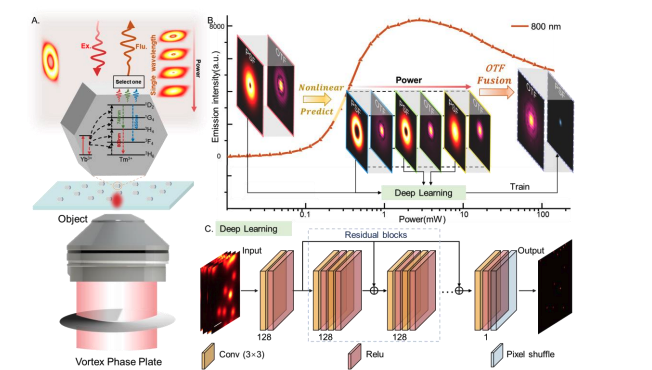
Computational Progressively Emission Saturated Nanoscopy (CPSN) simplifies super-resolution microscopy by combining upconversion nanoparticles (UCNPs) with deep learning. Traditional light microscopy is limited by the wave nature of light, restricting the level of detail visible in images. While existing super-resolution techniques overcome this limitation, many require complex optical setups or specialised fluorescent materials. CPSN addresses this challenge by harnessing the unique properties of UCNPs, which absorb multiple low-energy photons and emit a single higher-energy photon, creating a nonlinear relationship between illumination and brightness. The technique centres on carefully controlling the excitation power of a single doughnut-shaped beam to modulate the UCNPs’ response, effectively accessing different spatial frequencies within the sample. This allows researchers to reveal finer details that would otherwise be blurred. Instead of complex optics, the team uses deep learning – a type of artificial intelligence – to reconstruct a super-resolved image.
The system predicts how the image would appear under different illumination conditions, effectively fusing information from multiple ‘virtual’ images and leveraging the full range of spatial frequencies captured by the UCNPs. This results in a significantly sharper image than conventional microscopy and eliminates the need for manual adjustments. The method involves generating a spectrum of excitation states within the UCNPs by modulating the power of the doughnut-shaped beam. This effectively encodes a range of spatial frequency information within progressively saturated point spread functions (PSFs). A Deep Recursive Residual Network (DRRN) then fuses this information, generating a final super-resolved image that encompasses the full spectral content. The results demonstrate a remarkable improvement in resolution, achieving detail 29 times finer than the wavelength of light used for excitation, and a dramatic improvement in the signal-to-noise ratio, producing clearer, more vibrant images. CPSN offers several advantages over existing techniques, including reduced system complexity, minimised potential damage to the sample, and enhanced image quality with improved resolution, minimal distortion, and reduced information loss. While this study demonstrates the potential of DRRN for spectral fusion, obtaining optimal results with limited training data remains a challenge. Future efforts will focus on developing more efficient data generation strategies and exploring adaptive solutions to further enhance the performance and generalisability of CPSN for various super-resolution microscopy techniques. This approach has the potential to be widely adopted, offering a powerful and accessible tool for researchers across a range of disciplines.
👉 More information
🗞 Nonlinear Spectral Fusion Super-Resolution Fluorescence Microscopy based on Progressively Saturated Upconversion Nanoparticles
🧠 DOI: https://doi.org/10.48550/arXiv.2507.10129