The precise measurement of physical parameters underpins progress across science and technology, with applications spanning fundamental research to medical diagnostics. Keshav Das Agarwal, Sayan Mondal, and Ayan Sahoo, alongside colleagues at the Harish-Chandra Research Institute, review the rapidly developing field of quantum sensing, which promises to dramatically improve measurement precision. Their work explores how leveraging quantum phenomena – such as coherence and entanglement – allows scientists to surpass the limitations of traditional sensing techniques. This review brings together diverse approaches to quantum sensing, encompassing both ensemble systems like Bose-Einstein condensates and light-matter interactions, and lattice systems modelled by complex quantum models, offering a comprehensive overview of this exciting frontier.
Quantum Sensing Surpasses Classical Measurement Limits
Precise measurement underpins much of modern science and technology, and quantum sensing represents a revolutionary approach promising to surpass the limitations of classical techniques. This emerging field leverages the bizarre yet powerful principles of quantum mechanics – such as entanglement and coherence – to detect incredibly subtle changes in physical parameters like magnetic fields, time, and even gravity. The potential impact is enormous, offering new tools for materials science, medical imaging, and the search for elusive phenomena like dark matter.
Currently, many sensors are limited by inherent uncertainty in quantum systems that introduces noise and obscures the signal being measured. Quantum sensing aims to overcome this barrier by carefully preparing and manipulating quantum states – the fundamental building blocks of reality – to minimize this noise and extract the maximum possible information. This often involves creating entangled states, where multiple particles are linked, or exploiting quantum coherence, where particles exist in multiple states simultaneously.
These quantum properties allow sensors to detect signals far weaker than would be possible with classical methods. Recent advances focus on harnessing ultracold atoms and molecules, alongside trapped ions, as platforms for building these advanced sensors. These systems offer exceptional control and isolation from environmental noise, allowing researchers to create and manipulate quantum states with remarkable precision.
By trapping atoms in optical lattices – created by interfering laser beams – or using precisely controlled electromagnetic fields, scientists can simulate complex quantum systems and engineer materials with tailored properties. This ability to design and control quantum systems is crucial for developing sensors that are both highly sensitive and robust. Furthermore, researchers are exploring the use of quantum phenomena like quantum criticality – the point at which a material undergoes a dramatic change in its properties – to enhance sensing capabilities.
By operating sensors near a quantum critical point, it’s possible to amplify the signal being measured and achieve even greater precision. This approach, alongside the development of collective atomic systems that mimic the behaviour of many interacting particles, is opening up new avenues for designing sensors with enhanced resilience and performance. The ultimate goal is to create quantum sensors that are not only incredibly sensitive but also practical and scalable for real-world applications, ushering in a new era of precision measurement and scientific discovery.
Pioneering Quantum Sensing with Tailored Atomic Systems Researchers
Pioneering Quantum Sensing with Tailored Atomic Systems Researchers are increasingly turning to quantum systems to develop sensors with unprecedented precision. This work focuses on harnessing the unique properties of collective atomic systems – specifically, ensembles of atoms exhibiting quantum behaviour – to create highly sensitive detectors. The core strategy involves carefully engineering the quantum state of these atomic ensembles to maximize their sensitivity to external influences.
The approach centres on manipulating Bose-Einstein condensates (BECs), a state of matter where atoms behave collectively as a single quantum entity. Instead of relying on individual atoms, the team leverages many-body quantum effects to enhance sensing capabilities. A key innovation lies in the use of a ‘Bosonic Josephson Junction’ – essentially two interconnected BECs – to create a system where quantum entanglement can be precisely controlled.
Researchers don’t simply rely on naturally occurring quantum states; they actively shape the quantum properties of the BECs using carefully tuned control parameters. By adjusting the interactions between the two BECs, they can drive the system into different quantum regimes – from coherent spin states to highly squeezed states. ‘Spin squeezing’ is a particularly important technique, reducing quantum noise in one direction at the expense of increased noise in another, effectively focusing the sensor’s sensitivity.
The team employs both ‘adiabatic’ and ‘diabatic’ methods to achieve these tailored quantum states. Adiabatic methods involve slowly changing the system’s parameters, allowing it to evolve smoothly. Diabatic methods, conversely, involve rapid changes, offering faster control but requiring more precise manipulation.
Recent advances include ‘shortcuts to adiabaticity’ – techniques that mimic the benefits of slow evolution even with rapid changes, offering a powerful combination of speed and control. Furthermore, techniques like ‘one-axis twisting’ and ‘two-axis counter-twisting’ are used to dynamically generate spin-squeezed states, further enhancing the sensor’s performance. The ultimate goal is to achieve the ‘Heisenberg Limit’ (HL) of precision, a theoretical benchmark for quantum sensing.
By carefully controlling the entanglement and squeezing within the BEC system, the researchers demonstrate the potential to create sensors that approach this limit, promising significant improvements in sensitivity and accuracy. ## Pushing the Limits of Precision: Quantum Sensing with Advanced Materials Researchers are achieving remarkable advances in quantum sensing, developing techniques that promise to dramatically improve our ability to measure physical parameters with unprecedented accuracy. This progress stems from harnessing the unique properties of materials like Bose-Einstein condensates and specially engineered atomic lattices, moving beyond the limitations of traditional sensing methods.
A key area of investigation focuses on the Fermi-Hubbard model – a theoretical framework describing interacting electrons in a lattice – and its application to precision measurement. Studies reveal that manipulating the entanglement within these systems can significantly enhance sensing capabilities. Specifically, researchers have demonstrated that by carefully controlling the interactions between atoms in these lattices, they can generate high levels of entanglement, a quantum property that directly translates to improved measurement precision.
This is particularly promising for atomic clocks, where
This is particularly promising for atomic clocks, where recent work has overcome a key challenge – maintaining coherence while creating entanglement – by exploiting subtle effects of spin-orbit coupling. Beyond atomic clocks, these materials are also proving valuable for thermometry. By employing sophisticated algorithms and considering the fundamental statistical properties of the system, researchers are achieving more accurate temperature estimations than previously possible.
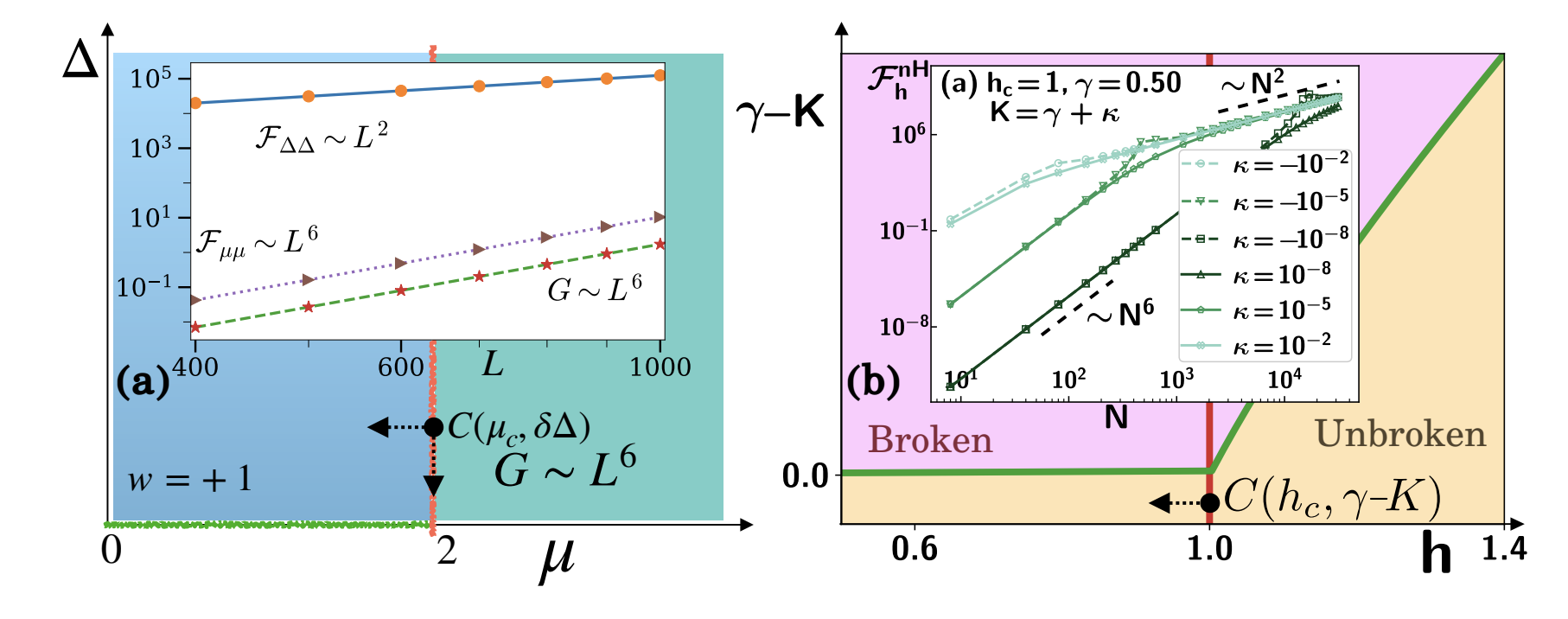
However, the most exciting breakthroughs are occurring at the edges of material behaviour. Researchers are discovering that exploiting critical points – the precise conditions where a material undergoes a phase transition – can dramatically amplify sensing capabilities. For example, by carefully tuning a system to the point where electrons transition between localized and delocalized states, the precision of field measurements can be boosted, scaling with system size in some cases.
Similarly, leveraging the unique properties of quasiperiodic potentials – carefully designed patterns that exhibit order without strict repetition – allows researchers to saturate the Heisenberg limit, achieving optimal measurement precision. Perhaps most intriguingly, researchers are exploring how topological phase transitions – fundamental changes in a material’s electronic structure – can provide robust and highly sensitive sensing platforms. By exploiting the emergence of protected edge states during these transitions, they are developing sensors that are inherently resistant to local disturbances, promising reliable and accurate measurements even in noisy environments.
Quantum Sensing with AMO Systems Quantum sensing is a rapidly maturing field within quantum technology, demonstrating the potential of utilising quantum properties – such as coherence and entanglement – to surpass classical limitations in sensing applications. This work consolidates current understanding of quantum sensing, exploring how quantum mechanics can enhance the precision of parameter estimation across diverse physical systems, moving towards the ultimate precision defined by the quantum Cramér-Rao bound. The work surveys sensing strategies implemented in ensemble systems – including spin ensembles, light-matter interactions, and Bose-Einstein condensates – and extends this analysis to lattice systems modelled by the Bose-Hubbard, Fermi-Hubbard, and spin models.
The authors emphasise that atomic, molecular, and optical (AMO) systems are leading platforms for quantum sensing due to their minimal noise and exceptional controllability. These systems, capable of hosting both bosonic and fermionic particles, offer versatile avenues for realising highly sensitive sensors. The authors acknowledge that further research is needed to identify and design the most resilient and precise quantum sensors, particularly focusing on programmable quantum materials.
While this review provides a comprehensive overview of existing approaches, it serves as a foundation for future investigations aimed at optimising sensor performance and expanding the range of detectable parameters.
🗞 Quantum sensing with ultracold simulators in lattice and ensemble systems: a review
🧠 DOI: https://doi.org/10.48550/arXiv.2507.06348



See today’s quantum computing news on Quantum Zeitgeist for the latest breakthroughs in qubits, hardware, algorithms, and industry deals.