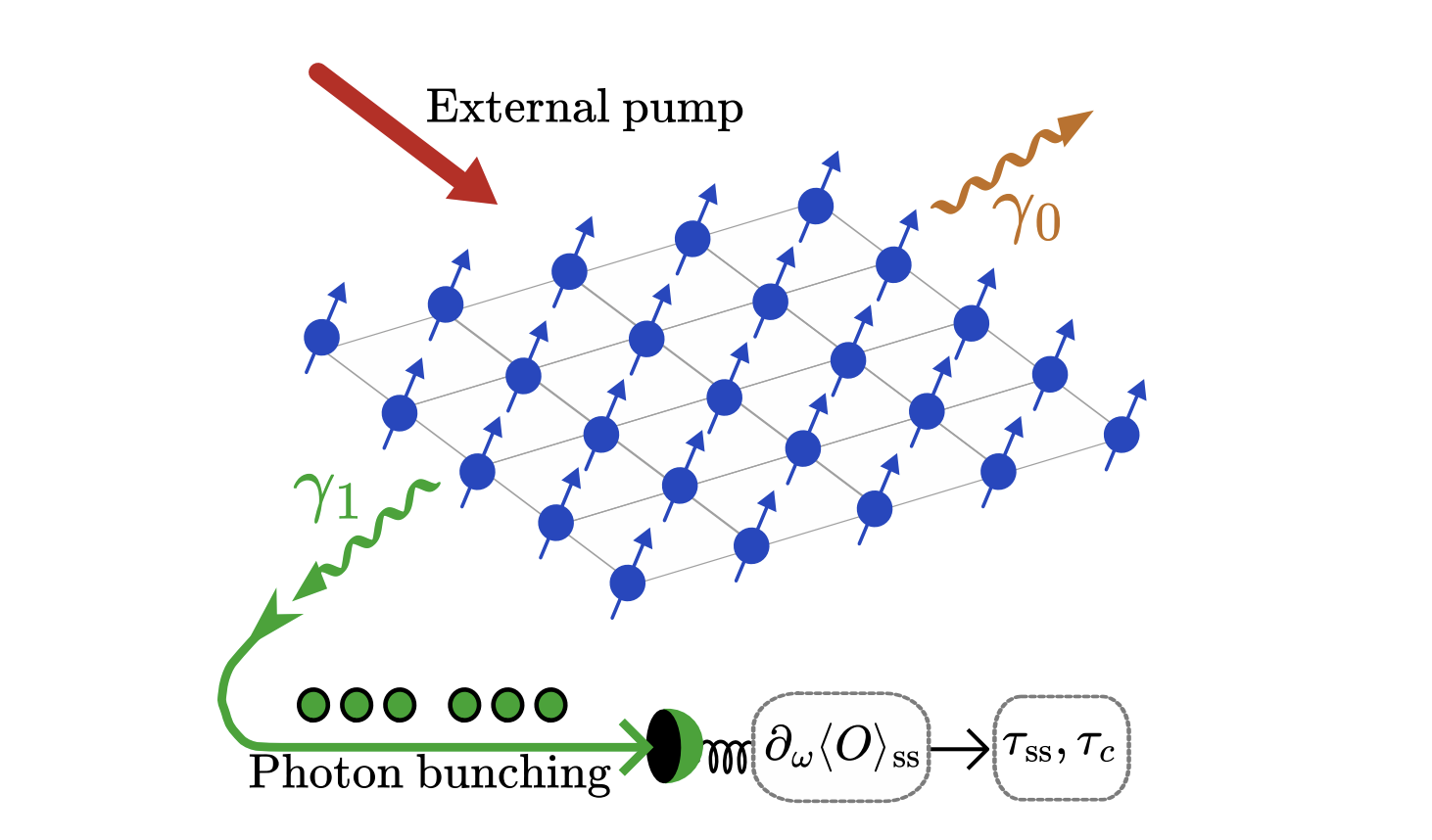
Understanding how systems change over time presents a significant challenge in physics, as accurately capturing these dynamics typically demands measurements faster than the system itself evolves, or complex computational modelling. Wojciech Górecki from INFN Sez. Pavia, Simone Felicetti from the Institute for Complex Systems (ISC-CNR), and Lorenzo Maccone from INFN Sez. Pavia, with colleagues, now demonstrate a novel method for determining these crucial time-dependent properties using only readily measurable, steady-state characteristics. The team develops general lower bounds for relaxation and correlation times, calculated from expectation values and their response to external controls, offering a powerful tool for analysing both experimental data and complex theoretical models. This approach successfully matches known results for critical systems, and importantly, provides new insights into systems – such as the infinite-range Ising model – where traditional dynamic analysis is currently impossible, opening avenues for characterising ultrafast phenomena and tackling previously intractable many-body problems.
Measuring Ultrafast Dynamics Without Fast Measurement Understanding how quickly a system changes is fundamental across many areas of physics, from lasers and quantum dots to the study of phase transitions. Directly measuring these rapid changes, however, presents a significant challenge, often requiring measurement speeds faster than the system’s dynamics or complex theoretical calculations. Researchers have developed a novel approach that overcomes these limitations, offering a new way to characterise ultrafast systems and gain insights into their behaviour.
The team’s method circumvents the need for extremely fast detectors by establishing a connection between a system’s steady-state properties – what can be measured when the system settles into a stable condition – and its underlying dynamic timescales. Instead of directly measuring the speed of change, they demonstrate a way to infer these timescales from static measurements. This innovative technique leverages principles from quantum metrology – the science of precise measurement – and information theory, revealing that the sensitivity of a system’s steady-state expectation value to small changes in a control parameter provides a lower bound on the system’s relaxation and correlation times.
Essentially, how much a measurable property shifts with a slight adjustment to a system parameter reveals information about how quickly the system responds to change. This is a powerful concept because steady-state measurements are far easier to perform than time-resolved measurements, opening up possibilities for characterising systems previously beyond experimental reach. To validate their approach, the researchers applied it to two distinct examples.
First, they examined a driven-dissipative resonator, where their calculated bounds closely matched existing analytical results. More significantly, they then turned to the infinite-range Ising model, a complex quantum system where solving the equations of motion is notoriously difficult. In this case, their method provided new insights into the system’s correlation behaviour, offering information that would be hard to obtain through traditional methods.
This demonstrates the broad applicability of their technique, offering a valuable tool for both theoretical analysis and experimental characterisation of complex quantum systems and beyond. The research presents a way to estimate the temporal characteristics of open quantum systems without needing to solve the complicated equations that describe their full dynamics. Open quantum systems interact with their environment, losing energy, for example, through photon emission.
The authors focus on using stationary properties of the system to infer how quickly it responds to changes or how long it takes to reach equilibrium. They demonstrate that information about the dynamics can be obtained from the statics, deriving mathematical inequalities that relate the relaxation time – how quickly the system settles down – and the correlation time of emitted photons to the steady-state properties of the system. Specifically, these bounds are determined by the derivative of the average magnetization (or a similar quantity) with respect to a control parameter, such as an external field.
The researchers demonstrated the effectiveness of their approach on a lossy cavity with squeezing, a quantum optical system where they could compare their bounds to exact analytical solutions, and on the dissipative transverse-field Ising model, a more complex many-body system where analytical solutions are difficult to obtain, making their bounds particularly valuable. For the Ising model, they found that the relaxation and correlation times scale linearly with the number of particles at the critical point, suggesting a fundamental dynamical property of the system. They also predict strong photon bunching in the dissipative Ising model, contrasting with the anti-bunching expected from a single spin.
The results demonstrate that quantum metrology with continuous measurements provides general lower bounds on both the relaxation and second-order correlation times. These bounds are easily calculated and measured, relying solely on steady-state expectation values and their derivatives with respect to a control parameter. This method extends readily to the autocorrelation of arbitrary observables, offering a versatile approach to characterise quantum systems.
In conclusion, the researchers have established a relation between the correlation time of out-of-equilibrium open quantum systems and their sensitivity to parameter changes. Specifically, they demonstrate that in critical models, extreme sensitivity is intrinsically linked to long relaxation and second-order correlation times. This relation provides a powerful tool for analysing the second-order correlation function in scenarios where only steady-state properties are accessible, and the full time dynamics are analytically or numerically intractable.
The developed framework can be extended to relate time autocorrelations of arbitrary observables with the system’s sensitivity to general Hamiltonian perturbations, opening new avenues for probing quantum criticality in dissipative systems. Possible extensions of this work include considering non-Markovian dynamics.
👉 More information
🗞 Time correlations from steady-state expectation values
🧠 DOI: https://doi.org/10.48550/arXiv.2507.08661