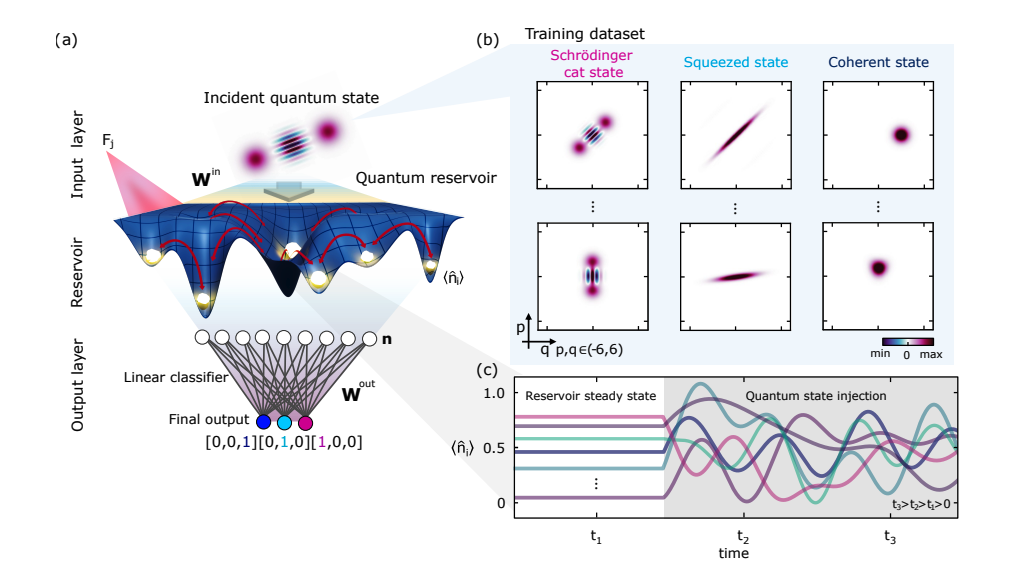
Quantum optical neural networks (QONNs) represent a developing field that merges the principles of quantum optics with machine learning, potentially offering computational advantages over classical systems. Świerczewski et al. present a novel computational framework to address a key limitation in QONN research: the difficulty of simulating large-scale bosonic lattices. Bosonic lattices are arrangements of bosons – particles that obey Bose-Einstein statistics – and are used to represent the quantum states within the network. The exponential growth of the Hilbert space – the mathematical space encompassing all possible quantum states – hinders accurate simulation of these networks. Their work employs the positive-P method, a phase-space technique, to efficiently model these systems, enabling the investigation of larger networks than previously possible. This approach facilitates validation of performance in machine learning tasks, specifically state classification and feature prediction, and reveals a nuanced relationship between reservoir size, nonlinearity, and input signal strength in determining overall performance.
Researchers develop a computational framework enabling the simulation of quantum optical neural networks (QONNs) with a significantly increased scale, potentially unlocking new capabilities in quantum information processing. QONNs represent a hybrid approach, integrating principles of classical neural networks with the laws of quantum optics to perform computations beyond the reach of conventional systems. A key limitation in the field has been the computational expense associated with accurately modelling these networks, particularly as their size increases.
The challenge stems from the exponential growth of the Hilbert space, a mathematical space encompassing all possible states of a quantum system. Accurately describing a system requires tracking the probabilities of all these states, a task that quickly becomes intractable for even moderately sized networks. Previous simulations have been restricted to small systems, limiting the exploration of more complex, multimode QONNs – networks capable of processing multiple streams of quantum information simultaneously.
Świerczewski and colleagues circumvent this limitation by employing
Świerczewski and colleagues circumvent this limitation by employing the positive-P method, a stochastic approach within phase-space representation. Phase-space, in quantum mechanics, describes the system using variables analogous to classical position and momentum, but incorporating quantum uncertainties. The positive-P method represents quantum states using a probability distribution in this phase-space, allowing for efficient simulation using classical computers. This method introduces stochastic noise, but the researchers demonstrate that this noise does not significantly impede performance in tasks such as quantum state classification and quantum future prediction.
The team successfully simulates systems containing dozens of nodes, classifying them as noisy intermediate-scale quantum (NISQ) systems. NISQ devices represent a current generation of quantum computers that are powerful enough to explore certain quantum algorithms, but still susceptible to errors. The simulations reveal that simply increasing the number of bosonic modes in a reservoir does not guarantee improved performance; instead, performance is governed by a complex interplay between nonlinearity, reservoir size, and the average occupation of the input mode. Specifically, dispersing input quantum information across too many reservoir nodes reduces the effective nonlinearity, degrading computational efficiency.
Optimisation of the reservoir demonstrates an optimal balance between reservoir size and input field density for a given quantum task. These findings are essential for the rational design and optimisation of optical bosonic reservoirs intended for future quantum neuromorphic computing devices. Future work could explore the impact of different reservoir topologies and coupling schemes on network performance, investigate robustness to noise, and explore potential for on-chip implementation.
More informationPhase-Space Framework for Noisy Intermediate-Scale Quantum Optical
Phase-Space Framework for Noisy Intermediate-Scale Quantum Optical Neural Networks
DOI: https://doi.org/10.48550/arXiv.2507.07684