Researchers demonstrate a method for detecting bosonic codes, applicable to rotation-symmetric and Gottesman-Kitaev-Preskill (GKP) codes, using an adaptive phase estimation algorithm with a single ancilla qubit. Detection precision achieves the Heisenberg limit, enabling efficient identification of excitation loss and displacement, and generation of arbitrary Fock states.
Addressing the Challenge of Quantum Decoherence
The Challenge of Quantum Error Correction
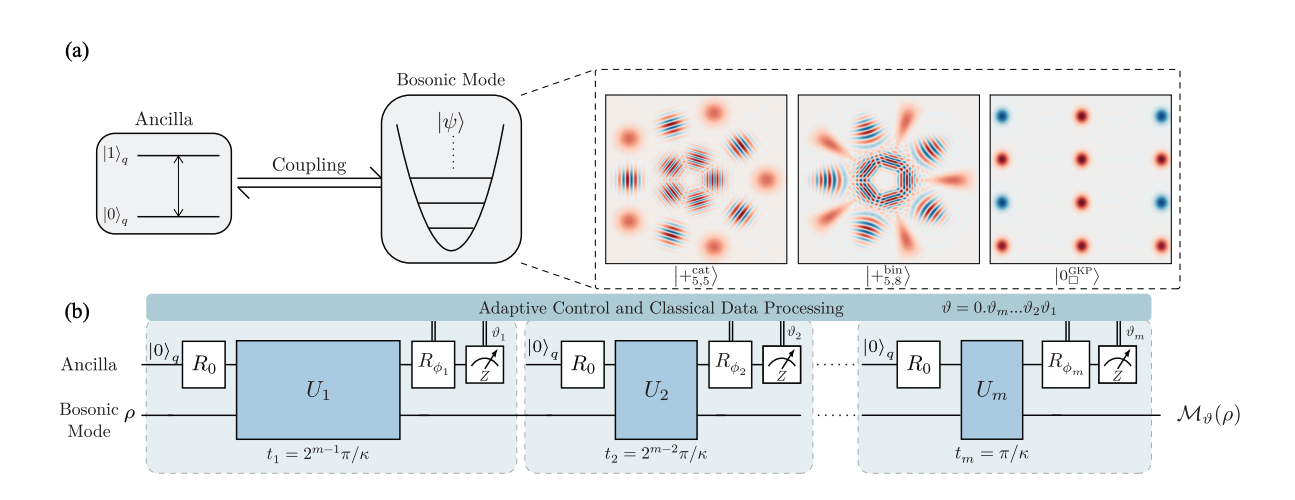
Quantum error correction represents a critical challenge in realising practical quantum computation, as the fragility of quantum states demands robust methods to preserve information. Researchers now present a versatile technique for detecting errors in bosonic codes, a class of quantum codes particularly suited for continuous variable quantum systems. Yuan-De Jin, from the Institute of Semiconductors, Chinese Academy of Sciences, Shi-Yu Zhang from the University of Michigan, and colleagues detail their approach in the article, ‘General Approach to Error Detection of Bosonic Codes via Phase Estimation’, demonstrating its efficacy across several code types, including rotation-symmetric and Gottesman-Kitaev-Preskill (GKP) codes. The method utilises an adaptive phase estimation algorithm, assisted by a single ancillary qubit, to achieve detection precision scaling to the Heisenberg limit, and offers a pathway towards implementing error detection in current experimental setups.
Quantum information processing fundamentally relies on the manipulation of qubits, yet these systems are inherently susceptible to environmental noise, inducing decoherence and errors. Protecting quantum information therefore necessitates quantum error correction (QEC), a suite of techniques designed to mitigate these errors and preserve the integrity of quantum computations. Bosonic QEC represents a promising avenue, utilising continuous variable systems and potentially offering hardware efficiency advantages over traditional qubit-based approaches, as recent experiments demonstrate bosonic codes are approaching the point where logical qubit coherence surpasses that of the physical qubits comprising it.
Bosonic codes are typically implemented using platforms such
Bosonic codes are typically implemented using platforms such as circuit quantum electrodynamics, trapped ions, and quantum acoustic systems, each presenting unique challenges and opportunities for optimisation. These codes broadly categorise by their underlying symmetry, with rotation-symmetric codes addressing errors like bosonic loss and dephasing, and translation-symmetric codes tackling displacement errors, demanding precise error detection for effective QEC. Bosonic loss refers to the loss of photons from the system, while dephasing describes the loss of the phase relationship between quantum states.
Developing the Adaptive Detection Algorithm
A Novel Method Using Adaptive Phase Estimation
This research establishes a versatile method for detecting bosonic quantum codes, employing an adaptive phase estimation algorithm facilitated by a single ancilla qubit. The technique proves broadly applicable to codes defined by symmetry or stabilizer operators, encompassing both rotation-symmetric codes and the Gottesman-Kitaev-Preskill (GKP) codes. Stabilizer operators are a set of operators used to define and characterise quantum error correcting codes. Crucially, the detection precision scales inversely with the total evolution time, achieving the Heisenberg limit, a fundamental benchmark in quantum metrology, representing the maximum precision achievable in a measurement.
Simulation Results and Code Validation
Simulation Results and Practical Code Detection
Researchers demonstrate the efficacy of this method through numerical simulations, specifically focusing on detecting bosonic excitation loss in higher-order cat and binomial codes, and displacement errors in finite-energy GKP codes. Cat and binomial codes utilise superposition states to encode information, while GKP codes encode qubits into continuous variables, offering resilience against certain types of noise. Superposition refers to the ability of a quantum system to exist in multiple states simultaneously. Furthermore, the research extends the capabilities of this method to efficiently generate arbitrary Fock states, which are essential resources for various quantum information processing tasks. Fock states represent a specific number of photons in a particular mode of the electromagnetic field.
The practicality of these schemes is underscored by
The practicality of these schemes is underscored by their feasibility within the constraints of current experimental capabilities, achieved through leveraging established techniques in circuit quantum electrodynamics (cQED), making the proposed methods readily implementable in existing quantum computing platforms. cQED involves coupling superconducting circuits to microwave photons, enabling the manipulation and control of quantum information. By achieving Heisenberg-limited precision and demonstrating compatibility with existing technology, this research contributes to the ongoing development of robust and efficient quantum information processing systems.
Future Potential and Advanced Error Modeling
Future Outlook and Advanced Error Modeling
Future research will likely focus on optimising the adaptive phase estimation algorithm for specific code parameters and noise environments, and investigating the robustness of the scheme against more complex error models, such as correlated errors, also presents a valuable avenue for exploration. Correlated errors occur when errors on different qubits are not independent. Furthermore, extending this approach to detect and correct errors in larger, more complex quantum codes remains a significant challenge and a key direction for advancing fault-tolerant quantum computation, paving the way for a future of robust and scalable quantum technologies.
🗞 General Approach to Error Detection of Bosonic Codes via Phase Estimation
🧠 DOI: https://doi.org/10.48550/arXiv.2507.03999
The implementation of this detection scheme inherently relies on the continuous monitoring of the system’s quadratures, typically achieved through homodyne or heterodyne detection in optical systems. These measurement techniques allow for the reconstruction of the complex electric field operator, $\hat{E}(t)$, at specific times and bases. By accurately measuring fluctuations in the field quadratures, the researchers effectively map environmental noise into measurable deviations from the ideal bosonic state manifold, providing quantitative metrics for error identification that are crucial for real-time feedback control.
Achieving the Heisenberg limit precision implies that the fundamental measurement time-energy uncertainty relation is utilized to maximize the quantum Fisher information extracted from the ancillary state. Specifically, the adaptive nature of the phase estimation suggests an iterative optimization process, where subsequent measurements adjust the unitary rotation angles based on the initial estimates, thereby minimizing the total measurement variance $\Delta \phi$ for a given coherence time, $\tau$.
From a theoretical perspective, the efficiency gains are rooted in the use of bosonic codes, which are naturally described by continuous Hamiltonians that preserve the symmetry of the vacuum state. This continuous variable nature allows error syndrome extraction not just through discrete checks, but through the measurement of continuous observables, such as the expectation value of the displacement operator, $\langle \hat{D} \rangle$, which signals the presence of accumulated phase or amplitude errors.
See today’s quantum computing news on Quantum Zeitgeist for the latest breakthroughs in qubits, hardware, algorithms, and industry deals.