The demand for faster, more efficient data transmission within microelectronic and photonic systems continues to drive innovation in interconnect technologies. Researchers are now exploring terahertz (THz) frequencies, a region of the electromagnetic spectrum offering substantial bandwidth potential, but hampered by challenges in miniaturisation and control. A new theoretical framework addresses these issues by utilising plasmonics, specifically surface plasmon polaritons (SPPs), to create chip-scale meta-networks capable of dynamically routing THz signals. This approach, detailed in the article ‘Terahertz Chip-Scale Meta-Networks with LSPR Routing: A Theoretical Framework’, is presented by Maryam Khodadadi, Hamidreza Taghvaee, and colleagues from IEEE, who demonstrate a method for modulating impedance to control the flow of localised surface plasmon resonances (LSPRs) and establish reconfigurable pathways for high-speed communication within integrated circuits.
Terahertz (THz) plasmonic communication offers a potential solution to the escalating limitations of current chip-scale interconnects, addressing issues of electrical resistivity, latency, congestion and electromagnetic interference that increasingly plague traditional wired and wireless links. Researchers actively develop methods to harness surface plasmon polaritons (SPPs) – electromagnetic waves that propagate along the interface between a metal and a dielectric material – for high-bandwidth, low-latency data transmission within nanophotonic platforms, thereby pushing the boundaries of data transfer speeds and efficiency. A novel Binary Field-Driven Meta-Routing Method enables dynamic control of THz plasmonic phenomena and electromagnetic properties, paving the way for more adaptable and efficient communication systems.
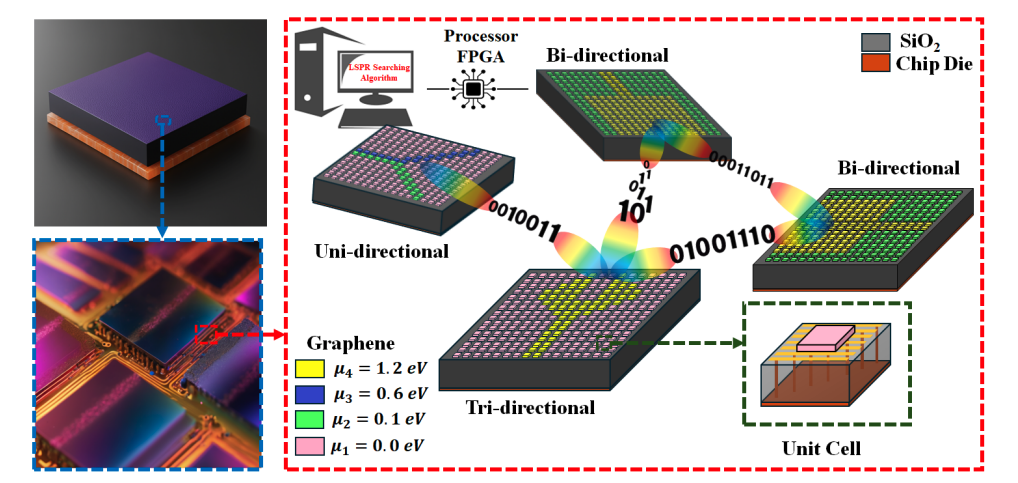
This method modulates impedance to facilitate the coupling and routing of localized surface plasmon resonances (LSPRs) across a meta-network, achieving real-time beam steering within chip-scale systems and optimising signal delivery. LSPRs represent the collective oscillation of electrons at the surface of a metallic nanostructure when excited by light. The approach integrates analytical conductivity models, coupled-mode theory, a mathematical framework used to describe the interaction of electromagnetic waves with coupled optical resonators, and algorithmic control, allowing for the predictive configuration of LSPR-based steering in reconfigurable metasurfaces and ensuring precise control over signal propagation. Researchers demonstrate the capabilities of four distinct meta-pixel antenna configurations – the Y-MetaRouter, MetaSwitcher, Penta-MetaEmitter, and CP-MetaCore – which exhibit unidirectional radiation, bi-directional steering, frequency-driven transitions, and circular polarization, expanding the versatility of the communication system.
Chemical potential modulation creates reconfigurable LSPR pathways and
Chemical potential modulation creates reconfigurable LSPR pathways and virtual SPP channels, offering a dynamic means of signal routing and adapting to changing communication needs. A Coupled-Mode Theory specifically for Field-Driven LSPR Meta-Networks models current distributions and accurately predicts far-field characteristics, demonstrating strong correlation with full-wave simulations and validating the theoretical framework. Researchers analyse a point-to-point meta-wireless link, confirming the scalability of this approach for low-latency, high-performance THz communication in applications such as Wireless Networks-on-Chip (WiNoC) and chiplet interconnects, showcasing its potential for real-world implementation. WiNoC represents a wireless communication infrastructure integrated directly onto a microchip, offering an alternative to traditional wired interconnects.
System-level metrics validate the feasibility of this technology for space-constrained, high-speed interconnects, suggesting a pathway towards overcoming the limitations of current chip communication paradigms and enabling more powerful and efficient electronic devices. The work, led by researchers at the Institute for Communication Systems, University of Surrey, including Mohsen Khalily, Pei Xiao, and Gabriele Gradoni, advances the field of on-chip communication by offering a potentially transformative solution for future microelectronic-photonic systems and solidifying their position as innovators in the field. Future research will focus on expanding the meta-network’s complexity, exploring multi-point communication scenarios, and investigating the integration of advanced materials to enhance performance further and reduce energy consumption.
👉 More information🗞Terahertz Chip-Scale Meta-Networks with LSPR Routing:
🗞 Terahertz Chip-Scale Meta-Networks with LSPR Routing: A Theoretical Framework
🧠 DOI: https://doi.org/10.48550/arXiv.2507.02764

See today’s quantum computing news on Quantum Zeitgeist for the latest breakthroughs in qubits, hardware, algorithms, and industry deals.