

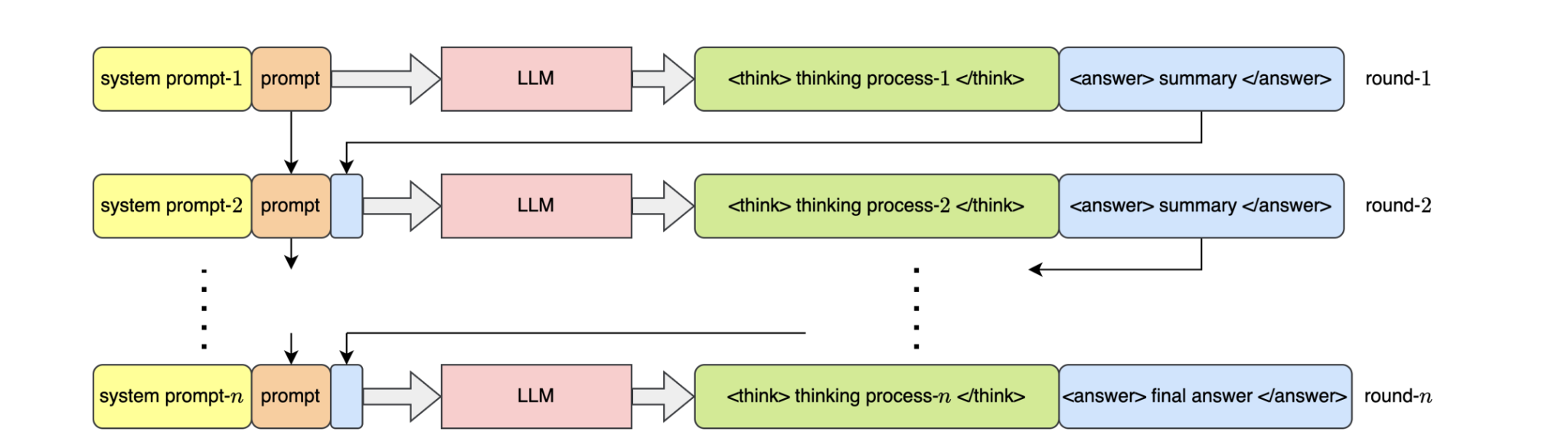
The limitations inherent in large language models (LLMs), specifically their finite context windows which restrict the number of tokens they can process at any given time, present a significant challenge to complex reasoning tasks. Researchers are actively exploring methods to circumvent this constraint, enabling LLMs to effectively manage problems requiring extended thought processes. Purbesh Mitra, Sennur Ulukus, and colleagues detail a novel reinforcement learning training method, termed MOTIF (Modular Thinking via Reinforcement Fine-tuning in LLMs), which facilitates multi-round reasoning, effectively expanding the model’s capacity for complex problem-solving. Their work, recently documented in a research paper, demonstrates improved accuracy on challenging mathematical benchmarks, achieved with enhanced sample efficiency.
Recent advances in large language models (LLMs) demonstrate considerable capability across diverse natural language processing tasks, yet these models frequently encounter limitations when addressing complex reasoning challenges. A primary constraint stems from the finite context window inherent in LLM architectures, restricting the amount of information the model can process simultaneously and hindering performance on tasks demanding extensive sequential reasoning. Researchers actively explore methods to overcome this limitation, focusing on strategies that augment the model’s ability to maintain coherence and accuracy over extended reasoning chains. This research introduces MOTIF, a novel reinforcement learning (RL) training method designed to expand the reasoning capacity of LLMs by enabling them to generate ‘thinking tokens’ across multiple rounds, effectively augmenting their context size and improving performance on complex tasks. Reinforcement learning is a type of machine learning where an agent learns to make decisions by receiving rewards or penalties for its actions.
The study addresses a critical bottleneck in LLM performance: the inability to effectively process arbitrarily long sequences of tokens required for intricate reasoning tasks, such as solving complex mathematical problems or engaging in multi-step logical deductions. To overcome this, the researchers propose a modular thinking strategy, implemented through the MOTIF training method, which allows the model to break down complex problems into manageable steps and reason over them sequentially. By training the open-source Qwen2.5-3B-Instruct model using MOTIF and parameter-efficient fine-tuning on the GSM8K dataset, they successfully demonstrate the feasibility and effectiveness of this approach, achieving significant improvements in performance on challenging benchmarks. Parameter-efficient fine-tuning involves updating only a small subset of the model’s parameters during training, reducing computational costs and memory requirements.
Introducing MOTIF: Solving Context Window Limitations
Introducing MOTIF: Multi-Round Reasoning Over Context Limits
The core innovation of MOTIF lies in its
The core innovation of MOTIF lies in its ability to enable the LLM to reason over multiple rounds, effectively circumventing the limitations imposed by fixed context windows. This modular approach allows the model to maintain coherence and accuracy even when dealing with lengthy calculations or multi-step proofs, as it can process information in smaller, more manageable chunks. The implementation leverages reinforcement learning to optimise the generation of thinking tokens, guiding the model towards more effective reasoning strategies and improving its ability to solve complex problems. These ‘thinking tokens’ represent intermediate reasoning steps, allowing the model to articulate its thought process and maintain a coherent line of reasoning.
Empirical Validation of Performance Gains on Benchmarks
Empirical Validation: Performance Gains on Benchmarks
Experimental results confirm the efficacy of MOTIF, yielding a 3.8% improvement in accuracy on the MATH500 benchmark and a 3.3% improvement on the AIME2024 benchmark when compared to training with the vanilla Group Relative Policy Optimisation (GRPO) algorithm. These results demonstrate that MOTIF is not only effective but also efficient, achieving significant improvements in performance with a relatively small amount of additional training. Importantly, these gains are achieved with notable sample efficiency, requiring only 15% of the samples used in the GRPO approach, highlighting the method’s ability to facilitate more effective learning with fewer data.
The researchers made the code and model publicly available, fostering collaboration and enabling other researchers to build upon their work, accelerating progress in the field of LLM reasoning. This commitment to open science demonstrates their dedication to advancing the state of the art and making LLM technology more accessible to the broader research community.
Future Directions and Generalizing Reasoning Capabilities
Future Work and Scope: Generalizing Reasoning Capabilities
Future work should focus on exploring the generalisability of MOTIF to other LLM architectures and datasets, assessing its performance on a wider range of tasks and evaluating its robustness to variations in input data. Investigating the optimal number of reasoning rounds and the strategies for managing information flow between rounds could further enhance performance. Additionally, research into combining MOTIF with other techniques for improving LLM reasoning, such as chain-of-thought prompting or tree of thoughts, may yield synergistic benefits. Expanding the scope of evaluation to include a wider range of mathematical problem types and difficulty levels is also crucial, ensuring that the method is not only effective on the specific benchmarks used in the study but also generalises well to other challenging problems.
In conclusion, this research presents a novel and
In conclusion, this research presents a novel and effective approach to improving LLM reasoning capabilities, addressing a critical limitation in current LLM technology. The MOTIF training method enables LLMs to reason over multiple rounds, effectively circumventing the limitations imposed by fixed context windows and achieving significant improvements in performance on challenging benchmarks. The researchers’ commitment to open science will undoubtedly accelerate progress in the field, paving the way for even more powerful and versatile LLM reasoning systems. This work represents a significant step forward in the quest to build LLMs that can truly understand and reason about the world around us.
🗞 MOTIF: Modular Thinking via Reinforcement Fine-tuning in LLMs
🧠 DOI: https://doi.org/10.48550/arXiv.2507.02851


