The behaviour of electrons in materials exhibiting strong interactions between charge and spin remains a central challenge in condensed matter physics, with potential implications for future technologies. Understanding these interactions is crucial for elucidating exotic quantum states of matter, such as quantum spin liquids (QSLs), where magnetic moments do not order even at absolute zero temperature. Jens H. Nyhegn, Kristian Knakkergaard Nielsen, Leon Balents, Georg M. Bruun and colleagues report their investigation into the dynamics of charge carriers within a QSL framework, detailing how these carriers fractionalise into distinct quasiparticles known as holons (carrying charge) and spinons (carrying spin). Their work, entitled ‘Spin-charge bound states and emerging fermions in a quantum spin liquid’, demonstrates the formation of bound states between these fractionalised particles, potentially offering a microscopic explanation for observed phenomena like Fermi arcs and providing insights into the mechanisms underlying high-temperature superconductivity.
Quantum spin liquids represent a peculiar state of matter where magnetic moments resist conventional ordering, even at temperatures approaching absolute zero, instead exhibiting complex quantum entanglement and fractionalised excitations. These materials are currently the focus of intense research, driven by a desire to understand their fundamental properties and explore potential applications in quantum technologies, particularly in the pursuit of high-temperature superconductivity. Recent investigations concentrate on the dynamics of charge carriers within these systems, revealing a complex interplay between spin and charge degrees of freedom that dictates their behaviour and potentially unlocks novel electronic states.
Scientists investigate strongly correlated materials, where interactions between electrons dominate their properties and give rise to emergent phenomena not observed in conventional metals. Theoretical frameworks, such as parton construction, are employed to decompose electrons into independent charge-carrying holons and spin-carrying spinons, a common expectation for quantum spin liquid systems. These approaches allow researchers to model the behaviour of these fractionalised excitations and predict their observable consequences in experiments. A quasiparticle is a collective excitation that behaves like a particle, even though it is composed of many interacting particles.
Studies reveal that while holons and spinons generally
Studies reveal that while holons and spinons generally behave as independent particles, they exhibit strong correlations due to a diverging scattering cross-section at specific momenta. This divergence signals the formation of long-lived, bound states between spinons and holons, a surprising result that deviates from simple fractionalisation scenarios and suggests a more intricate interplay between charge and spin. The scattering cross-section is a measure of the probability of a particle being scattered by another particle.
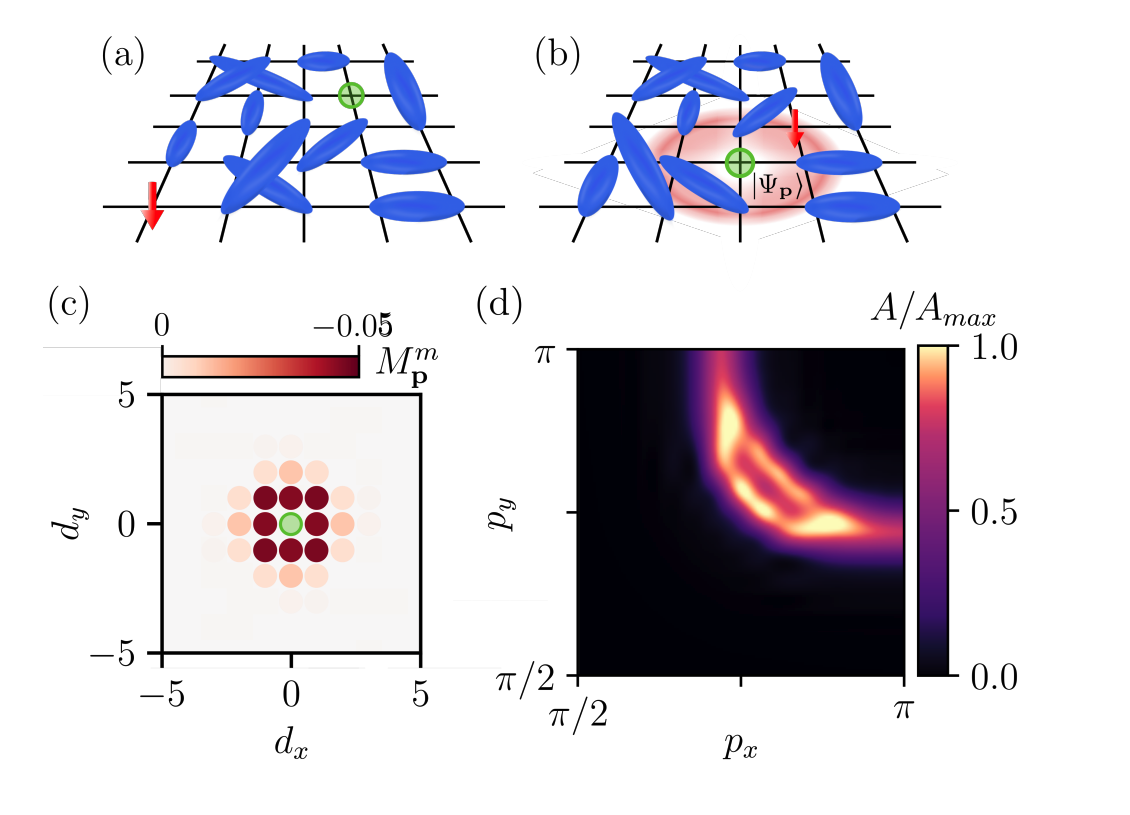
Researchers establish that these emergent fermions coalesce to form ‘hole pockets’ within the material’s electronic structure, providing crucial insight into the collective behaviour of charge carriers in quantum spin liquids. Remarkably, the location, shape, and intensity variations of these pockets closely match the ‘Fermi arcs’ observed in the pseudogap phase of high-temperature superconductors, suggesting a deep connection between these exotic states of matter. Fermi arcs are segments of the Fermi surface, the boundary between occupied and unoccupied electronic states, that appear in materials with unconventional electronic properties.
These findings provide a microscopic mechanism for the proposed ‘fractionalised Fermi liquid’ state and offer new avenues for understanding the pseudogap phase and the emergence of high-temperature superconductivity as originating from a quantum spin liquid ground state. Researchers continue to explore the properties of these materials, seeking to understand their fundamental behaviour and harness their potential for technological applications.
Recent research establishes a microscopic mechanism linking spin liquid behaviour to the emergence of fractionalised Fermi liquids, potentially explaining the pseudogap phase and high-temperature superconductivity. Scientists demonstrate that, within a single-band extended model featuring a quantum spin liquid background, holes exhibit fractionalisation into independent holons and spinons for most momenta, confirming theoretical predictions. However, they find that spinon-holon scattering diverges at specific momenta, indicating strong correlations and the formation of long-lived bound states between these particles, challenging the simple picture of independent fractionalised excitations.
Researchers analyse these bound states, demonstrating that they
Researchers analyse these bound states, demonstrating that they are responsible for the observed divergences and providing a theoretical framework for understanding the complex interplay between charge and spin. They predict that these fermions will manifest as distinct quasiparticle peaks in angle-resolved photoemission spectroscopy, with an intensity directly linked to their internal structure, allowing for detailed analysis of their electronic configuration and momentum distribution. Angle-resolved photoemission spectroscopy is an experimental technique used to measure the energy and momentum of electrons emitted from a material when illuminated with ultraviolet light. This combination of theoretical modelling and experimental techniques promises to shed light on the fundamental mechanisms governing the behaviour of charge carriers in quantum spin liquids and their potential role in high-temperature superconductivity.
🗞 Spin-charge bound states and emerging fermions in a quantum spin liquid
🧠 DOI: https://doi.org/10.48550/arXiv.2507.02508




See today’s quantum computing news on Quantum Zeitgeist for the latest breakthroughs in qubits, hardware, algorithms, and industry deals.