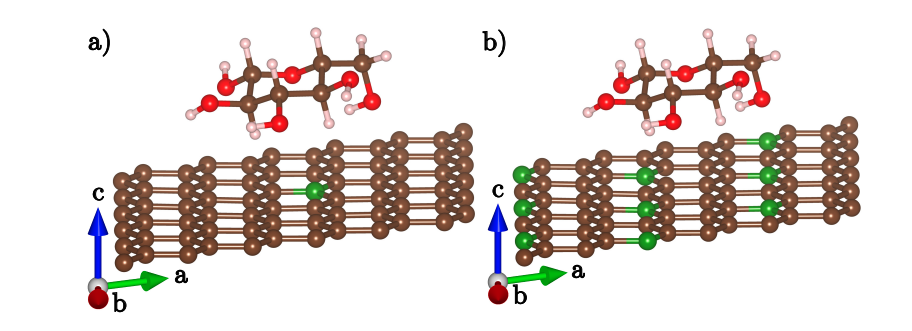
The detection of glucose, crucial for monitoring diabetes and various metabolic processes, benefits significantly from techniques that amplify weak molecular signals. Surface Enhanced Raman Spectroscopy (SERS), a method that intensifies Raman scattering through interaction with a substrate’s surface, offers a pathway to more sensitive glucose detection. Recent research focuses on optimising materials for SERS, with boron-doped graphene emerging as a promising candidate due to its enhanced signal amplification capabilities. Jan Komeda, Antonio Cammarata, and Tomas Polcar, alongside their colleagues, investigate the relationship between boron concentration within graphene and the resulting enhancement of glucose’s Raman signal, as detailed in their article, “Optimal boron-doped graphene substrate for glucose Raman signal enhancement”. Their work employs mechanical simulations to analyse how dopant concentration and arrangement influence SERS effectiveness, offering insights into designing improved substrates for glucose detection and potentially other analytes.
Surface Enhanced Raman Spectroscopy (SERS) represents a powerful analytical technique for detecting molecules adsorbed onto metal surfaces, and it relies on the amplification of Raman signals through interactions between the substrate and the analyte. Researchers continually investigate novel materials to improve SERS performance, and boron-doped graphene emerges as a promising candidate for glucose detection due to its distinctive electronic and vibrational characteristics. This study assesses the impact of varying boron concentration and distribution within graphene on SERS enhancement, employing mechanical simulations to evaluate its effectiveness as a substrate for sensitive glucose sensing.
The research establishes a clear correlation between dopant concentration and Raman signal enhancement, demonstrating that higher boron concentrations consistently yield a stronger amplification of glucose’s Raman signal. This finding builds upon previous observations concerning the thermodynamic stability of highly boron-doped graphene, suggesting its practical applicability in developing advanced sensing technologies. Researchers utilise mechanical simulations, focusing on interatomic force constants – a measure of the strength of bonds between atoms – and phonon eigenvector composition, to comprehensively evaluate the potential of B-graphene as a SERS substrate. Phonons represent quantised vibrational modes within a material, and their eigenvectors describe the pattern of atomic motion associated with each mode.
The investigation details how the orientation of the
The investigation details how the orientation of the analyte molecule, glucose, relative to the graphene surface critically influences the observed Raman response, highlighting the importance of controlling molecular alignment. Analysis of phonon eigenvectors reveals that specific orientations maximise signal enhancement, providing insights into the underlying mechanisms. Researchers employ a robust computational methodology, combining interatomic force constant and phonon eigenvector composition analysis, to predict and optimise performance. The observed enhancement arises from the creation of ‘hot spots’ on the graphene surface, where the electromagnetic field is intensified due to the interaction between the incident light and the plasmons – collective oscillations of electrons – within the boron-doped graphene.
Researchers utilise computational tools such as phonopy, phono3py, and the phtools suite (phonchar and eigmap) to ensure reproducibility and facilitate further investigation. The team meticulously examines the composition of phonon eigenvectors, correlating vibrational modes with signal enhancement, and providing a framework for identifying promising candidates. Phonopy and phono3py are software packages used to calculate phonon dispersion relations and vibrational properties of materials, while phtools provides tools for analysing and visualising phonon data.
This methodology is adaptable and not limited to the B-graphene/glucose system, allowing for the identification of other promising substrates and accelerating the development of sensitive and selective sensing technologies. By systematically investigating the relationship between material properties and SERS enhancement, researchers can design substrates tailored to specific analytes and applications.
The research demonstrates that boron-doped graphene effectively enhances
The research demonstrates that boron-doped graphene effectively enhances the Raman signal of glucose, positioning it as a viable substrate for SERS-based detection. This finding supports the potential for practical applications in sensing technologies, including point-of-care diagnostics and environmental monitoring.
🗞 Optimal boron-doped graphene substrate for glucose Raman signal enhancement
🧠 DOI: https://doi.org/10.48550/arXiv.2507.02642